Why Many E-Commerce Startups Fail in India Top 10 Reasons Explained (2026)
Why Many E-Commerce Startups Fail in India: Top 10 Reasons Explained
(2026)
India’s e-commerce industry is booming like never before.
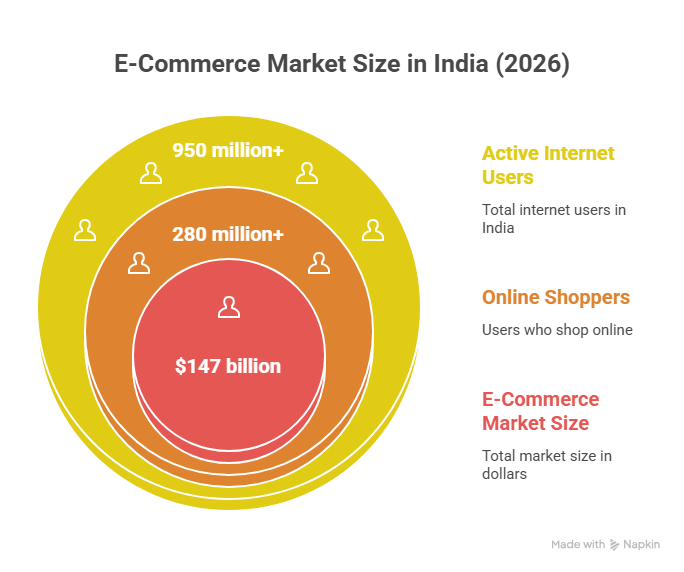
With 950 million internet users, a rapidly growing middle class, and smartphone penetration reaching the deepest corners of Bharat, the digital marketplace feels like a gold rush.
Yet, the hard truth stares every aspiring founder in the face:
“90% of Indian e-commerce startups fail within their first 5 years.” — NASSCOM & Startup India Report, 2025
For every Nykaa, Meesho, or Mamaearth that became a household name — hundreds of well-funded, well-intentioned e-commerce startups silently shut their doors.
Why?
That’s exactly what this guide answers.
Whether you’re a first-time founder, an early-stage entrepreneur, or an investor evaluating the Indian e-commerce landscape, understanding why startups fail is just as critical as knowing how to build them.
Let’s break down the Top 10 reasons why e-commerce startups fail in India — with real data, actionable fixes, and honest insights that most people won’t tell you.
The State of E-Commerce in India: A Quick Snapshot (2026)
Before diving into failure reasons, let’s set the context.
MetricFigure (2026)India’s e-commerce market size$147 billionProjected market size by 2030$350 billionActive internet users950 million+Online shoppers in India280 million+Startups launched annually (e-commerce)5,000–7,000Startups that survive beyond Year 5Less than 10%
The opportunity is massive. But so is the rate of failure.
Understanding the gap between the two is where successful entrepreneurs begin.
1.No Product-Market Fit — The Silent Startup Killer
Product-market fit (PMF) is the foundation of every successful business.
It means your product solves a real problem for a specific group of people — so well that they actively seek it out, pay for it, and refer others.
Without PMF, even the best-funded e-commerce startup will collapse.
What goes wrong:
Most Indian e-commerce founders make one fatal mistake — they fall in love with their idea instead of their customer’s problem.
They copy a Western business model, localise the branding, launch — and then wonder why nobody is buying.
India is not one homogenous market. It’s dozens of distinct micro-markets shaped by:
Regional culture and language
Income levels (Tier 1 vs. Tier 2 vs. Tier 3)
Buying habits and trust behaviour
Category maturity and awareness
A vegan protein supplement brand that thrives in Bengaluru may completely miss in Bhagalpur.
How to fix it:
Conduct 50+ customer discovery interviews before building anything
Use the “Mom Test” — ask about problems, not opinions about your product
Validate demand with a landing page + waitlist before investing in inventory
Track Net Promoter Score (NPS) from your first 10 customers
“Make something people want.” — Paul Graham, Co-founder of Y Combinator
2. Underestimating Last-Mile Delivery Complexity
Last-mile delivery is where Indian e-commerce dreams meet reality — and often break.
India’s geography is brutally complex. Delivering to a Mumbai high-rise is entirely different from reaching a customer in rural Meghalaya or a hill station in Uttarakhand.
The numbers that hurt:
Return-to-Origin (RTO) rates in fashion categories: 30–45%
Cash-on-delivery (COD) orders: Still account for 55–60% of all Indian e-commerce transactions
Failed delivery attempts in Tier 3+ cities: Up to 25% of all orders
Each failed delivery, RTO, or reverse logistics event destroys margin.
For a startup operating on 5–15% net margins, even a 20% RTO rate can make the entire business model unviable.
How to fix it:
Partner with multiple logistics providers (Shiprocket, Delhivery, Xpressbees, Ecom Express) — never depend on one
Offer prepaid incentives (5–10% discount) to reduce COD dependency
Use pin code-level RTO data to stop delivering to high-risk zones
Implement address verification via IVR calls before dispatching orders
Leverage ONDC (Open Network for Digital Commerce) for decentralised logistics access
3.Broken Unit Economics — Growing Broke
This is the most dangerous failure mode — because it looks like success right until it isn’t.
Unit economics is the profit or loss generated from a single transaction, after all direct costs are accounted for.
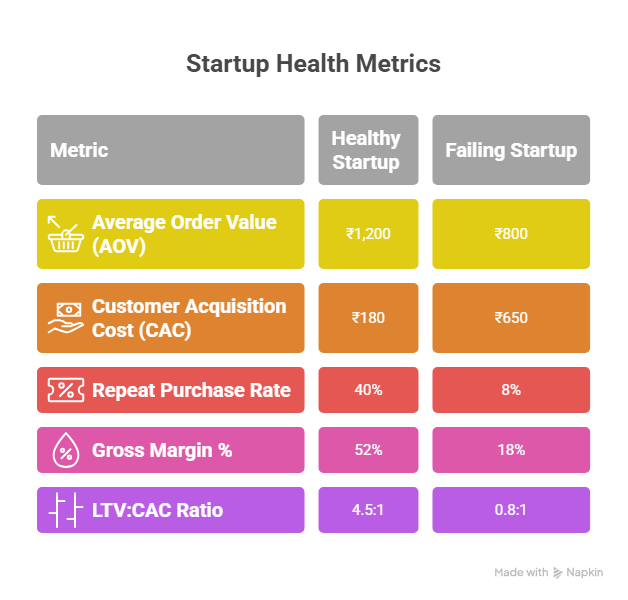
Here’s what broken unit economics looks like in practice:
MetricHealthy StartupFailing StartupAverage Order Value (AOV)₹1,200₹800Customer Acquisition Cost (CAC)₹180₹650Repeat Purchase Rate40%8%Gross Margin %52%18%LTV:CAC Ratio4.5:10.8:1
A LTV:CAC ratio below 3:1 is a red flag. Below 1:1 means you’re losing money on every customer you acquire.
How to fix it:
Calculate contribution margin per order before scaling any channel
Focus aggressively on customer retention — repeat buyers have near-zero CAC
Use cohort analysis to track how much customers actually spend over 6–12 months
Never discount as a default growth lever — it permanently trains customers to wait for sales
4.Competing With Giants Without Differentiation
Building a generic e-commerce store in 2026 and competing with Amazon India, Flipkart, Meesho, or Myntra is entrepreneurial suicide.
These platforms have:
Logistics networks covering 27,000+ pin codes
Brand trust built over a decade
Ad budgets in hundreds of crores per quarter
Private label products that undercut your pricing
And yet — founders keep launching “me-too” stores with no moat, no differentiation, and no reason for customers to choose them.
What wins against giants:
The answer is hyper-niche positioning.
Instead of “women’s ethnic wear” — build for “handloom sarees for working women in South India, priced under ₹3,000.”
Instead of “organic food” — build for “cold-pressed oils for diabetic households in Tier 2 cities.”
The riches are in the niches. Specificity creates defensibility.
Differentiation frameworks that work:
Product differentiation: Proprietary formulations, exclusive designs, or patented technology
Community differentiation: A loyal tribe that buys because of belonging, not just product
Service differentiation: Subscription models, personalisation, or white-glove experience
Distribution differentiation: Channels your competitors ignore (WhatsApp commerce, regional languages, ONDC)
5.Poor Technology and Mobile Experience
In India, e-commerce is mobile commerce.
87% of Indian online shoppers access stores via smartphone — predominantly mid-range Android devices on 4G connections with varying speeds.
If your app or website doesn’t perform flawlessly on a ₹8,000 Redmi phone with inconsistent internet — you’re losing customers before they even see your products.
The technology mistakes that kill conversions:
Page load time above 3 seconds (every extra second reduces conversions by ~7%)
No regional language support — 600 million+ Indians prefer regional languages online
Complex checkout flows with more than 3 steps
Missing UPI, BNPL, or EMI payment options
No WhatsApp integration for order updates and customer support
Poor product photography and missing size/fit guides
How to fix it:
Use Google PageSpeed Insights to benchmark and fix load speed
Integrate UPI (PhonePe, Google Pay), Razorpay, and BNPL options like Simpl, LazyPay, and ZestMoney
Add multilingual support using tools like Translate.com or Weglot
Implement progressive web app (PWA) technology for app-like experience without download friction
Use heat mapping tools (Hotjar, Microsoft Clarity) to identify where customers drop off
6. Building Weak Brand Trust
Trust is the currency of Indian e-commerce — especially in Tier 2 and Tier 3 cities where first-time online shoppers are still sceptical.
When a new customer lands on your store, a rapid-fire internal checklist runs in their mind:
“Is this website real or a scam?”
“Will I actually receive my order?”
“What if the product is different from the photo?”
“Can I get a refund easily?”
If your store doesn’t proactively answer these questions, the customer leaves. And they don’t come back.
The trust signals that convert Indian shoppers:
How to fix it:
Display Google Reviews, Trustpilot, or Judge.me ratings prominently on your homepage
Show real customer photos using tools like Loox or Yotpo
Publish video testimonials — they convert 3x better than text reviews in India
Be radically transparent about shipping times, return policies, and product limitations
7. Over-Reliance on Paid Ads Without Organic Strategy
Meta Ads and Google Ads are powerful tools — but terrible foundations.
In 2026, digital advertising costs in India have risen sharply:
Average CPM (cost per 1,000 impressions) on Meta India: Up 65% since 2022
Average CPC (cost per click) in competitive e-commerce categories: ₹18–₹85
Startups that build their entire customer acquisition strategy on paid ads are on a treadmill.
The moment you stop spending — traffic disappears. No brand equity. No residual growth. No compounding.
The organic channels that compound over time:
1. SEO and Content Marketing A well-optimised blog post or product page can drive free traffic for years with zero marginal cost. India’s search volume for product-specific queries grows 22% year-on-year.
2. WhatsApp Community Building India has 530 million+ WhatsApp users. A well-managed broadcast list or community group delivers 98% open rates — versus 20–25% for email.
3. YouTube and Regional Video Content Video content in Hindi, Tamil, Telugu, Kannada, and Marathi reaches audiences that English content completely misses. YouTube India has 500 million monthly active users.
4. Micro-Influencer Partnerships Influencers with 10,000–100,000 followers in niche categories deliver 6–8x higher engagement rates than macro-influencers — at a fraction of the cost.
5. Referral Programs A well-structured referral program can reduce CAC by 50–70%. Startups like Meesho built their early growth almost entirely on peer-to-peer referrals.
The winning formula:
70% organic / community channels + 30% paid amplification
Reason #8: Ignoring Regulatory and Compliance Requirements
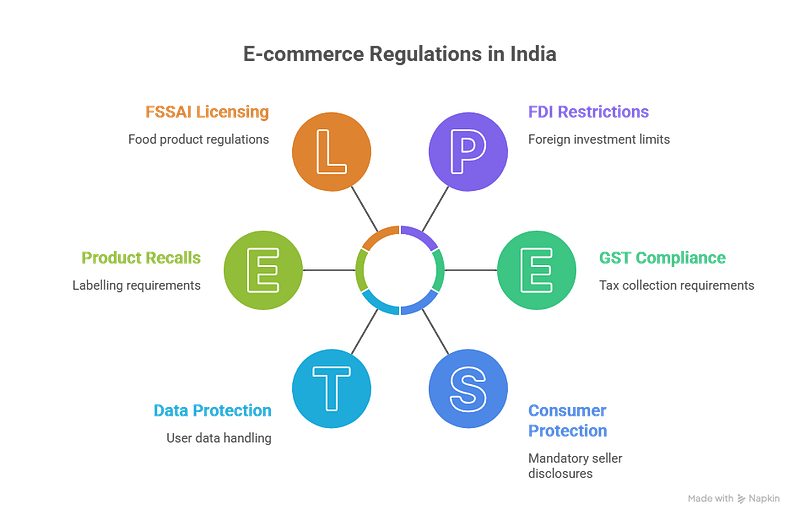
India’s regulatory environment for e-commerce has grown significantly more complex since 2023.
Founders who treat compliance as an afterthought — or worse, something to “figure out later” — risk fines, operational shutdowns, and permanent reputational damage.
Key regulations every Indian e-commerce startup must know:
How to fix it:
Engage a CA (Chartered Accountant) and a startup lawyer from Day 1 — not after the first crisis
Register under Startup India for legal and compliance support
Stay updated on ONDC policy developments, which are reshaping the Indian e-commerce regulatory landscape
Join iSPIRT, TiE, or NASSCOM to receive timely policy updates
9.Founding Team Gaps and Co-Founder Conflicts
A startup is only as strong as its founding team.
E-commerce is a multi-disciplinary beast. It demands simultaneous excellence in product sourcing, technology, digital marketing, supply chain, customer service, and finance.
Most founding teams are dangerously homogenous — all engineers, or all business graduates — with critical skill gaps that emerge at the worst possible moments.
The founding team a ₹1 Crore e-commerce startup needs:
Many early-stage startups outsource tech and finance — which is completely fine. What’s not fine is having no one who owns marketing or operations at the founding level.
Co-founder conflicts: the hidden killer
Research by Harvard Business School shows 65% of high-potential startups fail due to co-founder conflict — not market conditions.
How to prevent co-founder conflict:
Sign a Founders’ Agreement with defined roles, equity splits, and vesting schedules before launch
Use 4-year vesting with a 1-year cliff as the industry standard
Schedule monthly co-founder retrospectives to address tensions before they escalate
Define decision-making authority clearly — who has final say on product, hiring, and finance
10.Wrong Market Timing
Sometimes, the idea is brilliant. The team is exceptional. The execution is flawless.
But the timing is wrong — and even the best startup can’t survive that.
Market timing failure in Indian e-commerce looks like:
Launching a premium D2C brand during a consumer spending downturn
Building a subscription box service before the category has enough awareness
Entering a hyperlocal delivery model in cities where infrastructure isn’t ready
Launching voice commerce before regional language AI is accurate enough to trust
The timing factors Indian e-commerce founders must evaluate:
Macro-economic conditions: RBI consumer confidence index, disposable income trends
Category maturity: Is your target customer already buying this category online?
Infrastructure readiness: Logistics, payment, and internet infrastructure in your target geography
Regulatory tailwinds or headwinds: Is the government supporting or restricting your category?
Competitive intensity: Are incumbents already spending heavily to own the space?
How to fix it:
Study Google Trends India for your category — is search interest rising or plateauing?
Read Redseer, Bain-Google India, and NASSCOM annual e-commerce reports
Talk to 10 potential customers per week — their readiness is the most honest market timing signal you have
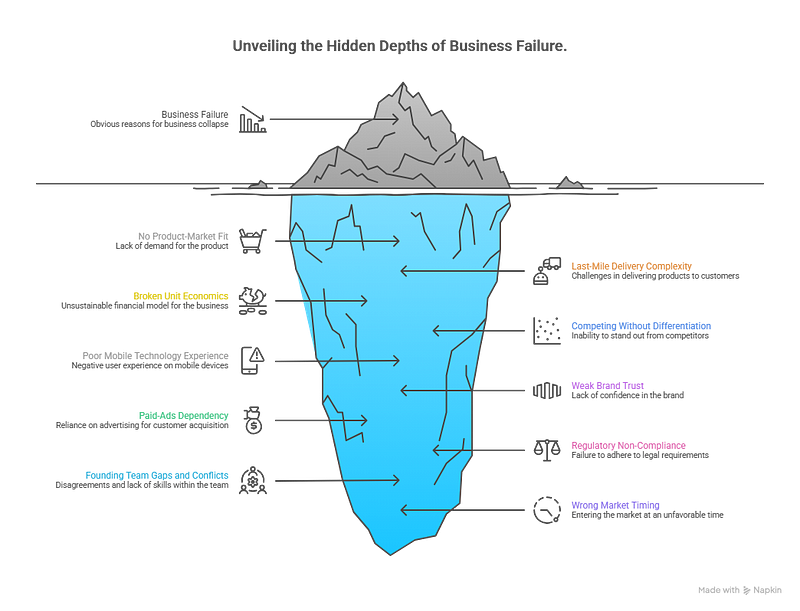
The 10 Reasons at a Glance
What Successful Indian E-Commerce Startups Do Differently
The startups that beat these odds share a set of common traits:
✅ They validate obsessively before investing heavily in product or inventory
✅ They pick a niche and dominate it before expanding
✅ They track unit economics from the very first order
✅ They build trust as aggressively as they build traffic
✅ They invest in organic growth channels that compound over time
✅ They stay compliant and treat legal hygiene as a competitive advantage
✅ They build for Bharat — designing for real Indian consumers in real Indian conditions
✅ They iterate fast — treating failure as feedback, not finality
Conclusion: Fail Less. Build Smarter. Win in Indian E-Commerce.
India’s e-commerce opportunity in 2026 is real, massive, and still wide open for the right founders.
But opportunity and success are not the same thing.
The entrepreneurs who build lasting e-commerce businesses in India are not those who avoid all mistakes. They’re the ones who:
Learn faster than their competition
Stay honest about what’s working and what isn’t
Prioritise customers over vanity metrics
Build the right team before the team is urgently needed
Execute with discipline long after the initial excitement fades
The 10 failure reasons in this guide are not a death sentence.
They are a roadmap in reverse — every reason a startup fails is a decision point where the right choice leads to survival, growth, and scale.
Read this list again. Honestly audit your startup against each point. Fix what needs fixing.
Your e-commerce success story starts with knowing exactly what to avoid.
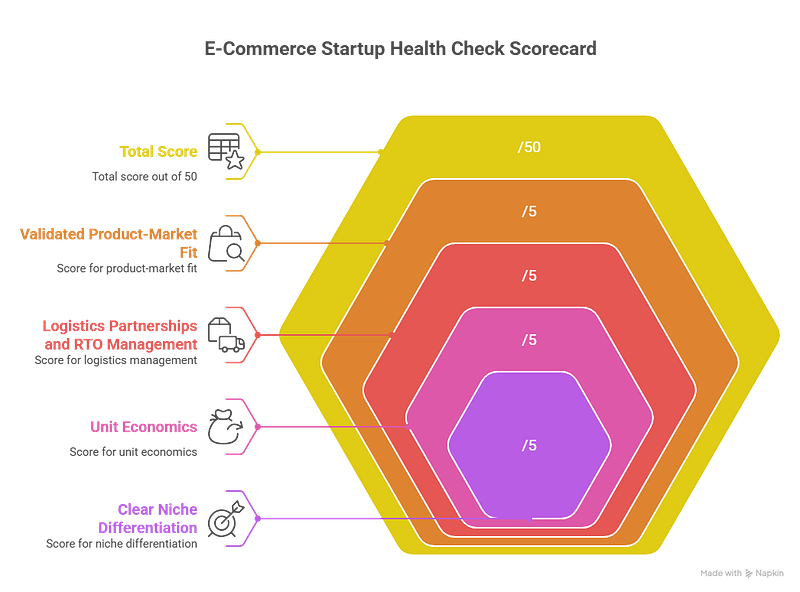
E-Commerce Startup Health Check: Self-Assessment Scorecard
Rate your startup from 1–5 on each dimension:
Score Guide:
40–50: Strong foundation — focus on scaling
25–39: Moderate risk — address red flags urgently
Below 25: High risk — pause and restructure before scaling
Found this guide valuable? Share it with a fellow e-commerce founder who needs an honest reality check. Have a question about your specific startup situation? Drop it in the comments — we read and respond to every one.


.png "why-indian-ecommerce-startups-fail-2026")



.png)