
- Feature complexity and custom functionality requirements
- Number of blockchain networks supported
- Smart contract audit scope and audit firm selection
- UI/UX design complexity and custom component development
- Multi-chain integration requirements
- Security infrastructure depth
- Post-launch maintenance and upgrade commitments
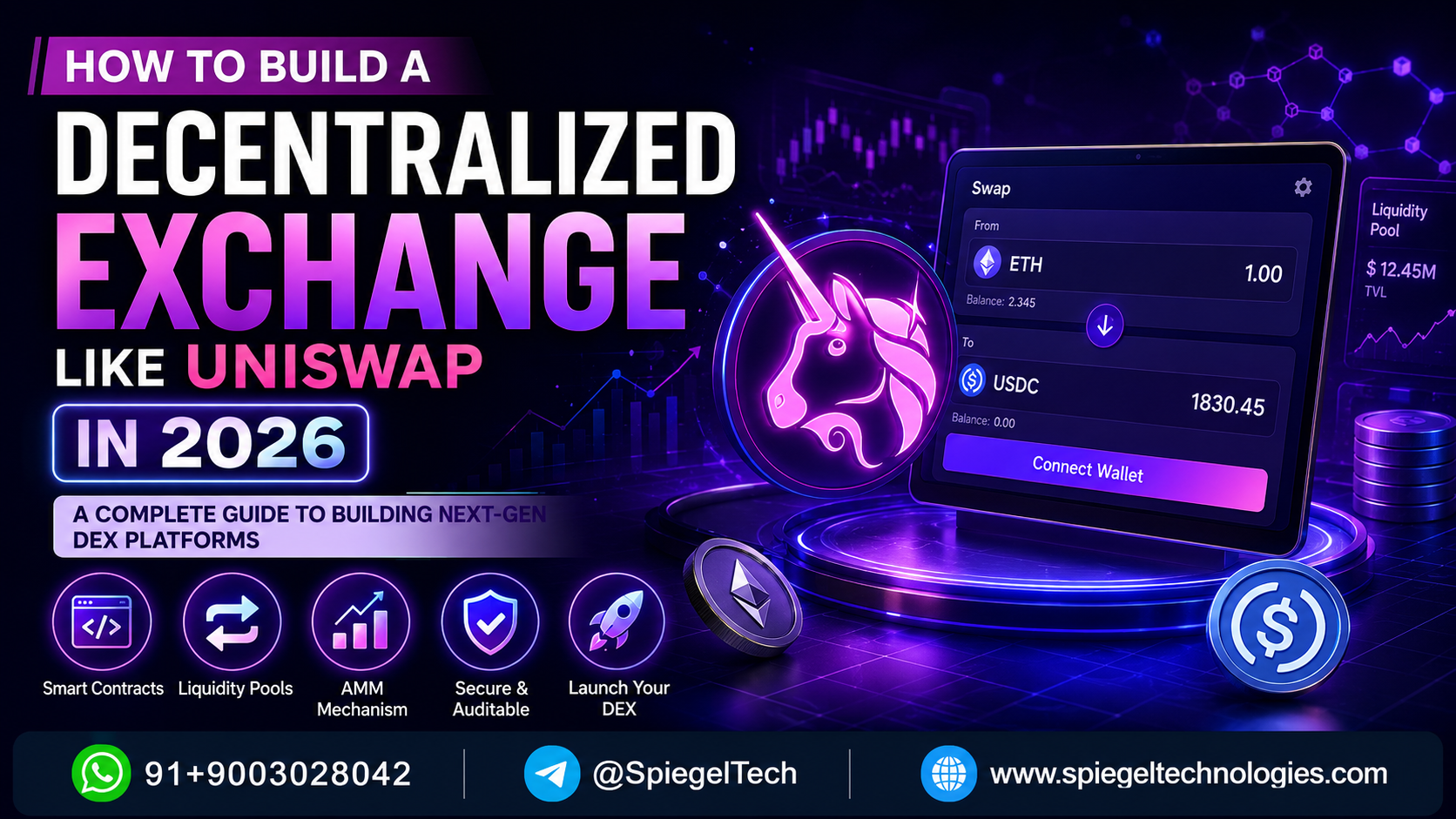
How to Build a Decentralized Exchange Like Uniswap in 2026: The Complete Guide
The DeFi market has reached USD 238.54 billion in 2026 and is projected to hit USD 770.56 billion by 2031, growing at a 26.43% CAGR. Uniswap — the benchmark against which every decentralized exchange development company measures its work — processed over 915 million transactions in 2025 alone and surpassed $1 trillion in annual trading volume. It became the first DEX to cross $3 trillion in cumulative trading volume, a milestone that took centralized exchanges decades to approach.
This is not a trend. This is infrastructure — and the window to build a meaningful position in it is open right now.
For entrepreneurs, fintech companies, and blockchain startups evaluating how to enter the DeFi space, building a decentralized exchange like Uniswap represents one of the most strategically compelling opportunities available. This guide covers everything you need to know: why the Uniswap model works, how to choose the right decentralized exchange script approach, what features to build, what it costs, and how to find the right decentralized exchange development company to execute your vision.
Why Build a Decentralized Exchange Like Uniswap?
Before evaluating DEX script options and development approaches, it is worth understanding why the Uniswap model specifically — rather than alternatives — represents such a strong foundation for a new DeFi business.
Uniswap's architecture solved problems that centralized exchanges cannot: it eliminated custodial risk, removed geographic access restrictions, enabled permissionless token listing, and automated market making through smart contracts that operate 24/7 without human intervention. The result is a platform that 10+ million DeFi participants worldwide trust with real capital.
The Uniswap Foundation reported over $116 million in total assets as of Q3 2025, with more than $108 million committed to grants and ecosystem growth — signaling that DeFi infrastructure investment is not slowing down. Institutional confidence in the AMM model has never been higher.
For businesses building on this foundation, the strategic advantages are concrete:
Proven Demand — Uniswap's volume figures prove that the market for automated, permissionless DEX trading is real, large, and growing. Building on a validated model reduces the market risk that kills most early-stage ventures.
Global Market Access — A decentralized cryptocurrency exchange script built on public blockchain infrastructure is accessible to anyone with a wallet and an internet connection. No geographic restrictions, no intermediary approvals.
Lower Operational Costs — Smart contract automation eliminates the operational overhead of traditional exchange management. The cost structure of a DEX is fundamentally more efficient than a centralized competitor.
New Token Launch Attraction — Uniswap's permissionless listing mechanism has made it the default venue for new token launches. Building a similar platform positions your exchange as an early liquidity destination for emerging crypto projects.
Future-Proof Investment — As blockchain infrastructure matures and DeFi adoption expands into institutional markets, a well-built DEX appreciates in strategic value rather than depreciating.
Three Ways to Build a Decentralized Exchange Like Uniswap
Every business considering a decentralized exchange development company engagement has three primary development paths available. The right choice depends on your timeline, budget, technical requirements, and long-term differentiation strategy.
Option 1: Custom Decentralized Exchange Development
Custom DEX development builds your platform entirely from scratch — your own smart contract architecture, your own AMM design, your own security protocols, your own interface. Every technical decision is made around your specific business requirements rather than inherited from a template.
This approach gives you maximum differentiation and complete ownership of every component. It is the right choice for businesses with genuine technical innovation requirements, long-term sustainability goals, and sufficient budget and timeline to invest in foundational engineering.
The tradeoff is significant: custom development requires deep blockchain expertise, a reliable decentralized exchange development company with proven smart contract capabilities, meaningful financial investment, and a development timeline measured in months rather than weeks.
Option 2: Uniswap-Like MVP Launch
An MVP approach focuses development on the core functionalities that make a DEX work: wallet integration, token swap functionality, liquidity pool creation, and fee distribution. Advanced features — analytics dashboards, multi-chain support, governance systems — come in subsequent iterations informed by real user behavior.
This is how Uniswap itself launched — a working, minimal product that real users could trade on immediately, with continuous optimization based on actual market feedback. The MVP approach reduces development risk, accelerates market entry, and generates real trading data that informs every subsequent product decision.
Option 3: Uniswap Clone Script
A Uniswap clone script is a pre-built decentralized exchange script that replicates Uniswap's core architecture and functionality in a customizable, deployable framework. Rather than building AMM logic, liquidity pool smart contracts, and trading interfaces from zero, a Uniswap clone script provides tested, production-ready infrastructure that you brand, configure, and launch as your own platform.
For businesses that need to enter the DeFi market quickly without significant custom development investment, a quality Uniswap clone script from an experienced decentralized exchange development company delivers the best combination of speed, cost efficiency, and competitive functionality.
Comparison: Which Approach Is Right for You?
| Factor | Custom Development | MVP Launch | Uniswap Clone Script |
|---|---|---|---|
| Development Cost | High | Moderate | Low |
| Time to Launch | 16–24 weeks | 12–16 weeks | 8–12 weeks |
| Customization | Complete | Moderate | Complete branding flexibility |
| Risk Level | Higher | Moderate | Lowest |
| Best For | Long-term differentiation | Market validation | Fastest market entry |
| Scalability | Highly scalable | Scales with phases | Scalable |
How a Uniswap-Like DEX Works: Step-by-Step
Understanding the mechanics behind a Uniswap-style exchange is essential context for any entrepreneur evaluating a decentralized cryptocurrency exchange script or DEX script investment. Here is how the AMM-powered trading process works:
Step 1: Wallet Connection
The user connects their crypto wallet — MetaMask, WalletConnect, or another Web3 wallet — to the DEX interface. This connection authorizes the platform's smart contracts to interact with the user's tokens.
Step 2: Token Pair Selection
The user selects the input token (what they want to swap away) and the output token (what they want to receive). The platform fetches real-time liquidity pool data for that specific trading pair.
Step 3: AMM Price Calculation
Unlike centralized exchanges that match individual buyers and sellers through an order book, a Uniswap-style decentralized exchange script uses an Automated Market Maker. Smart contracts calculate the token price based on the current ratio of assets in the liquidity pool — typically following the constant product formula (x × y = k).
Step 4: Transaction Preview and Confirmation
The platform displays the expected output amount, price impact, slippage tolerance, and transaction fee before the user confirms. Once confirmed in the user's wallet, the smart contract is triggered on-chain.
Step 5: Automated Trade Execution
The smart contract executes the swap atomically — the input token enters the liquidity pool, and the output token is sent directly to the user's wallet. No intermediary touches the funds at any point.
Step 6: Liquidity Provider Fee Distribution
A small fee (typically 0.3% in the Uniswap model) is automatically distributed to the liquidity providers who supplied the token pair to the pool — incentivizing continued capital provision that keeps the DEX liquid.
This entire process is what a well-built decentralized cryptocurrency exchange script automates through smart contract logic — and what a quality decentralized exchange development company engineers to execute flawlessly at scale.
Essential Features for a Uniswap-Like DEX Platform
Building a competitive DEX script-based exchange in 2026 requires a comprehensive feature set across three categories: user experience, administrative control, and security infrastructure.
User-Facing Features
Wallet Integration Support — Native compatibility with MetaMask, WalletConnect, Coinbase Wallet, Trust Wallet, and other major Web3 wallets. Users should be able to connect their preferred wallet in under 30 seconds.
Token Swap Functionality — The core AMM-powered swap interface with real-time price calculation, price impact display, and slippage tolerance configuration. This is the primary feature users interact with every session.
Liquidity Pool Management — Users should be able to add and remove liquidity from existing pools and create new pools for token pairs that don't yet exist on the platform.
Real-Time Price Updates — Live price feeds updating continuously based on pool composition and recent trade activity, with chart integration for trend visualization.
Slippage Tolerance Settings — User-configurable slippage tolerance that protects traders from receiving significantly less than the displayed price during volatile market conditions.
Transaction History — Complete on-chain transaction records accessible through the user interface — every swap, liquidity addition, and removal with timestamps and values.
LP Token Management — Liquidity providers receive LP tokens representing their pool share. Users need clear interfaces to view, manage, and redeem their LP token positions.
Token Search and Custom Import — Users can search listed tokens by name or contract address, and import unlisted tokens by pasting their contract address — enabling the permissionless listing that makes Uniswap-style platforms so attractive to emerging projects.
Staking and Yield Farming — On-platform staking and yield farming features extend the platform's value proposition beyond trading, giving users additional reasons to keep capital on the platform.
Admin-Facing Features
Liquidity Pool Management Dashboard — Administrative oversight of all active liquidity pools, including volume metrics, fee accumulation, and liquidity depth visualization.
Token Approval Controls — Administrative tools to review and approve token listings, flag suspicious contracts, and manage the token registry.
Fee Management System — Flexible configuration of protocol fees across different token pairs and trading types, with revenue tracking and distribution management.
Platform Analytics Dashboard — Comprehensive metrics including total value locked (TVL), 24-hour and 7-day trading volumes, unique user counts, and revenue attribution by pool.
Governance Management — Tools for managing decentralized governance proposals, voting periods, and on-chain execution of approved governance decisions.
Multi-Chain Support — Administrative controls for managing deployments across multiple blockchain networks from a unified dashboard.
Security Features
Smart Contract Audits — Independent third-party security auditing of all smart contracts before mainnet deployment. This is the single most important security investment in any decentralized exchange development company engagement.
Multi-Signature Wallet Integration — Requiring multiple authorized signatures for protocol parameter changes, treasury operations, and emergency pause functions.
Reentrancy Attack Prevention — Smart contract design patterns that prevent reentrancy exploits — one of the most common and damaging attack vectors in DeFi.
Anti-Phishing Protection — Platform-level protections against phishing attempts targeting users through spoofed interfaces or malicious token contracts.
DDoS Protection — Infrastructure-level protection keeping the platform accessible during targeted attack attempts against the frontend.
End-to-End Encryption — All user data in transit and at rest protected through industry-standard encryption protocols.
Slippage Controls — Maximum slippage enforcement that prevents users from executing trades that deviate significantly from expected prices during high-volatility events.
Security Monitoring and Updates — Continuous monitoring of smart contract interactions for anomalous patterns, with rapid response protocols for security incidents.
Step-by-Step Process to Build a Decentralized Exchange Like Uniswap
A professional decentralized exchange development company follows a structured process that minimizes risk at every stage:
Stage 1: Project Research and Market Analysis
Every serious DEX development project begins with thorough market research. This means analyzing your target user segment, understanding competitive positioning among existing DEX platforms, identifying underserved markets or asset categories, and defining the specific value proposition that will attract liquidity and traders to your platform rather than established alternatives.
Stage 2: Blueprint and Architecture Design
Based on research findings, a detailed technical blueprint defines how your smart contracts will be structured, which token standards will be supported, how the AMM pricing mechanism will function, and how the platform's economic model will sustain long-term liquidity incentives. This blueprint becomes the governing document for all subsequent development decisions.
Stage 3: UI/UX Architecture Planning
User experience is what converts technically capable platforms into platforms that people actually use. A strong UI/UX design for a Uniswap clone script-based platform makes decentralized trading accessible to users with varying levels of DeFi experience — not just blockchain-native power users. The interface must communicate complex information (price impact, slippage, pool composition) clearly and intuitively.
Stage 4: Smart Contract and Platform Development
This is the technical core of the project. Smart contracts implementing the AMM logic, liquidity pool management, fee distribution, and governance mechanisms are developed alongside the responsive frontend and backend systems that make the platform accessible to users. A quality decentralized exchange development company treats smart contract development and frontend development as parallel workstreams with synchronized review cycles.
Stage 5: Rigorous Testing
Testing for a decentralized cryptocurrency exchange script deployment goes far beyond standard software QA. Smart contracts are tested on testnet environments under simulated high-volume trading conditions, liquidity fluctuation scenarios, and edge-case market events. Security penetration testing, formal verification of critical contract functions, and load testing under simulated user volumes all precede mainnet deployment.
Stage 6: Security Audit
Independent security auditing of all smart contracts by reputable third-party audit firms is a non-negotiable step before any real funds interact with the platform. A single smart contract vulnerability can result in irreversible losses — the cost of an audit is trivial compared to the cost of a post-launch exploit.
Stage 7: Platform Launch and Post-Launch Support
Mainnet deployment is followed by continuous monitoring, rapid response to any anomalous activity, and an ongoing development roadmap that adds features based on real user behavior and market evolution. The best decentralized exchange development company relationships extend well beyond initial deployment.
Legal and Compliance Requirements for Launching a DEX
Any entrepreneur working with a decentralized exchange development company to build a DEX must address legal and regulatory requirements proactively. Regulatory frameworks for DeFi platforms continue to evolve globally.
Jurisdiction Selection — Register your company in a jurisdiction with clear and favorable crypto regulations. Switzerland, Singapore, and the Cayman Islands have established frameworks that many DeFi projects operate under successfully.
Business Registration and Licensing — Understand the licensing requirements applicable to your platform's functionality in your operating jurisdiction. Requirements vary significantly based on whether your platform handles fiat, requires KYC, or is considered a securities trading venue.
Token Listing Guidelines — Establish clear criteria for token listings that prevent fraudulent or unregistered securities from being listed on your platform. Document these guidelines formally.
Data Protection Compliance — GDPR compliance for EU-accessible platforms, and equivalent data protection standards for other jurisdictions, must be built into the platform architecture from the design phase.
Ongoing Compliance Monitoring — Crypto regulations are actively evolving in every major jurisdiction. Engage qualified legal counsel who specializes in DeFi regulation and maintain regular compliance reviews as your platform scales.
Revenue Streams: How Your DEX Generates Income
A well-designed decentralized exchange script platform creates multiple simultaneous revenue streams:
Swapping Fees — The primary revenue driver. Every token swap generates a small percentage fee (typically 0.1% to 0.3%) that flows to the protocol and liquidity providers according to the platform's fee distribution model.
Protocol Fee Share — Beyond fees distributed to liquidity providers, many DEX platforms retain a protocol-level percentage that funds ongoing development and treasury growth.
Staking Fee Revenue — Platforms offering staking functionality earn a commission on staking rewards or receive a portion of staked token yields.
Token Listing Fees — As your platform's liquidity and user base grow, charging projects for featured listings and promotional placements becomes a meaningful revenue stream.
Transaction Processing Fees — Beyond swaps, additional transaction types — withdrawals, smart contract interactions, cross-chain transfers — can each carry small processing fees.
Advertising and Sponsorship — A DEX with a substantial active user base attracts advertising revenue from crypto projects seeking visibility among active traders.
Premium Subscription Tiers — Advanced analytics tools, algorithmic trading bots, priority execution, and institutional-grade reporting can be offered under tiered subscription models.
How Much Does It Cost to Build a DEX Like Uniswap?
Development investment for a Uniswap-style DEX varies significantly based on approach and scope:
| Development Approach | Feature Level | Cost Range | Timeline |
|---|---|---|---|
| Uniswap Clone Script / MVP | Basic (swap, pools, wallet) | $4,000 – $0,000 | 8–12 weeks |
| Uniswap Clone Script / MVP | Advanced (multi-chain, analytics) | $5,000 – $8,000 | 12–16 weeks |
| Custom DEX from Scratch | Full-featured | $10,000 – $15,000+ | 16–24 weeks |
Key cost factors include:
How to Choose the Right Decentralized Exchange Development Company
Your choice of decentralized exchange development company is the single most consequential decision in your entire DEX project. Here is what to evaluate:
Smart Contract Engineering Depth — The company must have demonstrable expertise in Solidity development, AMM design, and DeFi protocol architecture — not just general blockchain development capability.
Security Audit Practices — Any credible decentralized exchange development company treats independent smart contract auditing as a standard component of every engagement. Ask for audit reports from previous projects.
Portfolio of Live DEX Deployments — Request access to live platforms built by the development team. Trading volume, liquidity depth, and user reviews of live products tell you more than any portfolio presentation.
DEX Script and Clone Script Experience — For businesses considering a Uniswap clone script or DEX script approach, ensure the company has specific experience with clone script customization, security hardening, and production deployment.
Post-Launch Support Commitment — Smart contract ecosystems require ongoing management as blockchain networks evolve. Your decentralized exchange development company should offer structured post-launch support with clear response time commitments.
Regulatory Compliance Capability — An experienced company helps you structure KYC/AML workflows and compliance architecture appropriate for your target jurisdictions from the design phase.
Frequently Asked Questions
Q1: What is a Uniswap clone script and how does it work?
A Uniswap clone script is a pre-built decentralized exchange script that replicates Uniswap's AMM architecture, liquidity pool system, and trading interface in a customizable software framework. Rather than building these systems from scratch, a Uniswap clone script provides tested, production-ready smart contracts and frontend code that a decentralized exchange development company customizes to your branding, feature requirements, and blockchain targets before deployment.
Q2: What is the difference between a DEX script and custom development?
A DEX script provides a pre-built foundation — tested AMM smart contracts, liquidity pool management, and trading interface — that you customize and deploy. Custom development builds every component from scratch. A DEX script approach is significantly faster and more cost-efficient; custom development offers complete technical differentiation. Most businesses entering DeFi for the first time benefit more from a quality decentralized exchange script than from a custom build.
Q3: How secure is a Uniswap clone script?
Security depends entirely on the quality of the Uniswap clone script and the decentralized exchange development company delivering it. A professionally built decentralized cryptocurrency exchange script with independent smart contract auditing from reputable firms can match or exceed the security standards of custom-built platforms. Never deploy a DEX script without independent security auditing — the cost of an audit is negligible compared to the cost of a smart contract exploit.
Q4: Which blockchain should I build my DEX on?
The optimal blockchain for your decentralized exchange development project depends on your target users and use case. Ethereum offers the deepest DeFi liquidity and broadest ecosystem support. Polygon and other Layer-2 networks offer lower transaction costs with Ethereum compatibility. BNB Chain provides a large existing user base with fast, affordable transactions. Solana offers the highest raw throughput for high-frequency trading. Most experienced decentralized exchange development companies will recommend a specific chain based on your target user segment and expected transaction volume.
Q5: How long does it take to launch a DEX with a Uniswap clone script?
A basic Uniswap clone script deployment with core swap functionality, liquidity pools, and wallet integration typically takes 8 to 12 weeks including security auditing and testing. An advanced decentralized exchange script with multi-chain support, custom analytics, and governance systems typically takes 12 to 16 weeks. A fully custom DEX built from scratch requires 16 to 24 weeks.
Q6: What is a decentralized cryptocurrency exchange script?
A decentralized cryptocurrency exchange script is the complete software package — smart contracts, frontend interface, backend systems, and admin tools — that powers a DEX platform. It defines how token swaps are calculated, how liquidity pools function, how fees are distributed, and how the platform interface presents all of this to users. A quality decentralized cryptocurrency exchange script is the technical foundation everything else is built on.
Q7: How does a DEX generate revenue without charging traditional exchange fees?
A DEX built on a Uniswap clone script model generates revenue primarily through swap fees — small percentages of each trade that flow to liquidity providers and the protocol treasury. Additional revenue comes from token listing fees, premium subscription features, advertising partnerships, and protocol fee shares. The autonomous nature of smart contract operations means DEX revenue generation is continuous and requires minimal operational intervention.
Q8: Do I need KYC on my DEX?
Whether KYC is required depends on your jurisdiction, your token listing standards, and whether your platform handles fiat currency. Fully decentralized DEX script platforms operating without fiat integration and without targeting restricted jurisdictions have historically operated without KYC requirements. However, regulatory requirements for DeFi platforms are actively evolving globally. Consult qualified legal counsel before making KYC decisions for your specific platform.
Q9: Can I add governance functionality to my Uniswap clone script?
Yes. Governance token systems, DAO voting mechanisms, and on-chain proposal execution can be added to a Uniswap clone script foundation. Many decentralized exchange development companies offer governance module integration as a standard service, enabling your platform's community to participate in fee parameter changes, new pool approvals, and protocol upgrade decisions.
Q10: What ongoing maintenance does a DEX platform require?
A DEX built on a decentralized cryptocurrency exchange script requires ongoing smart contract monitoring for security incidents, frontend updates as Web3 wallet standards evolve, gas optimization as blockchain network conditions change, new blockchain network integrations as your user base expands, and governance system management as your protocol matures. Partner with a decentralized exchange development company that offers structured post-launch support — the platforms that sustain long-term growth are those with continuous technical investment after launch.
Conclusion: The DeFi Opportunity Rewards Builders Who Move Now
The DeFi market is not waiting for late entrants. With Uniswap processing over $1 trillion in annual trading volume and the broader DeFi ecosystem projected to reach $770 billion by 2031, the infrastructure being built today will define the competitive landscape for the next decade.
A Uniswap clone script from an experienced decentralized exchange development company gives entrepreneurs the fastest, most cost-efficient path to a competitive market position. A quality DEX script delivers the tested AMM architecture, liquidity pool mechanics, and security infrastructure that would take years to engineer independently — letting you focus on community building, token partnerships, and market differentiation rather than foundational blockchain engineering.
The businesses that will lead DeFi's next growth phase are launching their platforms now. Your decentralized cryptocurrency exchange script is the starting point.