

-
Substantially lower startup costs compared to a direct MT5 license
- Faster time to market — weeks rather than months or years
- No requirement for deep in-house technical expertise
- Access to a globally recognized, trusted trading platform
- Scalable infrastructure that grows alongside your business
- Ongoing technical support from the provide
- Company registration with appropriate legal structure
- Minimum capital requirements (vary significantly by jurisdiction)
- Designated compliance officer appointment
- KYC and AML policy documentation
- Segregated client fund bank account establishment
- Technology and security infrastructure documentation
- Fast deposit crediting to trading accounts (ideally instant)
- Withdrawal processing within clear, published timelines
- Transparent fee disclosure for all payment methods
- Fraud prevention and chargeback protection systems
- Multi-currency account support for international clients
- Full MT5 mobile application deployment for both Android and iOS
- Real-time push notifications for price alerts, trade execution, and account events
- Simplified deposit and withdrawal processing within the mobile interface
- Biometric authentication for secure, frictionless login
- Consistent user interface between desktop and mobile to minimize the learning curve
HOW TO Start a Forex Brokerage WITH MT5 White Label in 2026
An MT5 White Label solution enables businesses to launch a branded forex brokerage without purchasing a standalone MetaTrader 5 license. The provider manages infrastructure while the broker focuses on operations, compliance, client acquisition, and growth.
One of the most common challenges new forex brokers face is underestimating operational costs beyond the MT5 platform itself. Many startups budget only for licensing but overlook liquidity connectivity, CRM customization, payment gateway fees, compliance management, and customer support. Planning for these costs before launch helps avoid delays and improves long-term sustainability. The global forex market never closes, never slows down, and never stops generating opportunity.According to the Bank for International Settlements (BIS), the global foreign exchange market records average daily trading volumes exceeding $7 trillion.
The challenge is not whether the market opportunity exists. It clearly does. The challenge is navigating the complexity of getting a forex brokerage off the ground: licensing, technology infrastructure, liquidity partnerships, compliance systems, and payment processing — all before you acquire your first client.
That is precisely where an MT5 white label solution changes the equation. Rather than building every component from scratch — an endeavor that can cost upwards of $100,000 before a single trade is executed — white label forex broker solutions give entrepreneurs a proven, fully functional trading infrastructure that they brand, customize, and launch as their own platform in a fraction of the time and at a fraction of the cost.
This guide covers everything you need to know about launching a forex brokerage using an MT5 white label solution in 2026: what it is, how it works, what it costs, and the step-by-step process that takes you from concept to live trading platform.
What Is an MT5 White Label Solution?
An MT5 white label solution is a licensed, fully operational copy of the MetaTrader 5 trading platform provided by an established broker or technology provider. The provider manages all backend infrastructure — servers, connectivity, maintenance, and technical updates — while you operate a fully branded version of the platform under your own company identity.
The practical implication is significant: you get a production-grade trading platform with your logo, your brand colors, your trading conditions, and your fee structure — without needing to build, host, or maintain the underlying technology yourself.
The alternative — purchasing an independent MetaTrader 5 license directly from MetaQuotes — typically costs upwards of $100,000 upfront plus significant ongoing infrastructure costs. White label forex broker solutions bring that investment down to a range accessible to serious startup brokerages and established financial companies expanding into FX trading.
Core advantages of an MT5 white label solution include:
What is Liquidity?
Liquidity refers to the availability of buyers and sellers in the market, allowing trades to be executed quickly with minimal price impact.
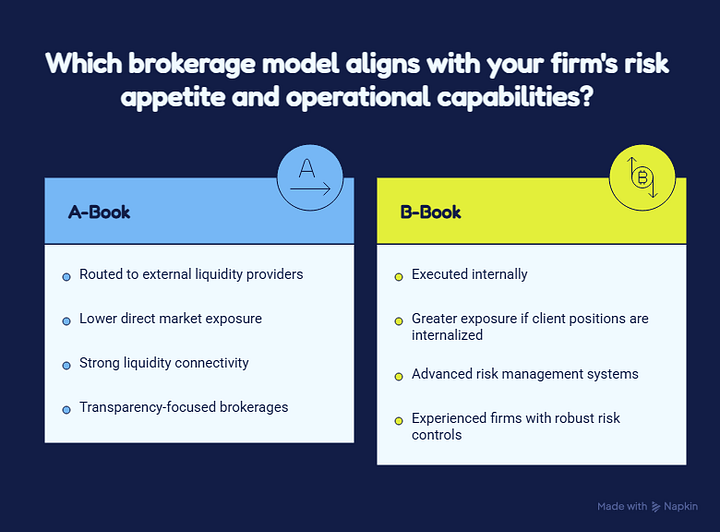
A-Book vs. B-Book Brokerage Model
The brokerage model you choose influences revenue generation, risk exposure, and operational complexity.
Why MetaTrader 5 Is the Right Foundation for Your Brokerage
Before evaluating specific white label forex broker solutions, understanding why MT5 specifically is worth building on helps clarify the strategic value of this infrastructure choice.
MetaTrader 5 is genuinely the world's most widely adopted multi-asset trading platform. Traders recognize it, trust it, and know how to use it — which dramatically reduces your onboarding friction compared to a proprietary platform that requires user education.
What MT5 brings to your brokerage:
Multi-Asset Trading — MT5 supports forex, equities, commodities, indices, and cryptocurrencies within a single platform. This gives your brokerage the flexibility to offer diverse trading products without maintaining separate technology stacks for each asset class.
Advanced Charting and Analytics — Comprehensive technical analysis tools, 21 timeframes, 80+ technical indicators, and a full suite of drawing tools give traders everything they need for sophisticated analysis — all within the platform interface.
Automated Trading Support — MT5's Expert Advisor (EA) framework supports automated trading strategy development and deployment. This is a major draw for algorithmic traders who represent a high-volume, high-value client segment.
Cross-Device Accessibility — Full-featured desktop platform plus native mobile applications for iOS and Android ensure your clients can trade from any device without compromise in functionality.
Deep Order Execution — Multiple order types (market, limit, stop, trailing stop), partial order filling, and market depth visibility give professional traders the execution tools they demand.
Step-by-Step Guide to Launching a Forex Brokerage With an MT5 White Label Solution
Step 1: Define Your Business Model
Every successful forex brokerage starts with a clearly defined business model. Your model determines your revenue structure, risk management approach, liquidity requirements, and regulatory needs — making it the most foundational decision in your entire planning process.
The three primary brokerage models are:
B-Book (Market Maker) — Your brokerage takes the opposing side of client trades internally. This model offers higher profit potential but requires sophisticated risk management to handle market exposure. It works best for brokerages with strong risk analytics capability and sufficient capital reserves.
A-Book (STP — Straight Through Processing) — Client trades are passed directly to external liquidity providers for execution. Your brokerage earns through spreads and commissions rather than trading against clients. This model eliminates direct market risk and is generally considered more transparent from a client trust perspective.
Hybrid Model — The most common approach among established brokerages in 2026. Lower-risk client trades are handled internally (B-Book) while higher-risk or larger-volume trades are routed to liquidity providers (A-Book). The split is typically managed by automated risk engine logic rather than manual decision-making.
Your business model choice shapes every subsequent decision in the brokerage setup process — from which white label forex broker solutions provider you select to how your MT5 CRM software development is structured.
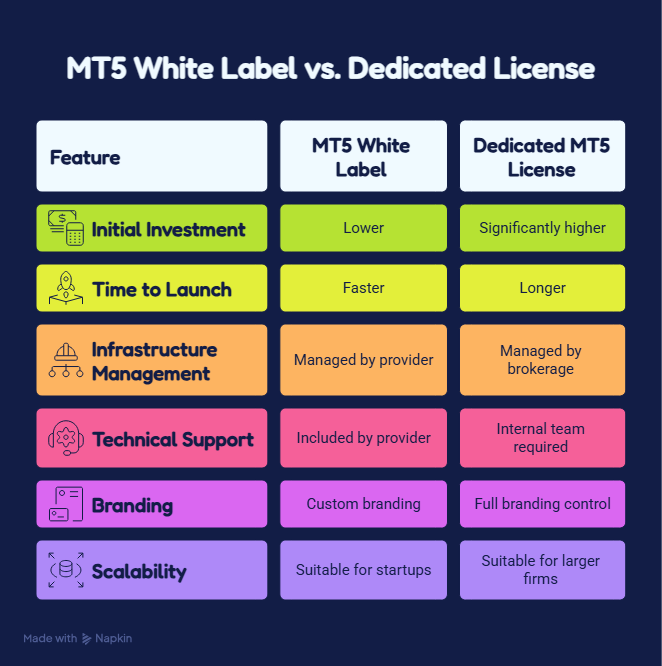
MT5 White Label vs. Dedicated MT5 License
One of the first decisions new brokerage owners face is whether to purchase a dedicated MetaTrader 5 license or use an MT5 White Label solution.
Step 2: Select the Right MT5 White Label Solution Provider
Your MT5 white label solution provider is your most important technology partner. Their infrastructure quality, support responsiveness, and liquidity relationships directly determine what your clients experience every time they open the platform.
What to evaluate when selecting a provider:
Server Stability and Uptime — Trading platforms have zero tolerance for downtime. Your provider's MT5 servers must maintain near-100% uptime with redundant failover systems. Ask specifically about their uptime history and what SLA commitments they offer.
Liquidity Integration Quality — The depth and quality of liquidity your provider connects you to determines your spreads, execution speed, and slippage rates. Tier-1 bank liquidity access is the benchmark standard for serious brokerages.
Technical Support Responsiveness — When technical issues arise during active trading sessions, response time is measured in minutes, not hours. Evaluate providers on their support team availability, response time commitments, and escalation procedures.
Branding and Customization Depth — Your platform should look and feel entirely like your own brand. Verify that the provider supports full white-label customization including logos, color schemes, trading instruments, and custom server naming.
Pricing Transparency — Understand exactly what you are paying for: setup fees, monthly licensing costs, per-trade costs, and any volume-based pricing tiers. Hidden costs in white label forex broker solutions are common — demand complete fee transparency before committing.
Step 3: Register Your Company and Obtain Regulatory Licensing
Forex brokerage operation requires legal registration and regulatory authorization in every jurisdiction where you serve clients. Attempting to operate without proper licensing is not just legally risky — it fundamentally undermines client trust and prevents you from establishing the banking and payment processing relationships your brokerage needs to function.
Popular regulatory jurisdictions and their characteristics:
Cyprus (CySEC) — Provides access to EU markets under MiFID II passporting rights. Strong credibility with European clients. Compliance requirements are rigorous but navigable with proper legal support.
United Kingdom (FCA) — Among the most respected regulatory bodies globally. FCA authorization signals the highest level of compliance commitment. Compliance requirements and capital minimums are demanding.
Dubai (DFSA) — Growing importance as a Middle East and Africa regulatory hub. DFSA authorization gives access to a rapidly expanding high-net-worth trading population.
Offshore Jurisdictions (St. Vincent, Seychelles, Vanuatu) — Lower compliance overhead and faster setup timelines make these attractive for startups. Client trust perceptions are lower than tier-1 jurisdictions, but they provide a viable entry point while building toward a primary license.
Core licensing requirements across most jurisdictions:
Step 4: Establish Liquidity Provider Relationships
Liquidity is the operational foundation of your brokerage. Without reliable, deep liquidity, your clients experience wide spreads, poor execution, and slippage — all of which drive them to competitors. Quality liquidity is what separates brokerages that retain traders from those that struggle to keep their first cohort active.
Key criteria for liquidity provider evaluation:
Spread Competitiveness — Tight spreads on major pairs (EUR/USD, GBP/USD, USD/JPY) are a baseline expectation for clients. Your spreads will be a primary factor in how your brokerage is evaluated against competitors.
Execution Speed — Sub-millisecond execution speeds eliminate slippage on market orders, particularly important during news events and high-volatility sessions when execution quality matters most to traders.
Liquidity Depth — Deep order books across both major and minor pairs enable large orders to execute without significant market impact, which is essential for attracting institutional or high-volume retail clients.
MT5 Connectivity — Confirm that your liquidity provider has direct, tested connectivity to the MT5 infrastructure rather than relying on bridge solutions that can introduce latency and execution risk.
Step 5: Implement MT5 CRM Software Development
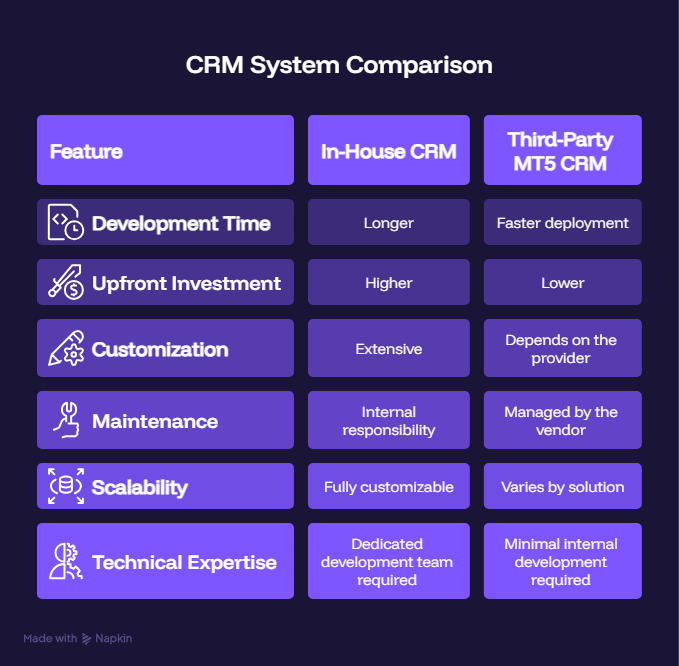
In-House CRM vs. Third-Party MT5 CRM
A CRM system is central to managing client onboarding, compliance, payments, and ongoing operations.
Which CRM Approach Is Right?
A third-party MT5 CRM is often the most efficient choice for new brokerages because it reduces implementation time and maintenance effort. As a brokerage grows and operational requirements become more specialized, an in-house CRM may provide greater flexibility and customization.
A sophisticated MT5 CRM software development solution is the operational hub of your entire brokerage business. While the MT5 platform handles trading, your CRM system handles everything else — client relationships, compliance, operations, marketing, and revenue management.
What comprehensive MT5 CRM software development delivers:
Client Onboarding Automation — Streamlined registration flows that guide new clients from account creation through KYC verification and first deposit without manual intervention at each step.
KYC Verification Management — Document collection, identity verification, risk classification, and approval workflows that keep your compliance team efficient even as client volumes scale.
Deposit and Withdrawal Processing — Real-time tracking of all client fund movements with automated reconciliation, payment gateway integration, and financial reporting.
Affiliate and IB Management — Multi-tier introducing broker tracking with automated commission calculation, transparent reporting for IBs, and flexible commission structure configuration.
Automated Marketing Tools — Email sequence automation, re-engagement campaigns for inactive clients, promotional offer management, and segmented communication based on client trading behavior.
Risk and Compliance Monitoring — Real-time alerts for suspicious activity, automated AML screening, and compliance reporting that keeps your regulatory obligations manageable.
Performance Analytics — Revenue attribution by client, channel, IB, and product — giving management the data needed to make informed decisions about resource allocation and growth strategy.
Investing in professional MT5 CRM software development from the start pays dividends throughout the brokerage lifecycle. A poorly chosen CRM creates operational bottlenecks that limit your growth ceiling; a well-built one scales with you.
Step 6: Build a High-Conversion Brokerage Website
Your website is your primary sales asset — the first thing prospective clients see and the platform through which they evaluate your brokerage's credibility before depositing funds. In 2026, a generic, template-based brokerage website is immediately recognizable and immediately trust-diminishing.
Essential elements of a high-converting brokerage website:
Clear Value Proposition — Communicate within three seconds what makes your brokerage the right choice: your spreads, your platform quality, your support availability, your regulatory status.
Seamless Account Opening Flow — Every unnecessary step in your registration process costs you clients. Optimize the path from landing page to funded account to the absolute minimum number of steps.
Secure Client Portal — A dedicated, professionally designed client area for account management, document submission, deposit processing, and trading history review builds confidence that your platform is trustworthy.
Educational Content — Brokerages that educate their clients acquire them at lower cost and retain them significantly longer. Market analysis, trading guides, and webinars create ongoing reasons to engage with your brand.
Mobile Optimization — A substantial portion of your prospective clients will first encounter your brokerage on mobile. A non-optimized mobile experience loses them before they read your first value proposition.
Regulatory Disclosure Visibility — Clearly displayed license numbers, regulatory body names, and risk warnings signal legitimacy and regulatory compliance — critical trust signals for prospective clients evaluating multiple brokerages.
Step 7: Configure Comprehensive Payment Gateways
The ability to deposit and withdraw funds quickly, securely, and with multiple payment options is one of the most practically important factors in client satisfaction. Payment friction is a leading cause of client abandonment both at onboarding and throughout the ongoing client relationship.
Payment methods your brokerage should support:
Bank Wire Transfers — The preferred method for larger deposits and institutional clients. Essential for credibility even if processing times are slower than alternatives.
Credit and Debit Cards — Visa and Mastercard instant deposits are expected as a baseline by retail traders globally. Card processing requires proper merchant account setup and chargeback management protocols.
Digital Wallets — Skrill, Neteller, and similar e-wallet options are particularly important for clients in regions with limited card acceptance or preference for intermediary payment services.
Cryptocurrency Deposits — Bitcoin, USDT, and Ethereum deposits are increasingly expected by modern traders and can open your brokerage to markets with limited traditional banking access.
Key payment infrastructure requirements:
Step 8: Deliver a Mobile-First Trading Experience
Mobile trading has moved from a convenience feature to a baseline expectation. A significant and growing majority of forex traders — particularly in high-growth markets across Asia, Africa, and Latin America — primarily trade on mobile devices.
Mobile experience requirements for your brokerage:
Your mobile experience is not a secondary consideration — for many of your clients, it is their primary and sometimes only trading interface.
Step 9: Build Your Introducing Broker Network
Introducing Brokers represent the most cost-efficient client acquisition channel available to a new forex brokerage. IBs have existing relationships with traders, established credibility within trading communities, and financial incentives aligned with your growth — making them a highly leveraged distribution channel.
Building an effective IB program:
Competitive Commission Structures — IBs evaluate multiple brokerages before committing their network. Your commission offering needs to be genuinely competitive, not just acceptable.
Multi-Tier IB Architecture — A multi-level IB structure where IBs earn commissions on the clients introduced by their own sub-IBs creates exponential network growth and deep loyalty to your platform.
Transparent IB Reporting — IBs need real-time visibility into their referred client activity, pending commissions, and historical earnings. Opacity in IB reporting destroys trust and drives IBs to competitors.
Dedicated IB Support — A dedicated support contact for IB relationships — someone who responds quickly and solves problems rather than deflecting them — is a significant competitive differentiator in IB recruitment.
Step 10: Execute a Multi-Channel Marketing Strategy
A technologically excellent brokerage with no marketing strategy acquires no clients. Marketing execution is what converts your MT5 white label solution investment into a growing, revenue-generating business.
Effective marketing channels for forex brokerages in 2026:
Search Engine Optimization — Long-term organic traffic growth through content marketing targeting trader education, platform comparisons, and trading strategy content. The highest-ROI marketing investment over a 12 to 24 month horizon.
Google Ads and Paid Search — Targeted campaigns capturing high-intent search traffic from traders actively researching brokerages. Requires careful jurisdiction management to comply with advertising regulations.
Social Media Marketing — Daily market analysis, trading content, and community engagement on platforms where your target trader demographic is active — primarily LinkedIn for institutional audiences, Instagram and YouTube for retail traders.
Influencer and Forex Creator Partnerships — Authentic endorsements from respected traders and market analysts carry significant weight with their audiences. Partnerships with credible forex content creators can drive high-quality client introductions.
Affiliate Marketing Programs — Structured affiliate programs with competitive commission models create a performance-based distribution network that scales without proportional marketing spend.
Step 11: Maintain Compliance and Security Standards
Regulatory compliance and platform security are not launch requirements that you satisfy once and move on from. They are ongoing operational commitments that require continuous attention.
Ongoing compliance requirements:
AML Monitoring — Continuous transaction monitoring for suspicious patterns with documented escalation procedures and regulatory reporting workflows.
KYC Updates — Periodic re-verification of existing client identity documentation, particularly for high-value accounts and clients in higher-risk jurisdictions.
Regular Audits — Scheduled internal and external compliance audits that identify gaps before regulators do.
Security Maintenance — Regular penetration testing, SSL certificate management, two-factor authentication enforcement, and security incident response planning.
Cost Breakdown: Launching a Forex Brokerage With an MT5 White Label Solution
| Component | Estimated Cost Range | Notes |
|---|---|---|
| MT5 White Label Setup | $5,000 – $20,000 | One-time setup fee to provider |
| Monthly White Label Fees | $1,000 – $5,000/month | Ongoing server and support costs |
| MT5 CRM Software Development | $2,000 – $15,000+ | Depends on customization depth |
| Website Development | $1,000 – $5,000 | Professional design recommended |
| Regulatory Licensing | $5,000 – $50,000+ | Varies significantly by jurisdiction |
| Liquidity Setup | Variable | Based on volume and provider |
| Payment Gateway Integration | $1,000 – $5,000 | Per payment method |
| Marketing Budget | Variable | Based on acquisition strategy |
| Total Estimated Range | $15,000 – $100,000+ | Vs. $100,000+ for direct MT5 license |
These figures are estimates based on industry knowledge and may have changed. Always obtain current quotes directly from providers before budgeting.
Common Mistakes to Avoid When Launching a Forex Brokerage
Choosing the Wrong White Label Provider — Provider quality determines your platform's reliability. A low-quality MT5 white label solution means downtime, poor execution, and client attrition that is extremely difficult to recover from.
Underestimating Compliance Complexity — Operating without proper licensing or with an inadequate compliance infrastructure creates legal exposure that can shut your brokerage down regardless of how well everything else is running.
Neglecting MT5 CRM Software Development — Underinvesting in MT5 CRM software development creates operational bottlenecks at exactly the moment your business needs to scale. A capable CRM is not optional infrastructure — it is essential.
Weak Marketing Investment — The best white label forex broker solution in the world generates zero revenue without clients. Underfunding marketing, particularly in the critical first six months, is one of the most common reasons well-built brokerages fail to reach sustainable scale.
Poor Customer Support Planning — Traders expect fast, knowledgeable responses when they have account issues or questions. Inadequate support infrastructure is consistently cited as a primary reason traders leave brokerages.
Building Without Scalability — Architecture decisions made at launch are expensive to change at scale. Ensure your MT5 white label solution provider, CRM system, and payment infrastructure can accommodate 10x your launch volume without requiring a complete rebuild.
Frequently Asked Questions
Q1: What is an MT5 white label solution and how does it differ from a direct MT5 license? An MT5 white label solution allows you to operate a branded version of the MetaTrader 5 platform through a licensed provider who manages backend infrastructure on your behalf. A direct MT5 license from MetaQuotes requires you to purchase, host, and maintain all infrastructure independently — at significantly higher upfront cost (typically $100,000+) and with greater technical responsibility. For most startup brokerages, white label forex broker solutions deliver a better cost-to-capability ratio.
Q2: How long does it take to launch a forex brokerage with an MT5 white label solution? With all preparation completed efficiently, a forex brokerage using an MT5 white label solution can typically be operational in 8 to 16 weeks. This timeline covers company registration, MT5 white label solution setup, MT5 CRM software development, website development, payment gateway integration, and initial compliance configuration. Regulatory licensing timelines vary significantly by jurisdiction and can extend the overall launch timeline.
Q3: What is MT5 CRM software development and why does it matter? MT5 CRM software development
creates the operational management system that connects your MT5 trading platform with client management, compliance workflows, financial processing, and marketing automation. Without a capable CRM, managing client onboarding, KYC, deposits, withdrawals, IB commissions, and marketing at scale requires unsustainable manual effort. Professional MT5 CRM software development is the difference between a brokerage that scales efficiently and one that hits operational ceilings at a few hundred clients.
Q4: Which regulatory jurisdiction is best for a new forex brokerage?
The best jurisdiction depends on your target market, budget, and long-term compliance ambitions. Cyprus (CySEC) and the UK (FCA) offer the highest client credibility and EU market access but require greater compliance investment. Offshore jurisdictions like Seychelles offer faster, lower-cost licensing but carry lower client trust perceptions. Many brokerages launch offshore first, then pursue a tier-1 license as they grow. Always consult qualified legal counsel — I am not able to provide specific legal advice, and regulatory requirements change frequently.
Q5: How do white label forex broker solutions generate revenue?
White label forex broker solutions generate revenue through spreads (the difference between bid and ask prices), commissions on trade execution, swap fees on overnight positions, account management fees, and in some models, market making profits. The specific revenue mix depends on whether you operate an A-Book, B-Book, or hybrid model. Proper revenue model design during the business planning phase is essential for long-term profitability.
Q6: What liquidity providers work best with MT5 white label solutions? Most professional MT5 white label solution providers have established relationships with multiple Tier-1 and Tier-2 liquidity providers and can facilitate integration as part of their setup service. When evaluating liquidity, prioritize spread competitiveness on your primary instruments, execution speed, and the provider's track record during high-volatility market events. I would recommend requesting specific liquidity provider names and their credentials from any white label forex broker solutions provider you evaluate.
Q7: Can I offer cryptocurrency trading on an MT5 white label platform? Yes — MT5 supports cryptocurrency CFD trading alongside forex, commodities, and equities. Adding crypto instruments to your MT5 white label solution depends on your liquidity provider offering crypto pricing feeds and your regulatory authorization permitting crypto product offerings. Regulatory treatment of crypto CFDs varies by jurisdiction, so confirm your licensing covers your intended product range before launching crypto instruments.
Q8: Is MT5 CRM software development necessary if I use a CRM provided by my white label provider?
Many white label forex broker solutions include basic CRM functionality as part of their package. Whether this is sufficient depends on your operational complexity, IB program scale, and marketing automation requirements. For brokerages planning aggressive growth, a purpose-built MT5 CRM software development solution typically delivers significantly better capability than generic bundled CRM tools — particularly for multi-tier IB management, advanced marketing automation, and detailed compliance reporting.
Conclusion :
An MT5 White Label solution offers a practical way to launch a forex brokerage using established trading infrastructure. By selecting the right technology partner, securing regulatory approvals, integrating liquidity, implementing CRM software, and developing a client acquisition strategy, businesses can build a scalable brokerage while reducing the complexity of developing a platform from scratch.