
- Passenger and driver mobile apps (Android or iOS)
- Basic GPS tracking and route navigation
- Single payment method integration
- Simple admin dashboard
- Standard push notifications
- User and driver registration and profile management
- Multi-payment gateway integration
- Ride scheduling functionality
- In-app messaging between passenger and driver
- Enhanced analytics dashboard
- Improved UI/UX design quality
- Driver earnings reporting
- Multi-stop ride support
- AI-powered driver-passenger matching
- Dynamic surge pricing engine
- SOS and emergency safety features
- Multi-language and multi-currency support
- Referral and loyalty program systems
- Advanced driver background verification integration
- Full ride replay and dispute resolution tools
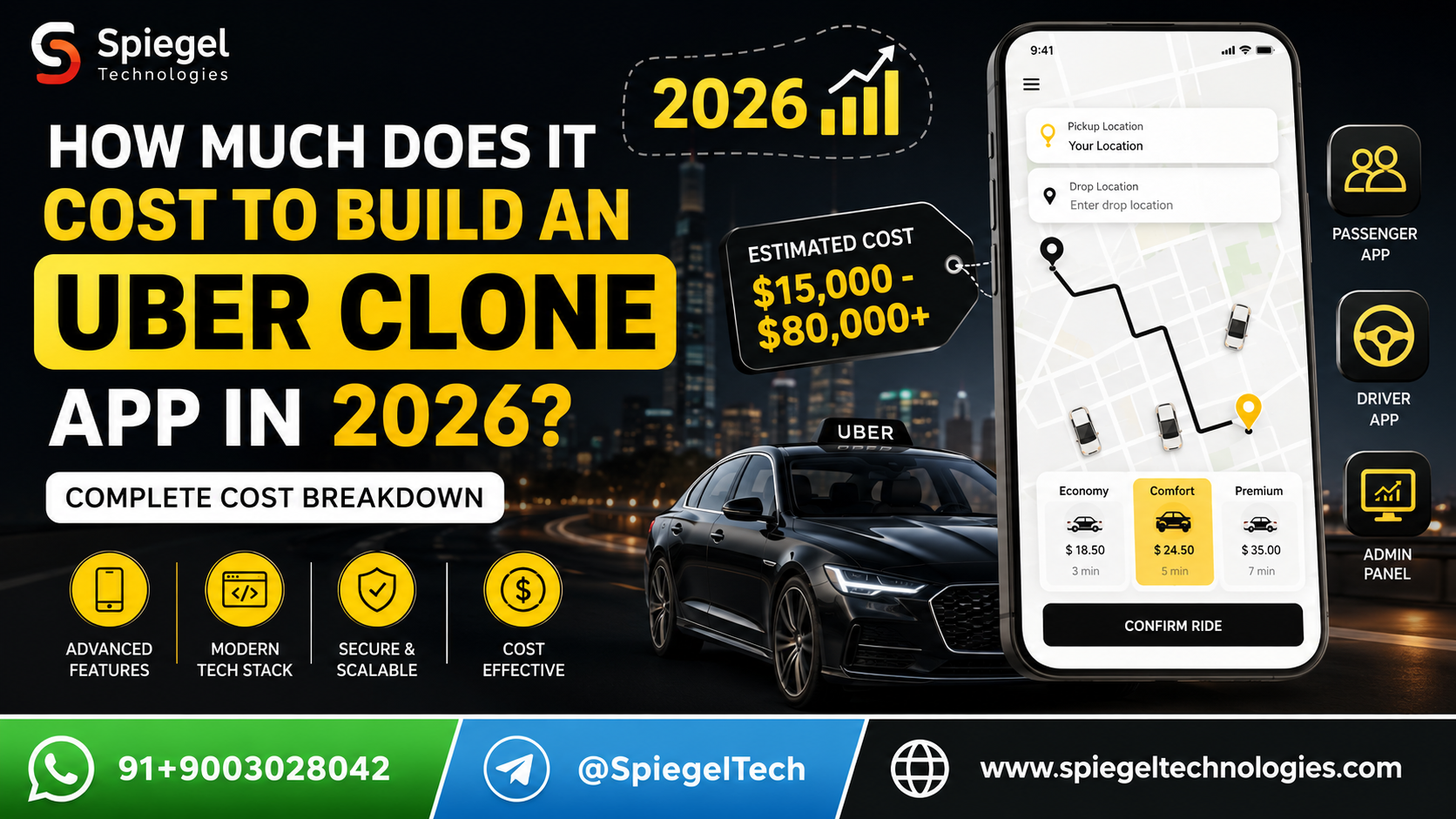
How Much Does It Cost to Build an Uber Clone App in 2026?
The ride-hailing industry is not slowing down — it is scaling up. Uber alone serves more than 130 million monthly active users across 80+ countries and generated approximately $35 billion in revenue through 7.6 billion trips in a single year. That scale of adoption represents something beyond a successful product. It represents a proven business model that entrepreneurs across the globe are now replicating, adapting, and improving for their own local and regional markets.
If you have been evaluating whether building an Uber clone app makes business sense in 2026, the answer the market is giving is a consistent yes. The on-demand transportation economy continues to expand, new geographies are underserved by existing platforms, and the technology required to build a competitive ride-hailing application has become significantly more accessible than it was five years ago.
The more practical question is not whether to build — it is how much it costs, what influences that cost, and how to build smartly without overspending on features you do not yet need.
This guide answers all of those questions with complete transparency.
What Is an Uber Clone App?
An Uber clone app is a ride-hailing application built on the same fundamental architecture and user experience model as Uber — connecting passengers who need transportation with nearby drivers through a GPS-powered, mobile-first interface. The "clone" designation does not mean a direct copy; it means a platform that replicates the proven functional framework while being fully customizable for your brand, market, pricing model, and feature set.
A fully functional Uber clone app ecosystem consists of three interconnected modules: a passenger-facing app, a driver-facing app, and an administrative dashboard. Each serves a distinct role in the ride-hailing workflow, and all three must work in seamless coordination to deliver the experience that users expect from a modern on-demand transportation platform.
Beyond traditional taxi booking app, the Uber clone app framework extends naturally to adjacent on-demand verticals — food delivery (Uber Eats model), courier and package delivery, medicine and pharmacy delivery, and any other service that benefits from real-time GPS matching between service providers and customers.
How an Uber Clone App Works: The Complete Ride Flow
Understanding the operational mechanics behind an Uber clone app helps clarify both the feature requirements and the development complexity involved:
Step 1 — Ride Request The passenger opens the app, enters their pickup location and destination, selects their preferred ride category (economy, premium, shared), and submits the ride request. The app displays an estimated fare and wait time before confirmation.
Step 2 — Driver Matching The platform's matching algorithm identifies available drivers nearest to the pickup location and sends the request to them simultaneously or in priority sequence based on proximity and rating.
Step 3 — Driver Acceptance An available driver accepts the ride request. The passenger receives real-time confirmation with the driver's name, photo, vehicle details, license plate, and live location on the map.
Step 4 — Ride Commencement The driver arrives at the pickup location. The passenger verifies the driver's identity through an OTP system, and the ride begins. Both the passenger and a designated contact can track the live route.
Step 5 — Payment Processing Upon arrival at the destination, payment is automatically processed through the passenger's pre-selected payment method — card, digital wallet, or cash. A receipt is generated and sent automatically.
Step 6 — Mutual Rating Both the passenger and driver rate the experience. This rating system is the trust mechanism that maintains service quality standards across the platform over time.
This six-step flow is what every element of your Uber clone app development must support — from GPS accuracy and matching algorithm performance to payment security and rating system design.
Core Components of an Uber Clone App
A complete Uber clone app solution requires three purpose-built modules, each with its own distinct feature set:
Passenger App
The passenger-facing application is the primary user interface and the primary driver of user satisfaction and retention. Key features include:
Profile Creation and Management — Simple registration via phone number or social login, with profile photo, saved addresses, and payment method management.
Cab Type and Ride Selection — Multiple ride category options (economy, premium, XL, shared) with transparent pricing for each before booking confirmation.
Real-Time GPS Tracking — Live map showing driver location from acceptance through arrival, giving passengers accurate wait time visibility and security.
Fare Calculator — Upfront pricing display before ride confirmation, with dynamic surge pricing clearly communicated during high-demand periods.
Multiple Drop-Off Points — Support for multi-stop rides within a single booking, a feature increasingly expected by modern users.
Preferred Driver — Ability to save and request preferred drivers from previous positive ride experiences.
Multiple Payment Options — Credit and debit cards, digital wallets, UPI (for relevant markets), and cash options depending on your target geography.
Ride History and Receipts — Complete trip history with full details including route, duration, distance, and final fare for every ride.
Ride Feedback and Rating — Post-ride rating and review system that contributes to platform-wide quality management.
Driver App
The driver app must make accepting rides, navigating routes, and managing earnings as frictionless as possible. Key features include:
Trip Planning and Navigation — Integrated turn-by-turn navigation with real-time traffic routing, optimized for the vehicle type and local road conditions.
Ride Request Management — Clear, time-sensitive ride request notifications with passenger details, estimated pickup distance, and trip preview before acceptance or decline.
Route Optimization — Intelligent routing that accounts for real-time traffic data, minimizing trip time for both driver efficiency and passenger experience.
Earnings Dashboard and Reports — Detailed earnings tracking by day, week, and month — including base fares, tips, bonuses, and deductions — giving drivers full financial visibility.
Availability Toggle — Simple online/offline status control that lets drivers manage their working hours without administrative complexity.
Passenger Selection Context — Access to passenger rating history before acceptance, helping drivers make informed decisions on longer trips.
Admin Panel
The administrative dashboard gives the platform operator complete operational visibility and control. Key features include:
User and Driver Management — Centralized management of all passenger and driver accounts, including verification status, activity history, and account controls.
Real-Time Analytics Dashboard — Live metrics on active trips, driver availability, geographic demand distribution, and platform performance indicators.
Trip History and Tracking — Complete historical record of every trip with route replay capability, useful for dispute resolution and service quality analysis.
Payment and Commission Management — Automated commission calculation, driver payout processing, refund management, and financial reporting across all payment methods.
Surge Pricing Controls — Dynamic pricing configuration by time, location, and demand conditions, with override capability for planned events.
Customer Support Tools — Integrated support ticket management for handling passenger and driver complaints, disputes, and account issues.
Key Features That Influence Uber Clone App Development Cost
Every feature decision in your Uber clone app development has a corresponding cost implication. Here are the features most significantly affecting your investment:
Real-Time GPS Tracking — Continuous location updates for passengers, drivers, and administrators require robust mapping API integration and backend infrastructure capable of handling concurrent location streams.
Advanced Payment Integration — Supporting multiple payment methods (Stripe, PayPal, Braintree, Venmo, Dwolla, UPI) requires individual integration work for each processor, plus PCI-compliant security infrastructure.
Analytics and Reporting Dashboard — Actionable business intelligence tools add development time but deliver the operational visibility needed to make data-driven growth decisions.
Push Notification System — Real-time alerts for ride status updates, promotional offers, driver arrival notifications, and payment confirmations across both iOS and Android require dedicated notification infrastructure.
Multi-Language and Multi-Currency Support — Essential for platforms targeting multiple geographies but adds meaningful development scope.
In-App Chat and SOS Features — Communication tools between passengers and drivers, plus emergency safety features, add development complexity but significantly improve platform trust and safety perception.
Scheduled Rides — Allowing passengers to book rides in advance for specific times requires additional scheduling logic and driver matching coordination.
Technology Stack for an Uber Clone App
The technology choices behind your Uber clone app determine its performance, scalability, and long-term maintenance cost:
| Layer | Technologies |
|---|---|
| Frontend | React, Angular, Vue.js, Swift (iOS), Kotlin (Android) |
| Backend | Java, Golang, Rust, Node.js, Python |
| Database | MongoDB, MySQL, PostgreSQL, Redis, Oracle |
| Maps and Navigation | Google Maps API, Apple Maps, Waze |
| Payment Processing | Stripe, PayPal, Braintree, Venmo, Dwolla |
| Cloud Infrastructure | AWS, Google Cloud, Microsoft Azure |
| Cloud Storage | Dropbox, pCloud, Icedrive |
| Real-Time Communication | WebSockets, Firebase, Socket.io |
Technology stack selection is not a one-size-fits-all decision — the right stack depends on your expected user volume, geographic deployment, and long-term scalability requirements. An experienced development team will recommend a stack based on your specific project parameters rather than defaulting to a single standard configuration.
Uber Clone App Cost Breakdown by Complexity
Development investment for an Uber clone app varies significantly based on feature scope, platform targets, and customization depth:
Basic Uber Clone App ($3,000 – $5,000)
A basic Uber clone app includes the core ride-hailing functionality that makes the business model work — passenger and driver apps, real-time GPS tracking, payment processing, booking management, and a fundamental admin dashboard. This tier is appropriate for startups entering a single market with a focused initial feature set, validating the business model before investing in advanced capabilities.
Included at this tier:
Medium Complexity Uber Clone App ($12,000 – $18,000)
A medium-complexity Uber clone app adds the feature depth that improves retention and competitive positioning: multiple payment methods, ride scheduling, in-app chat, detailed analytics, enhanced UI/UX design, and expanded admin controls.
Additional features at this tier:
Advanced Uber Clone App ($5000 – $15,000+)
An advanced Uber clone app is a full-featured, enterprise-grade platform built for competitive deployment in active markets. Premium UI/UX, AI-driven matching algorithms, surge pricing automation, comprehensive safety features, multi-language support, and advanced analytics are all included.
Additional features at this tier:
Factors That Determine Your Uber Clone App Development Cost
Several specific variables influence where your project falls within these cost ranges:
Platform Choice — Building for Android only, iOS only, or both platforms simultaneously affects development time and cost proportionally. Cross-platform frameworks (React Native, Flutter) can reduce this cost but involve their own tradeoffs.
Feature Complexity — Each additional feature beyond the core ride-hailing flow adds development time. The relationship is not always linear — some features (real-time surge pricing, AI matching) are disproportionately complex relative to their visible simplicity.
UI/UX Design Quality — Commodity design templates reduce cost but produce platforms that look and feel generic. Custom design work that delivers a distinctive user experience commands more investment but produces better retention outcomes.
Third-Party Integrations — Each external API integration (payment processors, mapping services, SMS verification, background check services) adds scope, testing requirements, and ongoing API cost.
Geographic Compliance Requirements — Platforms targeting regulated markets may require specific data handling, payment processing, or identity verification integrations that add development scope.
Post-Launch Maintenance Planning — Ongoing maintenance, feature additions, security updates, and performance optimization are recurring investments that should be budgeted from the start rather than treated as optional afterthoughts.
Development Process: How an Uber Clone App Gets Built
A professional development process for an Uber clone app follows a structured sequence:
Project Ideation and Market Research Thorough analysis of your target market, competitor landscape, user expectations, and operational constraints. This phase produces the feature prioritization that governs scope and budget decisions.
Technical Architecture and Blueprint Defining the system architecture, database design, API structure, and technology stack before any code is written. Good architecture decisions at this stage prevent expensive rebuilds later.
UI/UX Design Creating wireframes, user flow diagrams, and high-fidelity design mockups for all three app components — passenger, driver, and admin — with user testing to validate design decisions before development begins.
Development Parallel development of frontend interfaces, backend systems, database architecture, and third-party integrations with regular milestone reviews and client visibility into progress.
Quality Assurance Testing Comprehensive testing covering functional accuracy, performance under load, security vulnerability scanning, payment processing validation, GPS accuracy, and cross-device compatibility.
Deployment and Launch App Store and Google Play submission (for native apps), backend deployment to production infrastructure, and launch monitoring with rapid response to any post-launch issues.
Post-Launch Support and Iteration Ongoing maintenance, bug resolution, performance optimization, and feature additions informed by real user behavior data from your live platform.
Why Choose a Professional Uber Clone App Development Partner?
The difference between an Uber clone app that gains traction and one that loses users after the first week is almost never the business idea — it is the execution quality. A professional development partner with proven ride-hailing app delivery experience brings:
Reusable, Battle-Tested Architecture — Code that has already been stress-tested across multiple deployments has known performance characteristics. Building on a proven foundation is inherently less risky than pioneering new architecture.
Domain-Specific Feature Knowledge — Developers who have built multiple ride-hailing applications understand the edge cases, the performance requirements, and the UX decisions that matter — without needing to learn them at your expense.
Transparent Pricing and Timeline Commitments — Milestone-based delivery with clear deliverable definitions at each stage prevents the scope creep and cost overruns that characterize less structured development engagements.
Post-Launch Partnership — The best development relationships extend well beyond initial deployment, with ongoing support, feature development, and performance optimization that keep your platform competitive as the market evolves.
Frequently Asked Questions About Uber Clone App Development
Q1: How much does an Uber clone app cost to build in 2026?
Development costs for an Uber clone app range from approximately $7,000 for a basic single-platform version to $25,000 or more for a fully featured, multi-platform solution. The specific investment depends on platform choice (iOS, Android, or both), feature complexity, UI/UX design quality, third-party integrations, and ongoing maintenance requirements. Getting a detailed quote based on your specific feature requirements is always recommended before budgeting.
Q2: How long does it take to develop an Uber clone app?
A basic Uber clone app typically takes 8 to 12 weeks to develop and deploy. A medium-complexity version with additional features generally requires 12 to 16 weeks. An advanced, full-featured platform may take 16 to 24 weeks or more depending on the scope of customization and integration requirements.
Q3: What is the difference between an Uber clone app and a custom ride-hailing app?
An Uber clone app uses a pre-built framework that replicates Uber's core architecture — reducing development time and cost significantly. A fully custom ride-hailing app is engineered from scratch to entirely unique specifications. For most entrepreneurs entering the ride-hailing market, an Uber clone app delivers the best balance of speed, cost, and feature completeness. Custom development makes sense only when you have specific technical requirements that a clone script cannot accommodate.
Q4: Can I customize an Uber clone app with my own branding?
Yes — complete branding customization is a standard component of professional Uber clone app development. Your app will carry your brand name, logo, color scheme, and design language throughout all three modules (passenger app, driver app, and admin panel). The "clone" designation refers to the functional architecture, not the visual identity.
Q5: Which platforms should my Uber clone app support?
This depends on your target market's device demographics. If your primary market uses both iOS and Android devices in roughly equal proportion, building for both platforms simultaneously is recommended. If one platform dominates your target demographic, launching on that platform first and expanding later is a cost-efficient approach. Cross-platform frameworks like React Native or Flutter can enable a single codebase to serve both platforms, though with some performance and customization tradeoffs compared to native development.
Q6: Does an Uber clone app include real-time GPS tracking?
Yes — real-time GPS tracking for both passengers (tracking their driver's approach) and administrators (monitoring fleet activity) is a core feature of any Uber clone app. This functionality is typically built on Google Maps API or equivalent mapping services and requires backend infrastructure capable of handling continuous concurrent location updates from all active users and drivers.
Q7: What payment methods can an Uber clone app support?
A professional Uber clone app can support any combination of payment methods relevant to your target market: credit and debit cards (via Stripe, Braintree, or similar processors), digital wallets (PayPal, Apple Pay, Google Pay), UPI (for Indian markets), mobile money (for African markets), and cash payment options. Each payment method requires individual integration work, which factors into overall development cost and timeline.
Q8: Can I extend an Uber clone app to cover food delivery or other services?
Yes — the Uber clone app architecture extends naturally to adjacent on-demand verticals. Food delivery (Uber Eats model), courier and package delivery, medicine and pharmacy delivery, home services, and other on-demand categories all operate on the same fundamental matching and tracking infrastructure. Many businesses launch with ride-hailing and extend to additional verticals once the core platform is operational.
Q9: What ongoing costs should I budget for after launching my Uber clone app?
Post-launch costs for an Uber clone app include server and cloud infrastructure hosting (variable based on active users), third-party API costs (Google Maps, payment processors, SMS verification), ongoing maintenance and security updates, new feature development, marketing and user acquisition, and customer support operations. These ongoing costs should be factored into your financial planning from the start rather than treated as post-launch surprises.
Q10: Is an Uber clone app secure for handling payments and user data?
A professionally built Uber clone app implements multiple security layers: PCI-compliant payment processing through certified payment gateways, end-to-end encryption for all data in transit and at rest, two-factor authentication for sensitive account actions, and regular security auditing. The security level of your platform ultimately depends on the quality of your development partner and their adherence to security best practices throughout the development process.
Ready to Build Your Uber Clone App?
The on-demand transportation market is large, growing, and full of underserved opportunities in regional and niche markets globally. An Uber clone app built on proven architecture, with the right features for your target market and the professional development execution that keeps it reliable at scale, is a genuinely compelling business opportunity.
The technology is accessible. The business model is validated. The market demand is real.
Get a free consultation and complete cost breakdown for your Uber clone app project — and take the first step toward owning your market.