
- Governance tokens — Give holders voting rights over protocol parameters, upgrades, and treasury allocation. Uniswap's UNI is the canonical example.
- Utility tokens — Grant access to specific platform features or services. Compound's COMP token rewards users for protocol participation.
- Stablecoins — Maintain price stability by pegging to fiat or algorithmic mechanisms. MakerDAO's DAI is pegged to USD and backed by on-chain collateral.
- Liquidity/collateral tokens — Represent ownership stakes in liquidity pools or serve as collateral for lending. Aave's AAVE token can be staked as collateral to borrow other assets.
- What specific problem does this token solve within your protocol?
- What behavior are you incentivizing — liquidity provision, governance participation, long-term holding?
- How does the token's value accrue as the protocol grows?
- Total supply: Fixed supply creates scarcity (like Bitcoin's 21M cap); dynamic supply works for algorithmic stablecoins and inflationary reward tokens.
- Distribution model: How tokens are allocated across team, investors, ecosystem rewards, and treasury — and critically, the vesting schedules that govern release.
- Inflation/deflation mechanics: Will tokens be minted as rewards? Burned from fees? A poorly calibrated emission schedule can collapse token value regardless of protocol quality.
- Liquidity strategy: How will you bootstrap initial liquidity on DEXs? Insufficient liquidity makes your token effectively unusable.
- ERC-20 for standard fungible tokens on EVM chains (OpenZeppelin's implementation is the production-tested baseline)
- ERC-4626 for tokenized vault shares (yield-bearing tokens)
- Solidity or Vyper for EVM chains; Rust for Solana programs
- Hardhat or Foundry for development and local testing environments
- Web3 wallet connectivity: MetaMask, WalletConnect v2, Coinbase Wallet
- Subgraph indexing: The Graph Protocol for efficient on-chain data querying
- Price oracle integration: Chainlink or Pyth for reliable price feeds
- DEX integration: Uniswap V3/V4 or equivalent for liquidity and trading
- Smart contract logic verification
- Reentrancy and flash loan attack vectors
- Access control and privilege escalation risks
- Tokenomics manipulation scenarios (inflation exploits, liquidity drain attacks)
- Regulatory compliance considerations
- DEX liquidity pools: Uniswap, Curve, Balancer for token trading and price discovery
- Lending protocols: Aave or Compound for collateral eligibility
- Cross-chain bridges: LayerZero, Wormhole for multi-chain token deployment
- Governance platforms: Snapshot for off-chain voting; Tally for on-chain governance
- Real-time smart contract monitoring (Tenderly, OpenZeppelin Defender)
- On-chain governance for protocol parameter updates
- A clearly documented upgrade path (transparent proxy pattern or time-locked multisig admin)
- Community communication infrastructure for governance proposals
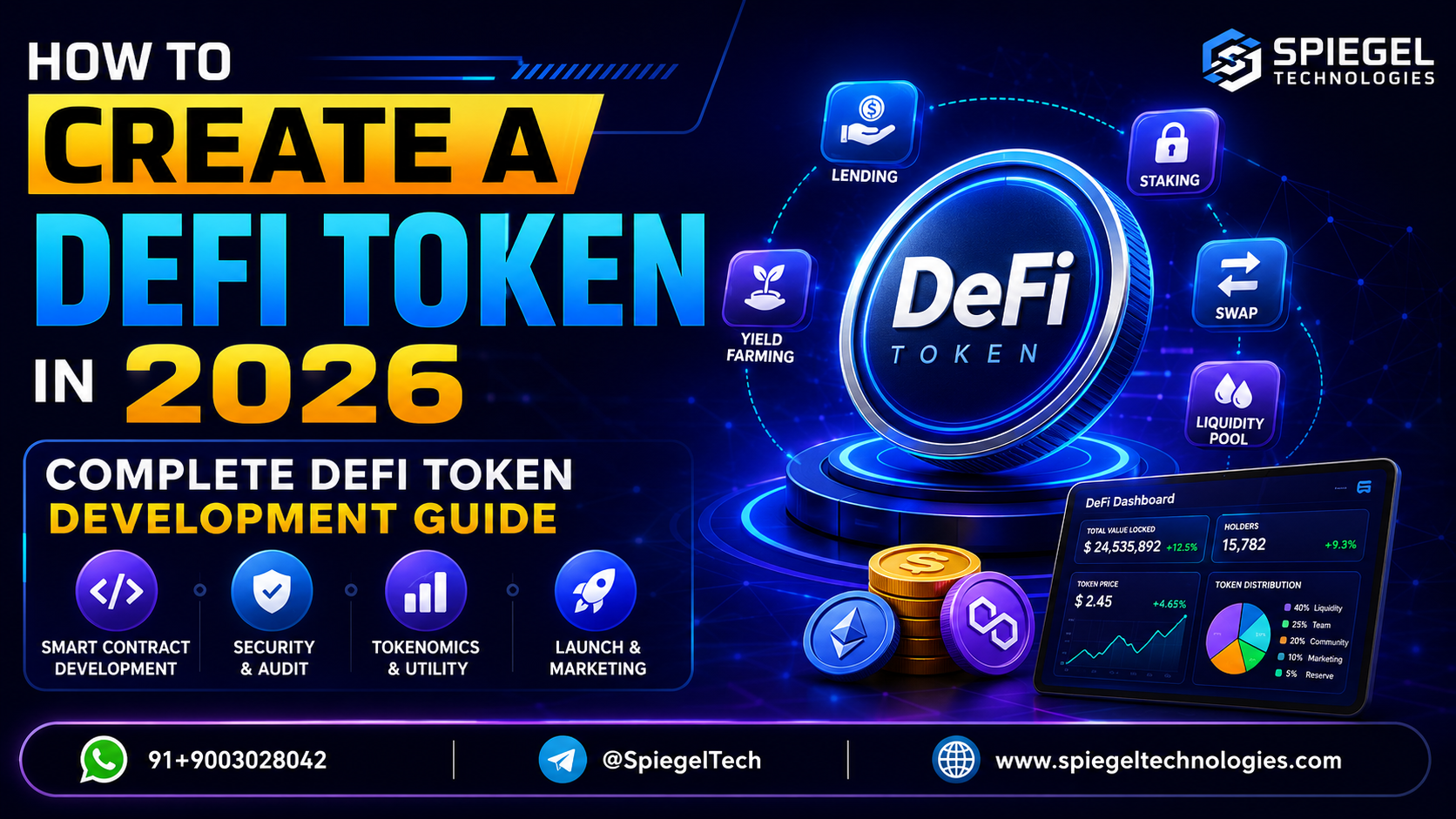
How to Create a DeFi Token in 2026: A Complete Guide to DeFi Token Development
The Decentralized Finance ecosystem has fundamentally changed how capital moves across the internet. DeFi protocols now handle billions of dollars in daily transaction volume — and at the center of every one of those protocols sits a DeFi token. Whether it governs a lending platform, rewards liquidity providers, or powers a DAO treasury, the DeFi token is the economic engine that makes decentralized systems work.
If you're an entrepreneur or developer asking how to approach DeFi token development in 2026, this guide gives you the complete picture — architecture decisions, smart contract considerations, real-world use cases, and the challenges you need to plan for before you write a single line of Solidity.
What Is a DeFi Token?
A DeFi token is a programmable digital asset that serves a defined function within a decentralized finance protocol. Unlike speculative cryptocurrencies, well-designed DeFi tokens exist to fulfill a specific economic or governance role — and that purpose is encoded directly into their smart contract logic.
DeFi tokens generally fall into four categories:
The smart contract managing a DeFi token defines everything: how it's minted, burned, transferred, and how it interacts with other DeFi protocols. Getting that contract right is the foundation of successful crypto token development.
Why DeFi Token Development Is Worth Serious Investment
Before walking through the technical steps, it's worth understanding the business case. Statista projects DeFi revenues to exceed $418 million — and that figure reflects only direct protocol revenue, not the broader value created by governance and liquidity incentive systems.
The strategic reasons to build a DeFi token for your business include:
Operational efficiency through automation. Smart contracts execute token transactions without intermediaries, reducing settlement time from days to seconds and eliminating the cost of manual reconciliation.
Access to decentralized fundraising. DeFi tokens enable Initial DEX Offerings (IDOs) and liquidity bootstrapping pools — fundraising mechanisms unavailable to traditional businesses that give early adopters genuine economic participation in your protocol's success.
Community-driven governance. Distributing governance tokens to users aligns incentives between the protocol and its stakeholders in a way that no equity structure can. Users who govern the protocol have a direct interest in its growth.
Programmable monetization. Transaction fees, staking rewards, and protocol revenue can be distributed directly to token holders through smart contracts — creating sustainable, transparent revenue-sharing models.
Global accessibility. A DeFi token operates on a permissionless blockchain, making your protocol accessible to anyone with an internet connection and a compatible wallet, regardless of geography or banking infrastructure.
How to Create a DeFi Token: 8 Technical Steps
Step 1: Define the Token's Purpose Precisely
Vague token design is the most common failure mode in DeFi token development. Before any technical work begins, you need clear answers to:
The answers to these questions determine every downstream technical decision, from smart contract architecture to distribution schedule.
Step 2: Choose the Right Blockchain for Your DeFi Token
Your blockchain choice affects transaction costs, developer tooling, user accessibility, and cross-protocol composability. The leading platforms for crypto token development in 2026 each have distinct tradeoffs:
| Blockchain | Strengths | Best For |
|---|---|---|
| Ethereum | Deepest DeFi ecosystem, highest composability | Governance tokens, established protocols |
| BNB Chain | Low fees, large retail user base | High-frequency utility tokens |
| Solana | High throughput, sub-cent fees | Trading bots, gaming, high-volume applications |
| Polygon | EVM-compatible, low cost | Scaling Ethereum-native projects |
| Avalanche | Fast finality, subnet architecture | Enterprise DeFi, custom chains |
For most DeFi token development projects, Ethereum or an EVM-compatible chain (Polygon, Arbitrum, Base) provides the best balance of ecosystem access and developer resources.
Step 3: Design Your Tokenomics
Tokenomics — the economic design of your DeFi token — determines whether your protocol thrives or collapses. Core parameters to finalize:
Step 4: Smart Contract Development
This is the most technically demanding phase of DeFi token development. Your smart contract must implement the full token logic — minting, burning, transfer restrictions, staking mechanics — while being resistant to the full attack surface of on-chain adversarial environments.
Key standards and tools:
A critical note: smart contract code handling DeFi tokens is immutable once deployed (unless you've implemented an upgradeable proxy pattern). Bugs in this code don't generate error logs — they generate exploits. Treat smart contract development with the same rigor you'd apply to financial infrastructure code.
Step 5: Frontend and Integration Development
The technical interface for your DeFi token — wallet integration, transaction UI, analytics dashboards — is what users actually interact with. Key integration requirements:
Step 6: Security Auditing — Non-Negotiable
No DeFi token should launch without an independent security audit. The audit process covers:
Reputable audit firms include Certik, Trail of Bits, Halborn, and OpenZeppelin. Budget for this from the start — retrofitting security after an exploit is orders of magnitude more expensive than auditing before launch.
Step 7: DeFi Protocol Integration
A DeFi token in isolation provides limited value. The goal is composability — your token working seamlessly within the broader DeFi ecosystem. Integration targets typically include:
Step 8: Deployment, Monitoring, and Ongoing Upgrades
Mainnet deployment is the beginning of your operational phase, not the end of development. Production requirements include:
DeFi Token Use Cases: Where Real Value Gets Created
Understanding the range of applications helps contextualize your token design decisions. Leading use cases in 2026:
Yield farming and staking — Tokens distributed as rewards for liquidity provision (e.g., Curve's CRV, PancakeSwap's CAKE) create incentives for early capital deployment.
Collateralized lending — Tokens used as on-chain collateral unlock borrowing without selling underlying positions. Aave's AAVE and Compound's COMP tokens both serve this function.
Insurance protocols — Nexus Mutual's NXM token funds smart contract insurance coverage and gives holders governance rights over claims.
Gaming and metaverse economies — DeFi tokens power in-game economies with real asset ownership. Sandbox's SAND token enables asset trading, staking, and governance within its metaverse.
DAO treasuries — Governance tokens coordinate decentralized capital allocation across multi-million dollar protocol treasuries, replacing traditional corporate governance structures.
Challenges to Anticipate in Crypto Token Development
Experienced developers know these issues before they become expensive:
Regulatory exposure: Depending on your token's design, it may qualify as a security under various jurisdictions' tests. The Howey Test (US), MiCA framework (EU), and equivalent standards elsewhere are all active considerations. Build compliance review into your pre-launch process.
Smart contract risk: The immutability of blockchain code means vulnerabilities are permanent unless you've planned for upgradeability. Flash loan attacks, reentrancy exploits, and oracle manipulation have drained hundreds of millions from DeFi protocols that launched without rigorous audits.
Liquidity bootstrapping: A technically excellent DeFi token with insufficient liquidity is essentially unusable. Your go-to-market strategy needs a credible answer to the cold-start liquidity problem.
Governance attacks: Governance tokens with concentrated distribution are vulnerable to hostile takeovers. Compound and Uniswap have both faced governance attack attempts. Token distribution design must account for this from day one.
When to Work with a DeFi Token Development Company
The intersection of smart contract security, tokenomics design, DeFi protocol integration, and frontend engineering is genuinely difficult to execute well as an internal first effort. A specialist DeFi token development partner brings production-tested code patterns, audit relationships, and hard-won experience with the failure modes that aren't in any tutorial.
When evaluating development partners, look for verifiable mainnet deployments, named audit partners, and documented post-launch support commitments — not just a portfolio of mockups.
The Bottom Line
DeFi token development in 2026 is both more accessible and more demanding than it was three years ago. The tooling has matured, the standards are clearer, and the ecosystem is deeper. But so is the competition, the regulatory scrutiny, and the sophistication of on-chain attackers.
Build with clear purpose, sound tokenomics, audited code, and a realistic liquidity strategy — and your DeFi token has a genuine foundation for long-term value. Cut corners on any of those, and the blockchain's transparency will make the consequences very public.
FAQ Section
1. What is a DeFi token?
A DeFi token is a blockchain-based digital asset designed to perform specific functions within decentralized finance protocols, such as governance, staking, liquidity provision, lending, or rewards distribution.
2. How much does DeFi token development cost?
The cost varies based on complexity, blockchain selection, smart contract features, security audits, and integrations. Basic DeFi token projects may start from a few thousand dollars, while enterprise-grade protocols can require significantly larger budgets.
3. Which blockchain is best for DeFi token development?
Ethereum remains the leading choice due to its mature ecosystem and liquidity. However, networks such as Polygon, Arbitrum, Base, Solana, and Avalanche offer lower fees and faster transaction speeds depending on project requirements.
4. What programming language is used for DeFi token development?
Most EVM-compatible DeFi tokens are developed using Solidity or Vyper. Solana-based projects typically use Rust.
5. Why is a smart contract audit important for DeFi tokens?
Security audits help identify vulnerabilities, logic flaws, reentrancy risks, access-control issues, and potential exploits before deployment, reducing the risk of financial losses.
6. What are the main types of DeFi tokens?
The primary categories include governance tokens, utility tokens, stablecoins, and liquidity or collateral tokens.
7. Can a DeFi token be upgraded after deployment?
Yes, through upgradeable smart contract architectures such as proxy contracts. However, upgrades should be governed transparently through multisig controls or DAO governance mechanisms.
8. How do DeFi tokens generate value?
Value can be generated through governance rights, staking rewards, fee-sharing mechanisms, ecosystem utility, collateral usage, and increasing demand as protocol adoption grows.
9. What is tokenomics in DeFi token development?
Tokenomics refers to the economic design of a token, including supply, distribution, emissions, vesting schedules, utility, incentives, and value accrual mechanisms.
10. How long does it take to develop a DeFi token?
A standard DeFi token project can take anywhere from 4 to 16 weeks depending on smart contract complexity, security requirements, integrations, testing, and auditing processes.