MetaMask Clone Script: The Complete Guide to Building Your Own Web3 Wallet in 2026
The cryptocurrency wallet market has never been more competitive — or more full of opportunity. As Web3 adoption accelerates globally, millions of new users are entering the digital asset space every month, each one needing a secure, reliable, and intuitive way to store and manage their crypto holdings.
MetaMask remains the gold standard. With over 30 million active users, it has defined what a Web3 wallet should look and feel like. But here is what most entrepreneurs don't immediately realize: you don't have to build the next MetaMask from scratch to compete in this space. A MetaMask clone script gives you everything that made MetaMask successful — the architecture, the security, the user experience — fully customizable under your own brand.
Whether you are a startup founder exploring Web3, an established business expanding into DeFi, or a blockchain development team looking to accelerate time to market, this guide covers everything you need to know about how to create a MetaMask clone, what features matter most, and how to choose the right MetaMask clone development company for your project.
What Is a MetaMask Clone Script?
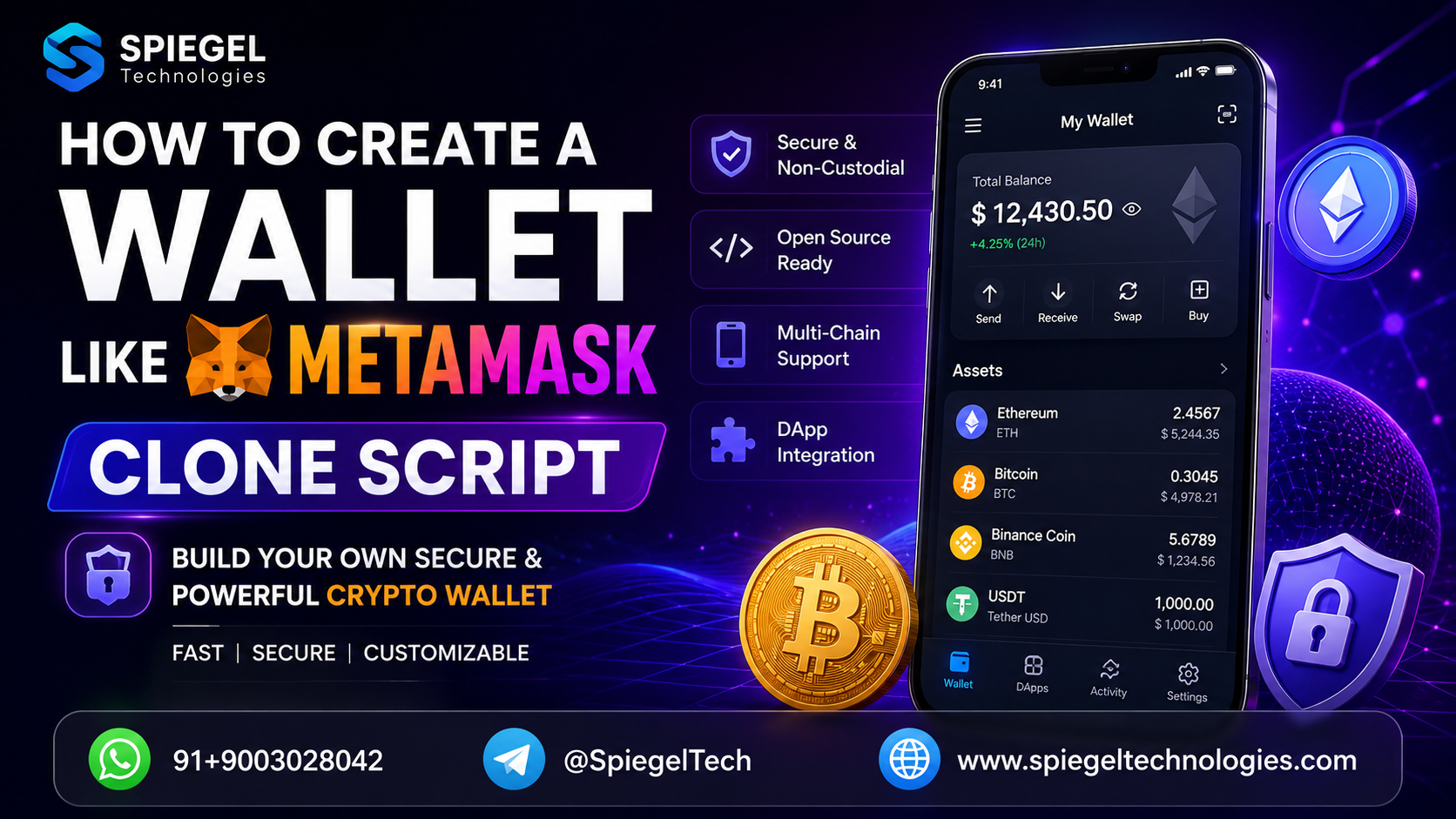
A MetaMask clone script is a pre-built, fully functional cryptocurrency wallet software that replicates the core architecture and features of the original MetaMask wallet. Rather than engineering a Web3 wallet from the ground up — a process that typically involves months of smart contract development, security auditing, UI/UX design, and blockchain integration work — a MetaMask clone script gives you a production-ready foundation that you customize, brand, and launch as your own product.
Think of it as the difference between building a house brick by brick versus starting with a structurally sound framework and customizing the interior to your exact specifications. The MetaMask wallet clone script handles the complex foundational engineering. You focus on differentiation, branding, and user acquisition.
A high-quality white label MetaMask clone includes everything users expect from a professional Web3 wallet: multi-chain support, DApp browser integration, secure key management, real-time market data, and seamless transaction management — all ready to go live under your brand name from day one.
Why Building a MetaMask Clone Makes Business Sense in 2026
The timing for entering the Web3 wallet market has rarely been better. DeFi total value locked continues to grow, NFT ecosystems are expanding into gaming and real-world assets, and institutional adoption of digital assets is driving mainstream demand for secure, professional-grade wallet infrastructure.
Here is why entrepreneurs and enterprises are increasingly choosing to build a MetaMask clone rather than either building from scratch or relying on third-party wallet services:
Speed to Market: A MetaMask clone script dramatically compresses your development timeline. What would take an in-house team 12 to 18 months to engineer from scratch can be customized and deployed in weeks — a critical advantage in a market where momentum matters.
Cost Efficiency: Custom Web3 wallet development at a professional standard is expensive. A crypto wallet clone script eliminates the bulk of that engineering cost, allowing you to redirect your budget toward product differentiation, marketing, and user growth.
Proven Technical Architecture: The MetaMask wallet architecture has been stress-tested by tens of millions of users across billions of transactions. A MetaMask wallet clone script built on that proven foundation carries significantly less technical risk than a custom build starting from zero.
Complete Brand Ownership: Unlike integrating a third-party wallet SDK into your product, a white label MetaMask clone gives you complete ownership of the user experience, the data, and the brand relationship. Your users interact with your wallet — not someone else's.
Customization Freedom: A quality MetaMask clone script is a starting point, not a constraint. You can add features, remove unnecessary complexity, support additional blockchain networks, and build entirely new capabilities on top of the foundation it provides.
Supported Cryptocurrencies in a MetaMask Wallet Clone Script
One of the most important features of any MetaMask wallet clone script is the breadth of its multi-currency support. A professional web3 wallet clone script supports all major cryptocurrencies and token standards out of the box, including:
Ethereum (ETH) — The foundational asset of the smart contract ecosystem and the native currency of MetaMask's home network. Full ETH support with gas management and transaction history is a baseline requirement.
Binance Coin (BNB) — Native currency of BNB Chain, one of the most active DeFi ecosystems globally. BNB support opens your wallet to the full Binance Smart Chain DApp ecosystem.
TRON (TRX) — High-throughput blockchain with an active DeFi and gaming ecosystem. TRX support expands your wallet's utility into TRON's growing user community.
Cosmos (ATOM) — The interoperability-focused blockchain enabling cross-chain communication. ATOM support positions your MetaMask clone app within the growing Cosmos ecosystem.
Tezos (XTZ) — Self-amending blockchain with active NFT and DeFi communities. XTZ support adds access to Tezos' unique on-chain governance ecosystem.
Bitcoin Cash (BCH) — Fast, low-cost peer-to-peer transactions. BCH support attracts users who prioritize everyday payment functionality alongside DeFi access.
Dogecoin (DOGE) — One of the most recognizable cryptocurrencies globally with a highly engaged retail community.
Stellar (XLM) — Fast, low-cost cross-border payment network with strong institutional adoption for remittance use cases.
VeChain (VET) — Enterprise-focused blockchain with strong supply chain and B2B use cases.
ERC-20 Tokens — Full support for the entire ERC-20 token standard means your MetaMask clone script automatically supports thousands of tokens across the DeFi and NFT ecosystems without additional integration work.
A well-built crypto wallet clone script also makes it straightforward to add support for additional networks and token standards as your user base grows and the Web3 landscape evolves.
Core Features of a Professional MetaMask Clone App
When you create a MetaMask clone, the feature set you ship with determines how competitive your wallet is from day one. Here are the essential features every MetaMask clone app needs to deliver:
Multi-Currency and Multi-Chain Support
Users expect to manage assets across multiple blockchain networks from a single wallet interface. Your web3 wallet clone script should support seamless network switching, accurate cross-chain balance display, and native asset management for every supported blockchain.
Secure Private Key Management
Private key security is the most fundamental responsibility of any cryptocurrency wallet. Your MetaMask wallet clone script must implement industry-standard encryption for key storage, secure seed phrase generation and backup workflows, and ensure that private keys never leave the user's device — not even to your servers.
Seamless Transaction Management
Send, receive, and track transactions across all supported networks with real-time confirmation status, gas fee estimation and customization, and complete transaction history. This is the core daily-use functionality that determines how much users trust and rely on your MetaMask clone.
DApp Browser and Web3 Integration
MetaMask's defining feature is its ability to connect users to decentralized applications directly from the wallet interface. Your MetaMask clone app must include a built-in DApp browser with Web3 injection, enabling users to interact with DeFi protocols, NFT marketplaces, gaming platforms, and governance systems without leaving the wallet environment.
Hardware Wallet Integration
For high-value users and institutional participants, hardware wallet support — Ledger and Trezor compatibility at minimum — is a trust signal that distinguishes serious MetaMask clone development from lightweight solutions. Implement hardware wallet integration as a standard feature, not an optional add-on.
Multi-Factor Authentication
Layer your security model with multiple authentication options: biometric authentication for mobile (Face ID, fingerprint), hardware security key support, and time-based one-time password (TOTP) integration. A white label MetaMask clone with robust MFA gives users meaningful control over their account security posture.
Real-Time Market Data and Portfolio Tracking
Users want to see the value of their holdings in real time. Integrate live price feeds, portfolio value tracking in multiple fiat currencies, price charts with configurable timeframes, and token price alerts. This transforms your MetaMask clone script from a transaction tool into a genuine portfolio management product.
NFT Gallery and Management
In 2026, NFT support is not optional. Your MetaMask clone app should automatically detect and display NFTs held in connected wallets, with metadata rendering, collection organization, and direct transfer capabilities.
Token Swap Integration
Native token swapping — powered by DEX aggregators — allows users to exchange assets directly within the wallet without navigating to an external platform. This feature dramatically increases daily active usage and positions your web3 wallet clone script as a comprehensive DeFi entry point.
Cross-Platform Compatibility
Your MetaMask clone should be accessible everywhere users need it: Chrome extension for desktop browsers, native iOS app, native Android app, and a responsive web interface. Consistent experience across all platforms is a baseline expectation for competitive wallets in 2026.
How to Create a MetaMask Clone: Step-by-Step Development Process
Understanding the development process helps you make informed decisions when partnering with a MetaMask clone development company. Here is how a professional MetaMask clone build unfolds:
Step 1: Define Requirements and Scope
Before any development begins, document your specific requirements in detail. Which blockchain networks must be supported at launch? What is your target user segment — retail crypto users, DeFi power users, institutional participants? What custom features differentiate your wallet from existing alternatives? Clear requirements prevent scope creep and keep development timelines on track.
Step 2: Choose Your Technology Stack
The technology choices underlying your MetaMask clone script determine its long-term performance, security, and extensibility. Ethereum-compatible networks using the EVM (Ethereum Virtual Machine) standard are the most widely supported, but your stack should also accommodate non-EVM networks if your target user base requires it. Discuss technology stack selection carefully with your MetaMask wallet development company before committing.
Step 3: Smart Contract Development
Smart contracts govern the on-chain behavior of your wallet — asset storage, transaction authorization, multi-signature schemes, and DApp interaction protocols. Professional smart contract development for a MetaMask clone requires experienced Solidity developers who understand both the functionality requirements and the security implications of every design decision.
Step 4: UI/UX Design
The user interface is where your white label MetaMask clone establishes its brand identity and differentiates from the competition. Design for simplicity first — the majority of your users will not be blockchain engineers — while preserving access to advanced features for power users. Invest in professional UI/UX design; it is one of the highest-ROI elements of your MetaMask clone app.
Step 5: Security Implementation
Security must be designed into your MetaMask clone script at every layer, not added as a final step. Implement end-to-end encryption, secure key derivation functions, certificate pinning for mobile apps, runtime application self-protection, and comprehensive audit logging. Your MetaMask wallet development company should treat security implementation as a first-class development concern throughout the entire project.
Step 6: Blockchain Network Integration
Connect your web3 wallet clone script to every supported blockchain network through reliable node infrastructure. Implement WebSocket connections for real-time balance and transaction updates, and build network-switching functionality that is seamless and error-tolerant from the user's perspective.
Step 7: Security Auditing
Independent security audits are non-negotiable for any serious MetaMask clone development project. Engage reputable third-party auditors to review smart contract code, application security, key management implementation, and API security. Resolve every finding before launch — the cost of a post-launch exploit vastly exceeds the cost of a pre-launch audit.
Step 8: Testing and Quality Assurance
Comprehensive testing covers functional testing of every user flow, performance testing under simulated load, security penetration testing, and compatibility testing across target devices and browsers. Do not abbreviate this phase — it is what stands between you and a painful post-launch incident.
Step 9: Deployment and Launch
Deploy your MetaMask clone app to production infrastructure with redundancy, monitoring, and incident response procedures in place. A staged rollout — beginning with a limited beta user group before full public launch — gives you valuable real-world feedback and a controlled environment to resolve edge cases before full exposure.
Step 10: Post-Launch Maintenance and Evolution
Your MetaMask clone script requires ongoing maintenance: security patches, network upgrades, feature additions, and performance optimization. Build a post-launch support plan before you launch, not after. The MetaMask wallet development company you choose should offer clear post-launch support terms as part of your engagement.
How to Choose the Right MetaMask Clone Development Company
The quality of your MetaMask clone development company relationship determines the quality of your final product. Evaluate every candidate on these criteria:
Blockchain Engineering Depth — Your MetaMask wallet development company should have demonstrable expertise in smart contract development, Web3 wallet architecture, and multi-chain integration — not just general software development capability.
Security-First Culture — Ask specifically about their security development practices, audit partnerships, and how they have handled security incidents on previous projects. Any reputable MetaMask clone development company treats security as a design principle, not a checklist item.
Portfolio of Live Products — Request references and live product examples. A credible metamask wallet development company can point to deployed wallets that real users are using in production today.
Customization Capability — Your white label MetaMask clone needs to reflect your brand and serve your specific user segment. Ensure the development company offers genuine customization depth, not just surface-level UI changes.
Transparent Pricing and Timelines — Reliable MetaMask clone development companies provide detailed project scopes, realistic timelines, and transparent pricing structures. Be cautious of providers who quote unusually low prices or unrealistically short timelines.
Post-Launch Support Commitment — The relationship should not end at deployment. Ensure your MetaMask wallet development company offers ongoing maintenance, security updates, and technical support under clear contractual terms.
White Label MetaMask Clone: The Fastest Path to Market
For businesses that need to move quickly, a white label MetaMask clone offers the fastest path from concept to live product. White label solutions provide a fully functional, pre-audited crypto wallet clone script that you brand, configure, and deploy under your own identity — typically in weeks rather than months.
The white label MetaMask clone approach is particularly compelling for crypto exchanges looking to add wallet functionality, DeFi protocols building integrated user experiences, gaming platforms launching in-game asset management, and fintech companies expanding into digital asset services.
The key to maximizing a white label MetaMask clone investment is choosing a provider who offers genuine technical depth beneath the surface — not just a branded wrapper around a shallow feature set. Your users will discover the difference quickly, and in the Web3 world, user trust is extraordinarily difficult to rebuild once lost.
Frequently Asked Questions (FAQ)
Q1: What exactly is a MetaMask clone script and how does it differ from the original MetaMask?
A MetaMask clone script is pre-built wallet software that replicates MetaMask's core architecture and features while giving you complete ownership and customization rights. Unlike the original MetaMask, which is a third-party product you integrate with, a MetaMask clone runs under your brand, on your infrastructure, with your design — giving you full control over the user relationship and data.
Q2: How long does it take to build a MetaMask clone app?
Timeline depends on the scope of customization and the number of blockchain networks supported at launch. A white label MetaMask clone leveraging a proven MetaMask clone script foundation can typically be deployed within 4 to 8 weeks. A fully custom MetaMask clone development project with extensive bespoke features may take 3 to 6 months.
Q3: Which blockchain networks can my MetaMask clone script support?
A well-architected web3 wallet clone script can support any EVM-compatible blockchain — Ethereum, BNB Chain, Polygon, Arbitrum, Avalanche, and others — as well as non-EVM chains like Solana, TRON, and Cosmos with appropriate integration work. Your MetaMask wallet development company should be able to accommodate any network your target users require.
Q4: How much does it cost to create a MetaMask clone?
Cost varies based on feature complexity, the number of supported chains, custom development requirements, and the reputation and location of your MetaMask clone development company. A white label MetaMask clone script engagement is significantly more cost-efficient than a ground-up custom build. Request detailed scoping and transparent pricing from multiple providers before committing.
Q5: Is a MetaMask clone script secure enough for production use?
A professionally built MetaMask clone script from a reputable MetaMask wallet development company — with independent security audits completed before launch — can meet and exceed the security standards of custom-built wallets. The key requirements are independent auditing, proven key management architecture, and a development partner with a documented security-first development culture.
Q6: Can I migrate existing users from another wallet to my MetaMask clone?
Yes. Users can import existing wallets into your MetaMask clone app using their seed phrases or private keys, following the same process as importing into the original MetaMask. For platform-level migrations involving large user bases, consult with your MetaMask clone development company about migration tooling and communication strategies.
Q7: Can I launch my MetaMask clone script as a white label solution?
Absolutely. A white label MetaMask clone is one of the most common deployment models. It allows you to fully customize branding, design, feature set, and supported networks while launching under your own brand name — with no visible reference to the underlying technology partner.
Q8: What ongoing maintenance does a MetaMask clone require?
Ongoing maintenance for a MetaMask wallet clone script includes security patches as new vulnerabilities are discovered, updates for blockchain network protocol changes and hard forks, feature additions as your user base grows and demands evolve, performance optimization as usage scales, and customer support infrastructure. Ensure your MetaMask clone development company offers a structured post-launch support agreement before signing any contract.
Q9: Can I add features to my MetaMask clone that the original MetaMask doesn't have? Yes — and this is one of the most compelling arguments for building your own MetaMask clone rather than relying on the original. You can add custom features including native token swapping, integrated staking, DeFi yield dashboards, in-wallet fiat on-ramps, NFT minting tools, social recovery mechanisms, and any other capabilities your specific user segment values.
Q10: Do I need blockchain expertise to manage my MetaMask clone after launch? Not necessarily. A reputable MetaMask wallet development company provides admin tooling and documentation that allows non-technical teams to manage day-to-day platform operations. For deeper technical changes — network additions, smart contract upgrades, security incident response — you will benefit from either retaining your development partner on a support contract or building in-house blockchain expertise over time.
Conclusion: Build Your Web3 Wallet Future With a MetaMask Clone
The Web3 wallet market is growing rapidly, and the opportunity to capture a meaningful share of it has never been more accessible. A MetaMask clone script gives entrepreneurs and enterprises a proven, secure, and fully customizable foundation to build a competitive Web3 wallet — without the cost, risk, and timeline of starting from scratch.
The next generation of Web3 users is arriving. Your MetaMask clone app can be the wallet that welcomes them.