
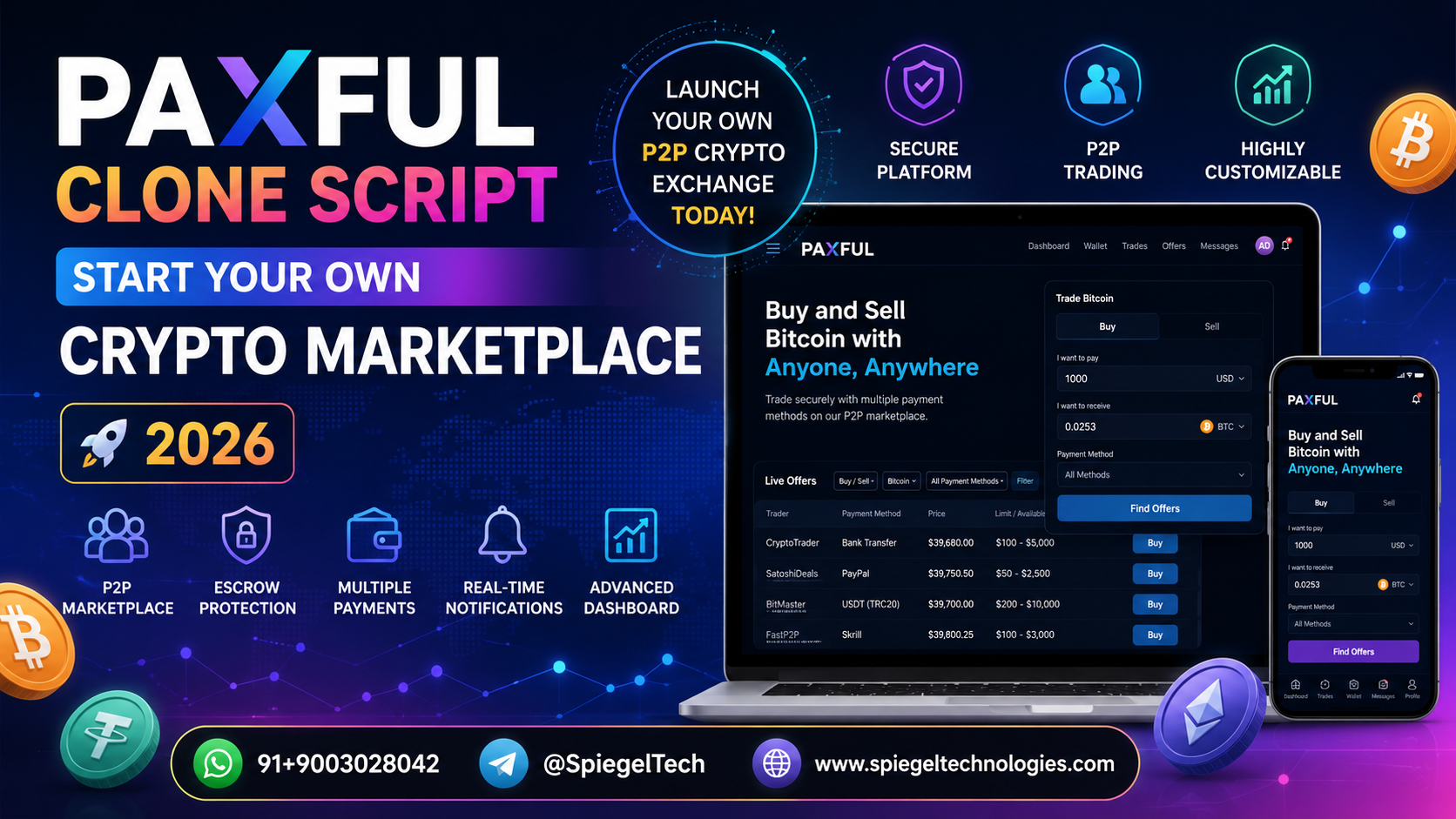
Paxful Clone Script: The Complete Guide to Building a P2P Crypto Exchange in 2026
The numbers make a compelling case on their own. The global cryptocurrency exchange platform market was valued at USD 45.89 billion in 2023 and is projected to reach USD 264.32 billion by 2030, growing at a 28.4% CAGR. Behind that growth is a clear and accelerating shift: startups, fintech firms, and enterprises are treating crypto trading platforms as serious, long-term revenue channels — not speculative experiments.
Within that broader market, P2P crypto exchanges have carved out a distinct and defensible position. They let buyers and sellers trade directly, with the platform handling escrow, payments, identity verification, and dispute resolution. Paxful proved this model could work at scale — serving millions of users across regions with vastly different payment habits, banking access, and regulatory environments.
That proof of concept created an immediate opportunity for businesses that want to replicate the model under their own brand. A Paxful clone script gives them exactly that — a faster, more cost-efficient route to market with the core infrastructure already built and tested. This guide covers everything you need to know about the Paxful exchange clone opportunity: how it works, what it costs, what features matter, and how to build one that competes.
Why the P2P Crypto Exchange Market Demands Attention Right Now
Before evaluating a Paxful clone investment, understanding the market dynamics driving demand is essential.
Crypto adoption is not slowing down — it is accelerating in exactly the markets where P2P trading is most valuable. Chainalysis ranked India first in its 2025 Global Crypto Adoption Index, followed by the United States, Pakistan, Vietnam, and Brazil. APAC crypto trading activity grew from approximately $81 billion in July 2022 to $244 billion by December 2024 — a threefold increase driven primarily by retail users seeking flexible, locally accessible trading options.
Security context matters equally. Reuters reported that crypto hacks caused USD 2.2 billion in losses in 2024. Chainalysis documented over $3.4 billion in crypto theft during 2025 alone, with the Bybit attack accounting for $1.5 billion. An additional $17 billion was lost to crypto scams and fraud in 2025. These figures underscore why platform security is not a secondary consideration in Paxful clone script development — it is the primary factor that determines whether users trust your platform with their funds.
The combination of surging retail demand, fragmented payment infrastructure across emerging markets, and persistent security failures at underprepared platforms creates a clear entry point for well-built Paxful exchange clone products that prioritize both usability and security from the ground up.
What Is a Paxful Clone Script?
A Paxful clone script is ready-made P2P crypto exchange software engineered to replicate the core architecture and functionality of the Paxful platform. Rather than building every module from scratch — trading engine, wallet system, escrow mechanism, admin dashboard, KYC workflows, dispute management — a Paxful clone provides a production-ready foundation that businesses customize, brand, and deploy as their own product.
The operating model is straightforward. Users create accounts and complete identity verification. They post buy or sell offers specifying the cryptocurrency, price, payment method, trade limits, and terms. The platform matches buyers and sellers. When a trade begins, the escrow system locks the seller's crypto until the buyer confirms payment. Upon payment confirmation, funds are released automatically. Ratings and reviews build trader reputation over time, creating a self-regulating trust economy.
Paxful Clone vs. Custom Development: The Key Differences
| Factor | Paxful Clone Script | Custom Development |
|---|---|---|
| Time to Market | Weeks to months | 12–18+ months |
| Development Cost | Significantly lower | High (larger team, longer cycle) |
| Technical Risk | Lower (tested modules) | Higher (unknown issues until testing) |
| Customization | Brand, features, payments, compliance | Unlimited but costly |
| Security Foundation | Pre-audited core components | Requires full security build |
| Best For | Startups, fintech brands, payment firms | Enterprises with unique technical requirements |
The commercial logic is clear. A Paxful clone script cuts launch time, reduces build cost, and gives businesses a proven operating model. It is the right starting point for crypto startups, fintech companies, payment service providers, and enterprises that want to enter P2P crypto trading with controlled budgets and faster market access.
How a Paxful Exchange Clone Works: The Complete P2P Escrow Flow
Understanding the escrow flow is essential for evaluating any Paxful clone product — it is the mechanism that makes P2P trading trustworthy between strangers, and the component that most directly determines platform security and user experience.
Step-by-Step P2P Escrow Flow Diagram Description
Stage 1 — User Registration and KYC Verification New users register and complete identity verification. KYC checks confirm identity, limit fraudulent account creation, and enable the platform to meet AML obligations. FATF standards require virtual asset service providers to implement risk-based checks, registration, transaction monitoring, and AML controls.
Stage 2 — Offer Creation Verified users post buy or sell offers specifying the cryptocurrency (Bitcoin, USDT, Ethereum), their price (often at a premium or discount to market), accepted payment methods, trade size limits, and any specific trade terms.
Stage 3 — Buyer-Seller Matching The platform displays available offers filtered by payment method, trade size, currency, and trader rating. Buyers browse offers and initiate trades with sellers whose terms match their needs.
Stage 4 — Crypto Locked in Escrow (Critical Security Stage) The moment a buyer initiates a trade, the Paxful clone script automatically locks the seller's crypto in an escrow smart contract. This is the pivotal security mechanism: the seller cannot withdraw or cancel the crypto mid-trade, and the buyer cannot claim funds without completing payment. Both parties are protected.
Stage 5 — Payment Execution and Proof Submission The buyer completes payment through the agreed method — bank transfer, mobile money, UPI, gift card, or any of hundreds of other supported options — and submits payment proof within the chat system.
Stage 6 — Payment Verification and Crypto Release The seller verifies payment receipt. Upon confirmation, the escrow releases crypto to the buyer's wallet automatically. If either party disputes the transaction, the platform admin team intervenes with evidence review.
Stage 7 — Ratings and Reputation Update Both parties rate the trade. Completed trades and positive ratings build trader reputation scores visible to future counterparties, creating natural incentives for honest behavior and discouraging fraud.
This escrow-based workflow is why Paxful exchange clone platforms build user trust faster than unescrow'd alternatives, particularly in markets where users have limited recourse through traditional financial systems.
Core Features of a Professional Paxful Clone Script
A competitive white label Paxful clone in 2026 needs to deliver for three distinct groups: the users who trade on the platform, the admin team that operates it, and the security infrastructure that protects everyone involved.
User-Facing Features
Multi-Currency Wallet System — Support for Bitcoin, Ethereum, USDT, and additional assets with integrated hot and cold storage management, real-time balance updates, and secure deposit and withdrawal flows.
Buy and Sell Offer Management — Intuitive offer creation with flexible parameters: coin, price, payment method, trade limits, geographic restrictions, and custom trade terms. Users should be able to create and edit offers in under two minutes.
Real-Time Trade Chat — In-platform encrypted messaging between buyer and seller during active trades, with file sharing for payment proof, automated status notifications, and trade timer visibility.
Multiple Payment Method Support — A professional Paxful clone script supports hundreds of payment options simultaneously: bank transfers, mobile money (M-Pesa, GCash, bKash), UPI, PayPal, Wise, gift cards (Amazon, iTunes, Google Play), and local payment rails specific to target markets. Payment flexibility is the primary competitive differentiator in regional P2P markets.
Trader Rating and Review System — Post-trade feedback with completion rate tracking, dispute history, and verified trade counts — the trust infrastructure that makes repeat trading behavior sustainable.
Trade Alerts and Notifications — Real-time push notifications, email alerts, and in-platform messages for offer matches, trade initiations, payment confirmations, and dispute updates.
Mobile App Access — Native iOS and Android applications delivering full platform functionality on mobile, where the majority of P2P crypto trading in emerging markets originates.
Admin-Facing Features
Comprehensive Admin Dashboard — Unified control center with real-time visibility into trade volume, user activity, revenue metrics, dispute queue, KYC status, and platform health indicators.
User Management and Verification Controls — Tools to review KYC submissions, approve or restrict accounts, monitor trader behavior patterns, flag suspicious activity, and manage account tiers with different trading limits.
Fee Configuration System — Granular control over transaction fees, escrow fees, withdrawal charges, premium listing costs, and subscription tier pricing. Revenue model flexibility without requiring code changes.
Dispute Resolution Workflow — Structured dispute management with evidence review tools, trade history access, chat log visibility, and resolution documentation for compliance records.
Revenue Tracking and Analytics — Real-time revenue dashboards segmented by fee type, payment method, geography, and coin — giving operators the data needed to optimize fee structures and identify growth opportunities.
Compliance and Reporting Tools — Transaction logs, AML screening results, sanctions check records, suspicious activity report generation, and GDPR data management tools for platforms serving EU users.
Security Features
Multi-Signature Wallet Architecture — Requiring multiple authorization signatures for significant fund movements eliminates single points of failure in the wallet infrastructure.
Two-Factor Authentication — Mandatory 2FA for login, trade initiation, and withdrawal requests using authenticator apps or hardware security keys.
Escrow Lock Mechanism — Cryptographically enforced escrow that prevents seller fund withdrawal during active trades, protecting buyers from non-delivery fraud.
KYC and AML Screening — Automated identity verification with document scanning, liveness detection, sanctions screening against global watchlists, and real-time transaction monitoring for suspicious patterns.
DDoS Protection and Rate Limiting — Enterprise-grade infrastructure protection keeping the platform accessible during targeted attack attempts.
Cold Wallet Storage — The majority of platform-held funds maintained in offline cold storage, minimizing exposure to online theft attempts.
Anti-Phishing Controls — Personalized anti-phishing codes in platform communications help users identify authentic platform emails from spoofed attempts.
AI Fraud Detection — Machine learning models analyzing trade patterns, account behavior, and transaction velocity to flag suspicious activity before it results in user losses.
White Label Paxful Clone: Brand Ownership With Proven Infrastructure
A white label Paxful clone takes the clone script model one step further — delivering a fully branded, customized exchange product under your company's identity, with no visible reference to the underlying technology provider.
For businesses investing in long-term brand building, the white label Paxful clone approach is particularly compelling. Your users interact with your brand at every touchpoint. Your platform builds the user trust and recognition that drives retention and referrals. The underlying technology is yours — to customize, extend, and evolve as your market understanding deepens.
The white label Paxful clone model is the preferred approach for:
Fintech Companies adding crypto trading to existing wallet or payment products, where brand consistency across the user experience is essential for retention.
Payment Service Providers building crypto settlement infrastructure for remittances and merchant transfers under their established brand identity.
Regional Market Specialists building P2P exchanges tailored to specific payment ecosystems — UPI in India, M-Pesa in East Africa, GCash in the Philippines — where local brand recognition matters as much as the platform features.
Enterprise Operators launching crypto trading as a new business line within an existing regulated entity, where regulatory relationships depend on operating under the company's licensed identity.
Technology Stack Behind a Production-Ready Paxful Clone
Frontend Technologies
React.js and Angular are the leading frameworks for Paxful clone script frontend development in 2026. Both deliver fast page loads through component-based architecture, responsive mobile layouts without separate mobile codebases, and the clean, real-time interface that active P2P traders demand. The interface must make offer browsing, trade initiation, payment proof upload, escrow status visibility, and chat interaction intuitive for first-time crypto users — not just experienced traders.
Backend Frameworks
Node.js excels for high-concurrency trade processing and real-time WebSocket connections for chat and notifications. Python suits complex data processing, fraud detection models, and analytics pipelines. PHP remains viable for content management and admin interfaces. The backend must handle escrow state machines, wallet balance management, KYC status tracking, dispute records, and fee calculations with absolute accuracy — errors in financial calculations are not recoverable.
Blockchain Integration
Production-ready Paxful exchange clone infrastructure requires native wallet support for Bitcoin, Ethereum, and USDT (both ERC-20 and TRC-20 variants) at minimum. Smart contracts can enforce escrow rules for EVM-compatible assets, reducing manual admin intervention and adding transparent on-chain transaction records. Blockchain node infrastructure — either self-hosted or through enterprise providers like Infura or QuickNode — must maintain high availability since wallet operations cannot queue behind node downtime.
Security Infrastructure
SSL/TLS encryption for all user sessions is baseline. DDoS protection through Cloudflare or equivalent enterprise providers keeps the platform reachable during attack periods. Cold wallet storage for the majority of held funds with multi-signature authorization for cold-to-hot transfers. Hardware Security Modules (HSMs) for private key management in high-volume deployments. Regular third-party penetration testing and smart contract auditing as ongoing operational practices.
Step-by-Step Process to Launch a Paxful Clone Exchange
Step 1: Define Business Requirements
Begin with the decisions that shape every subsequent technical and commercial choice. Which geographic markets will you serve at launch? Which cryptocurrencies will be supported? What payment methods matter most for your target users — bank transfers, mobile money, gift cards, UPI? What is your fee model — seller-side only, both parties, or tiered by volume? What are your user verification requirements and how do they align with regulations in your operating jurisdictions?
These decisions define your Paxful clone script customization roadmap and should be documented in detail before any development begins.
Step 2: Select a Paxful Clone Script Provider
Your technology partner choice determines the quality of your foundation. Evaluate providers on demonstrated exchange delivery experience (not just portfolio claims), code quality and source code ownership terms, wallet security architecture, admin control depth, post-launch technical support commitments, and the ability to add custom features without breaking existing modules.
A cheaper Paxful clone script that requires expensive fixes for security gaps, poor performance, or limited customization will cost significantly more in total than a well-built solution selected with proper due diligence.
Step 3: Customize for Your Market
Brand-level customization covers more than logo and color scheme. Localize the interface language, payment method display, fiat currency support, and regulatory disclosure text for each target market. Build the payment method integrations specific to your geographic focus. Design the onboarding flow to match the technical familiarity level of your target users — a platform serving East African mobile money users needs a different UX approach than one targeting European bank transfer traders.
Step 4: Integrate Payments, Wallets, and Escrow
Payment integration is the highest-complexity component of Paxful clone development outside of security. Each payment method — bank transfer, UPI, mobile money, gift card — has its own verification requirements, confirmation timelines, and fraud risk profile. Wallet integration requires careful attention to deposit address management, withdrawal confirmation flows, and network fee handling. Escrow smart contracts must be audited independently before deployment.
Step 5: Security Audit and Compliance Setup
Before any user funds touch your platform, complete an independent security audit of all smart contracts, API endpoints, wallet management systems, and admin controls. Set up KYC and AML workflows compliant with regulations in every jurisdiction you plan to serve. Configure GDPR-compliant data handling for any EU users. Establish your dispute resolution procedures with documented response time commitments.
Step 6: Staged Testing and Launch
Test every user flow under realistic conditions: trade initiation through escrow release, disputed trade resolution, wallet deposit and withdrawal across all supported assets, KYC submission and review, admin actions, and fee calculation accuracy. Launch initially to a limited user group — a beta cohort of invited traders — before opening to the public. Monitor closely for edge cases that testing environments don't replicate.
Step 7: Post-Launch Growth Operations
The work intensifies after launch. Monitor platform performance metrics, fraud patterns, dispute rates, and user retention. Add payment methods and supported coins based on user demand signals. Implement liquidity strategies to ensure offer availability for new users. Optimize fee structures based on competitive analysis and volume data. Build the community trust that transforms early adopters into long-term platform advocates.
Monetization: How a Paxful Clone Exchange Generates Revenue
A well-designed Paxful clone script creates multiple simultaneous revenue streams, which is one of the most compelling financial arguments for launching a P2P exchange.
Revenue Stream Cost Table
| Revenue Stream | Model | Typical Range | Notes |
|---|---|---|---|
| Transaction Fees | Per-trade percentage | 0.5% – 2% per trade | Primary revenue driver; often charged to sellers only |
| Escrow Fees | Per-trade flat or percentage | $0.50 – $2.00 per trade | Additional to or inclusive of transaction fees |
| Premium Listings | Flat or subscription | $50 – $500/month | Featured offer placement and search priority |
| Subscription Plans | Monthly/annual tiers | $29 – $299/month | Lower fees, higher limits, priority support |
| Withdrawal Fees | Per-withdrawal flat | $1 – $5 per withdrawal | Network cost plus platform margin |
| Affiliate/Referral | Revenue share | 20% – 50% of referred fees | Reduces acquisition cost; scales organically |
| Spread Margins | Per instant trade | 0.5% – 3% spread | On instant buy/sell features |
| Ad Placements | CPM or flat rate | Variable | Sponsored coin or payment method promotion |
Transaction fees form the revenue foundation. Most Paxful exchange clone platforms charge sellers a fee on completed trades and allow buyers to trade without a direct platform charge. This buyer-friendly structure accelerates user acquisition in competitive markets while sellers incorporate the fee into their offer pricing.
Subscription models serve power traders and OTC desks willing to pay monthly fees for lower per-trade costs, higher withdrawal limits, and priority dispute support. This creates predictable recurring revenue alongside the variable transaction fee income.
Referral programs reduce customer acquisition costs in markets with strong grassroots crypto activity. Chainalysis ranked India, the United States, Pakistan, Vietnam, and Brazil as the top five crypto adoption markets in 2025 — regions where community-driven referral growth consistently outperforms paid advertising.
Use Cases: Who Benefits From a White Label Paxful Clone?
Crypto Startups
Startups can use a Paxful clone to launch niche exchanges targeting specific regional markets, payment ecosystems, or asset types — gift card trading, stablecoin-to-local-currency exchange, or agricultural commodity token trading. A focused niche platform serving one market exceptionally well consistently outperforms broad platforms with shallow local relevance.
Fintech Companies
Fintech brands can integrate a white label Paxful clone into existing wallet or payment applications, adding crypto trading as a complementary revenue stream while retaining users who currently leave the platform to trade elsewhere.
Payment Service Providers
Payment firms can use a Paxful exchange clone to enable crypto settlement for remittance corridors and merchant transfers. Chainalysis research confirms that stablecoins are playing an increasingly important role in remittances, cross-border commerce, and inflation protection — particularly in emerging markets where local currency volatility is high.
Regional Market Specialists
Businesses with deep knowledge of specific local payment ecosystems — UPI in India, M-Pesa in Kenya, GCash in the Philippines, Pix in Brazil — can build white label Paxful clone products that out-compete global platforms through superior local payment integration and culturally appropriate user experience design.
Security and Compliance: Building a Platform Users Can Trust
Why Security Must Shape the Build From Day One
The security stakes in P2P crypto exchange development are unambiguous. Chainalysis documented over $3.4 billion in crypto theft during 2025. Combined with $17 billion in scam and fraud losses, the message for any Paxful clone script developer is clear: security cannot be a final-phase consideration. It must be designed into every layer of the system from the first architectural decision.
Essential Security Controls
Multi-signature wallet authorization for all significant fund movements. Cold wallet storage for the majority of platform-held assets. Two-factor authentication enforced across login, trading, and withdrawal actions. End-to-end encrypted trade chat. Escrow lock mechanisms that are cryptographically enforced rather than procedurally enforced. AI-driven fraud detection monitoring behavioral patterns across the user base in real time.
Compliance Framework Requirements
A production-ready white label Paxful clone must support KYC identity verification, AML transaction monitoring, sanctions screening against OFAC and other global watchlists, suspicious activity report generation, and risk scoring for high-value accounts. For platforms serving EU users, GDPR compliance requires explicit user consent frameworks, data minimization practices, and documented data subject rights procedures. FATF standards require virtual asset service providers to implement registration, risk-based due diligence, ongoing monitoring, and AML reporting — requirements that must be built into platform architecture rather than handled manually.
What Does a Paxful Clone Script Actually Cost?
Cost clarity is one of the primary reasons businesses choose a Paxful clone script over custom development. Here is a realistic breakdown:
| Component | Paxful Clone Script | Custom Development |
|---|---|---|
| Core Platform | $15,000 – $50,000 | $100,000 – $300,000+ |
| Customization and Branding | $5,000 – $25,000 | Included in custom cost |
| Security Audit | $10,000 – $40,000 | $15,000 – $60,000 |
| Payment Integrations | $3,000 – $15,000 per method | $5,000 – $20,000 per method |
| Mobile App Development | $15,000 – $40,000 | $30,000 – $80,000 |
| Compliance Setup | $5,000 – $20,000 | $10,000 – $40,000 |
| Deployment and Infrastructure | $2,000 – $10,000 | $5,000 – $20,000 |
| Post-Launch Support (annual) | $10,000 – $30,000 | $30,000 – $100,000+ |
| Total Estimated Range | $50,000 – $200,000 | $200,000 – $600,000+ |
The cost differential between a Paxful clone script and custom development is significant — and the gap widens further when you factor in the time cost of the additional 6 to 12 months typically required for custom builds. For most businesses entering the P2P crypto exchange market, the Paxful clone approach delivers faster time to revenue at substantially lower financial risk.
Conclusion: The P2P Crypto Exchange Opportunity Rewards Early Movers
The market case for launching a Paxful clone in 2026 has never been stronger. Crypto adoption is accelerating in exactly the regions — South Asia, Southeast Asia, Sub-Saharan Africa, Latin America — where P2P trading with flexible local payment options is most valuable. Regulatory frameworks are clarifying, reducing the uncertainty that previously deterred institutional participants. And the proven Paxful business model has already demonstrated that users across diverse markets will engage with P2P trading platforms that offer genuine payment flexibility and security.
A Paxful clone script gives businesses the fastest path to capturing that opportunity: a tested core infrastructure, faster time to market, lower development cost, and the flexibility to customize for any geographic market or payment ecosystem. A white label Paxful clone extends that advantage by delivering full brand ownership and user relationship control.
The businesses that move now — building with security-first architecture, genuine local payment depth, and clear compliance frameworks — will establish the user trust and trading volume that creates durable competitive moats before the market consolidates around dominant regional players.
FAQs – Paxful Clone Script
1. What is a Paxful Clone Script?
A Paxful Clone Script is a pre-built peer-to-peer crypto exchange software that replicates the core features of Paxful, allowing users to buy and sell cryptocurrencies using an escrow-based system.
2. How does a Paxful clone script work?
It works by matching buyers and sellers. When a trade starts, the seller’s crypto is locked in escrow until the buyer completes payment. Once confirmed, the crypto is released automatically.
3. Is a Paxful clone script legal?
Yes, it is legal to develop and use a Paxful clone script, but the platform must comply with local regulations such as KYC, AML, and financial licensing requirements depending on the jurisdiction.
4. How much does it cost to build a Paxful clone exchange?
The cost typically ranges from $50,000 to $200,000+ depending on features, customization, security requirements, and mobile app development.
5. What features should a Paxful clone script include?
Key features include escrow system, multi-currency wallet, user verification (KYC), trade chat, dispute resolution, admin dashboard, and multiple payment method support.
6. How long does it take to launch a Paxful clone platform?
With a ready-made script, it can take 2–6 weeks, while custom development may take 6–12 months or more.
7. What are the benefits of using a Paxful clone script?
It reduces development time, lowers costs, provides a tested architecture, and allows faster market entry with built-in security and trading features.
8. Can I customize a Paxful clone script?
Yes, most Paxful clone scripts are fully customizable, allowing you to modify branding, features, payment methods, UI/UX, and compliance settings.
9. Is escrow necessary in a P2P crypto exchange?
Yes, escrow is essential because it secures transactions by holding crypto until both buyer and seller confirm the trade, reducing fraud risk.
10. Who should use a Paxful clone script?
It is ideal for crypto startups, fintech companies, payment service providers, and entrepreneurs who want to launch a P2P crypto trading platform quickly.