RWA Tokenization Development Company
Asset ownership is undergoing its most significant structural transformation in decades. The traditional systems that govern how physical and financial assets are verified, transferred, and settled — paper documentation, centralized databases, multi-party intermediaries — are being systematically replaced by blockchain-based digital infrastructure that is faster, more transparent, and accessible to a genuinely global pool of investors.
Real world asset tokenization sits at the center of that transformation. By converting physical and financial assets into blockchain-based digital tokens, RWA tokenization development creates asset management systems where ownership records are immutable, transfers are automated, and assets that were previously accessible only to institutional or high-net-worth investors become available to participants worldwide.
The market numbers validate the momentum. On-chain RWAs have crossed $36 billion, representing extraordinary growth since 2020. The sector grew 260% in H1 2025 alone, reaching approximately $27.7 billion by 2026. Tokenized funds now hold approximately 44.5% of the market. BlackRock, JPMorgan, and Franklin Templeton have all launched tokenized products. And approximately 60% of asset managers in the US and Europe are actively planning RWA exposure.
Forecasts suggest a $2 trillion to $30 trillion market by 2030, with real estate tokenization alone projected to reach $4 trillion by 2035.
This guide covers everything businesses, investors, and development teams need to understand about RWA tokenization development — what it is, how it works, what services a professional RWA tokenization development company delivers, and how to evaluate platforms for your specific asset class and business objectives.
What Is RWA Tokenization Development?
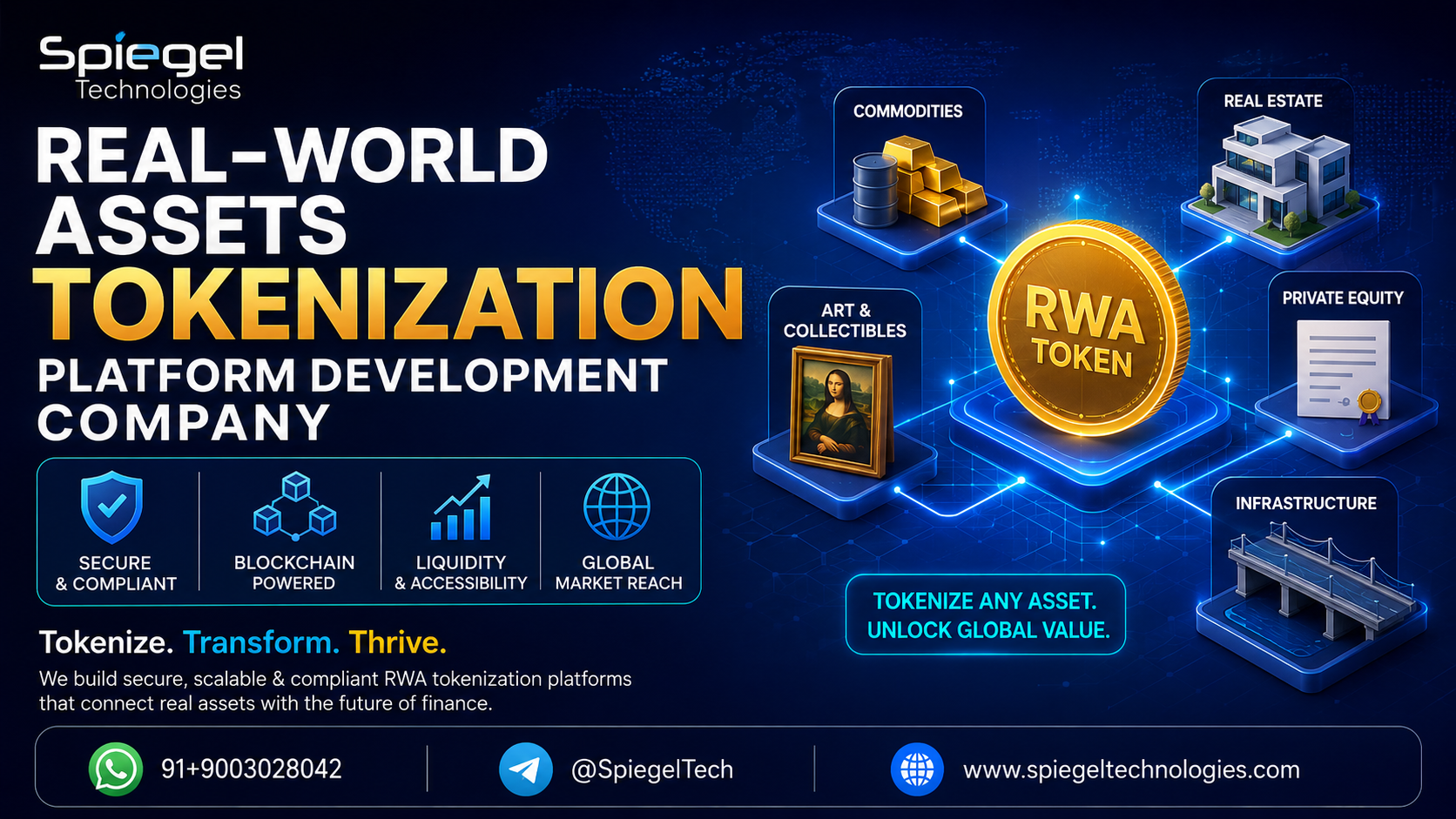
Real world asset tokenization is the process of converting physical and financial assets — real estate, commodities, art, bonds, equities, private equity, and more — into digital tokens that exist on a blockchain network. Each token represents ownership of the underlying asset or a fractional portion of it, with ownership rights, transfer conditions, and asset details recorded transparently and traceably on-chain.
RWA tokenization development refers specifically to building the blockchain-based systems and platforms that enable this conversion process. A professional RWA tokenization development company builds the complete infrastructure stack : smart contracts that govern asset rules, token standards appropriate for each asset class, compliance workflows for regulatory adherence, marketplace interfaces for trading, and ongoing management systems that keep tokenized asset records accurate and auditable.
The fundamental shift blockchain asset tokenization creates is straightforward but profound: instead of relying on paper certificates, centralized registries, or intermediary verification for asset ownership, every ownership record exists on an immutable, publicly verifiable blockchain ledger. Transfers that previously required days and multiple counterparties happen in minutes through automated smart contract execution.
Why Businesses Are Adopting Real World Asset Tokenization in 2026
The adoption curve for real world asset tokenization has moved decisively from early adopters to mainstream institutional participants. Understanding the drivers behind this shift explains why RWA platform development has become one of the most strategically important areas in blockchain infrastructure:
Fractional Ownership Unlocks Previously Inaccessible Markets
A fractional ownership platform built on blockchain technology allows high-value assets — a commercial real estate property, a portfolio of bonds, a collection of fine art — to be divided into thousands or millions of smaller ownership units. An investor who cannot afford a $10 million property can purchase $1,000 worth of tokenized ownership in it. This democratization of access fundamentally expands the market for assets that were previously only available to institutional or ultra-high-net-worth participants.
Liquidity Transformation for Illiquid Asset Classes
Traditional real estate, private equity, and commodity investments are notoriously illiquid. Selling a position requires finding a buyer, negotiating terms, and completing lengthy legal and financial processes. Digital asset tokenization transforms this dynamic by enabling 24/7 trading of ownership positions on tokenized assets platforms — dramatically improving liquidity for asset classes that have historically been capital traps.
Operational Efficiency Through Smart Contract Automation
Every step in traditional asset transfer — verification, legal documentation, settlement, record updating — requires human intervention, time, and cost. Asset tokenization development replaces these manual processes with smart contracts that execute automatically when predefined conditions are met. Dividend distributions, ownership transfers, compliance checks, and settlement all happen programmatically, reducing both cost and settlement time.
Institutional Validation Creating Market Confidence
BlackRock's tokenized money market fund, JPMorgan's blockchain-based collateral settlement system, and Franklin Templeton's tokenized US government fund have collectively shifted the institutional perception of RWA tokenization development from experimental to essential. When the world's largest asset managers are actively deploying tokenized products, the technology's legitimacy is no longer a question.
Global Investor Access Without Geographic Barriers
A blockchain asset tokenization platform accessible via the internet removes the geographic constraints that traditionally limited participation in local real estate, regional private equity, or country-specific commodity markets. A retail investor in Southeast Asia can hold fractional ownership in European commercial real estate. A pension fund in Australia can access US private credit markets. Geographic democratization of asset access is one of the most powerful structural advantages RWA tokenization platforms provide.
Our Complete RWA Tokenization Development Services
A professional RWA tokenization development company delivers end-to-end services across the complete lifecycle of asset tokenization — from initial assessment through ongoing platform management. Here is what comprehensive RWA tokenization development services encompass:
Asset Assessment and Onboarding
Every real world asset tokenization project begins with rigorous asset evaluation. This involves reviewing ownership documentation, verifying asset valuation through independent appraisal, assessing legal title clarity, and confirming that the asset meets the platform's criteria for tokenization. Assets that pass assessment are onboarded with complete documentation into the platform's asset management system, establishing the authoritative record that the token supply will represent.
Smart Contract Development
Learn more about our Smart Contract Development services for secure, audited blockchain applications.These self-executing programs define the rules governing every asset-related action: how ownership is transferred, how dividends or yields are distributed, what compliance requirements must be satisfied before a transfer executes, and how disputes are resolved. Professional asset tokenization development builds smart contracts that are modular, auditable, and upgradable — accommodating regulatory changes and business evolution without requiring complete redeployment.
Token Design and Creation
The token structure for each digital asset tokenization project is designed around the specific characteristics of the underlying asset and the regulatory environment in which it operates. A real estate token representing fractional property ownership has different structural requirements than a security token representing equity in a private company or a commodity token backed by physical gold. Each token design balances ownership representation, compliance requirements, transfer restrictions, and investor rights.
Token Issuance and Distribution
Controlled token issuance ensures that the total token supply accurately reflects the underlying asset value and ownership structure. Each token is minted according to predefined asset parameters and distribution rules, with complete records maintained from initial issuance through every subsequent transfer. For security token development projects with investor accreditation requirements, issuance workflows integrate eligibility verification before tokens are distributed to any investor wallet.
Compliance and Legal Support
RWA platform development in regulated asset classes requires compliance infrastructure that goes far beyond standard blockchain security. Identity verification through KYC processes confirms investor eligibility. AML transaction monitoring flags suspicious activity for review. Transfer restrictions enforce regulatory requirements — ensuring that tokens representing securities are only transferable between qualified investors, for example. For financial asset tokenization projects involving cross-border participation, multi-jurisdictional compliance support addresses the varying regulatory requirements of each target market.
RWA Marketplace Integration
A RWA marketplace development layer enables investors to buy and sell tokenized assets through an accessible trading interface. These platforms can also integrate with our Cryptocurrency Exchange Development solutions for secondary trading functionality .Marketplace integration connects the tokenization infrastructure to liquidity — without a marketplace, tokenized assets remain illiquid regardless of their technical quality. Professional RWA marketplace development includes order matching, price discovery, settlement integration, and portfolio management tools that give investors a complete asset management experience.
Ownership and Transaction Management
Every ownership change and transaction on a tokenized assets platform is recorded directly on the blockchain, creating an immutable, time-stamped audit trail. This on-chain record eliminates the ambiguity and disputes that arise in traditional asset management, where ownership records may exist across multiple disconnected systems. Investors, regulators, and auditors can independently verify ownership history at any point.
Platform Maintenance and Support
RWA tokenization platforms require ongoing technical management after launch. Smart contract updates to address security findings or regulatory changes, blockchain network upgrades that require protocol adjustments, new asset class integrations, and performance optimization as the platform scales all fall under ongoing support responsibilities. A professional RWA tokenization development company provides structured maintenance programs that keep platforms stable, secure, and competitive throughout their operational lifecycle.
Core Features of a Professional RWA Tokenization Platform
Building a competitive RWA tokenization development solution requires a comprehensive feature set that addresses the needs of asset owners, investors, compliance teams, and platform operators simultaneously:
Fractional Ownership Infrastructure
The fractional ownership platform capability is the feature that most directly expands market access. Dividing high-value assets into smaller ownership units requires not just token supply management but also legal structure support, investor registry management, and distribution calculation systems that accurately allocate returns proportionally across potentially thousands of token holders.
Transparent On-Chain Ownership Records
Every ownership detail — who holds how many tokens, when they were acquired, what price was paid, and what the transfer history looks like — is recorded on the blockchain in a clear, traceable format. This transparency replaces the opacity of traditional private market record-keeping with a verifiable, auditable ownership structure that builds investor confidence and simplifies regulatory reporting.
Automated Smart Contract Execution
Smart contract automation covers the complete operational lifecycle of tokenized assets: executing transfers when conditions are met, distributing yield payments on schedule, enforcing lock-up periods and transfer restrictions, and triggering compliance checks before any transaction completes. This automation eliminates the operational overhead and human error risk that burdens traditional asset management.
Multi-Asset Class Compatibility
A well-architected blockchain asset tokenization platform supports multiple asset types within a single infrastructure. Real estate, commodities, financial instruments, art, private equity, and supply chain assets each have different token structures and compliance requirements, but they share common infrastructure for wallet management, investor access control, marketplace functionality, and administrative oversight.
Investor Access Control
Sophisticated access control systems manage who can hold, trade, or participate in specific tokenized asset offerings. For security token development projects, these controls enforce accreditation requirements, jurisdiction-based restrictions, and trading window limitations — all through automated smart contract logic rather than manual gatekeeping.
Secure Asset Data Management
The integrity of asset data — valuations, legal documentation, ownership certificates, compliance records — is as important as the security of the tokens themselves. Professional asset backed tokenization platforms implement secure data handling with cryptographic proof linking on-chain tokens to off-chain asset documentation, maintaining consistency and preventing unauthorized modification of asset records.
Token Standards Used in RWA Tokenization Platform Development
Choosing the right token standard is one of the most consequential technical decisions in any RWA tokenization development project. Different standards support different asset characteristics, compliance requirements, and blockchain ecosystems:
ERC-20 (Ethereum)
Businesses launching fungible investment tokens often begin with our ERC20 Token Development services before expanding into broader RWA ecosystems The foundational fungible token standard on Ethereum, used in digital asset tokenization for assets where each token unit is identical and interchangeable — commodity shares, fund units, revenue-sharing tokens. ERC-20's universal support across wallets, DEXs, and DeFi protocols makes it the highest-liquidity standard for fungible tokenized assets platforms.
ERC-721 (Non-Fungible)
Implements non-fungible tokens where each token is unique and indivisible — ideal for real estate tokenization platform projects where each property is a distinct asset, or for art and collectibles tokenization where unique provenance documentation is essential. ERC-721 tokens carry individual metadata linking each token to its specific underlying asset.
ERC-1400 (Security Tokens)
The security token standard specifically designed for security token development in regulated environments. ERC-1400 includes built-in compliance features — transfer restrictions, investor verification requirements, forced transfers for regulatory actions, and document attachment for legal documentation — making it the appropriate standard for financial asset tokenization in stocks, bonds, and regulated securities.
ERC-1155 (Multi-Token)
Enables both fungible and non-fungible tokens within a single smart contract — particularly valuable for fractional ownership platform projects where an asset portfolio includes both unique properties (ERC-721 style) and fungible fractional shares of those properties (ERC-20 style). This standard reduces deployment costs and simplifies cross-asset management.
BEP-20 (Binance Smart Chain)
The Binance Smart Chain token standard offers faster transaction processing and lower network costs than Ethereum mainnet — making it appropriate for blockchain asset tokenization projects targeting high transaction volumes or cost-sensitive markets where Ethereum gas fees would create friction for smaller investors.
ST-20 (Polymath)
Purpose-built for security token development on the Polymath platform, ST-20 incorporates compliance controls directly into the token standard — controlled transfer restrictions, investor verification integration, and regulatory rule enforcement built into every transaction. Ideal for asset backed tokenization projects requiring strict securities law compliance.
TRC-20 (TRON)
The TRON blockchain token standard provides fast transaction capabilities and cost-efficient operations for digital asset tokenization projects requiring rapid settlement and high-volume trading. TRC-20 is particularly appropriate for commodity tokenization projects where frequent ownership transfers and trading activity are expected.
RWA Tokenization Use Cases by Asset Class
Real Estate Tokenization Platform
Real world asset tokenization began its mainstream adoption journey with real estate — and for good reason. Commercial properties, residential developments, and real estate investment portfolios are high-value, traditionally illiquid, and geographically constrained in their investor base. A real estate tokenization platform converts property ownership into tradable digital tokens, enabling fractional investment, 24/7 liquidity, and global investor access for assets previously only accessible through direct purchase or private funds.
Commodity Tokenization
Gold, silver, oil, agricultural commodities, and rare materials are represented as blockchain tokens linked to verified physical holdings. Blockchain asset tokenization of commodities enables ownership transfer without physical movement of the underlying asset, dramatically reducing the operational complexity and cost of commodity trading while enabling fractional exposure for investors who want commodity portfolio diversification without large minimum investments.
Art and Collectibles Tokenization
Fine art and collectibles are among the most illiquid high-value asset classes. Digital asset tokenization converts verified artworks into NFT-based tokens with provenance documentation, enabling fractional ownership of museum-quality works and creating secondary market liquidity where none previously existed. This opens art investment to a global retail audience while maintaining clear, auditable ownership records.
Financial Asset Tokenization
Bonds, equities, fund units, and derivative instruments are being converted to blockchain-based tokens through financial asset tokenization infrastructure. Security token development for financial instruments enables 24/7 settlement, automated compliance, and fractional access to investment minimums that previously excluded retail participants from institutional-grade fixed income and equity products.
Private Equity Tokenization
Private equity holdings have historically been among the least liquid investments available — lock-up periods of 7 to 10 years are standard. Asset tokenization development for private equity converts fund interests into tradable tokens, creating secondary market liquidity that improves the capital efficiency of private markets participation.
Supply Chain Asset Tokenization
Manufacturing equipment, inventory, and logistics assets are tokenized through RWA tokenization platforms that track asset movement and ownership at every stage of the supply chain. This creates verifiable provenance records, enables asset-backed financing against supply chain assets, and improves visibility for all supply chain participants.
Invoice and Revenue Tokenization
Businesses convert invoices and future revenue streams into tokenized assets through asset backed tokenization infrastructure, accessing working capital by representing future payments as tradable digital tokens. Investors purchase these tokens at a discount and receive face value at settlement — creating a new asset class for yield-seeking investors and a flexible financing tool for businesses.
RWA Tokenization Development Process: Step by Step
A professional RWA tokenization development company follows a structured development process that ensures technical quality, regulatory compliance, and operational readiness before any platform goes live:
Stage 1: Requirement Analysis Define the asset type, tokenization objectives, target investor profile, regulatory environment, and technical requirements. This stage establishes the project scope and shapes every subsequent technical decision.
Stage 2: Asset Evaluation and Structuring Review ownership documentation, legal title, valuation methodology, and asset-specific compliance requirements. Structure the asset in a way that supports clear digital token representation with unambiguous ownership rights.
Stage 3: Blockchain Selection Select the appropriate blockchain network based on transaction throughput requirements, gas cost considerations, existing liquidity ecosystem, and regulatory acceptance in target markets. Most RWA platform development projects in 2026 deploy on Ethereum or Ethereum-compatible Layer-2 networks.
Stage 4: Smart Contract Development Build the smart contracts governing asset rules, ownership rights, transfer conditions, compliance logic, and distribution mechanisms. This is the most technically critical phase of RWA tokenization development and requires experienced blockchain engineers and independent security auditing.
Stage 5: Token Design and Creation Design the token structure — standard selection, supply definition, metadata schema, and compliance feature integration — based on the specific characteristics of the underlying asset and the regulatory environment.
Stage 6: Platform Development Build the RWA tokenization platform interface supporting asset listing, token management, investor onboarding, marketplace trading, and administrative oversight. This is where the technical infrastructure becomes an accessible product for asset owners and investors.
Stage 7: Compliance and Security Integration Integrate KYC/AML workflows, transfer restriction enforcement, transaction monitoring, sanctions screening, and data protection controls. For security token development projects, this stage also includes investor accreditation verification systems.
Stage 8: Testing and Deployment Comprehensive testing of all platform components — smart contract function verification, security penetration testing, user flow testing, load testing under simulated usage volumes — before mainnet deployment.
Stage 9: Maintenance and Support Ongoing platform management including security patch deployment, smart contract upgrades, new asset class integrations, regulatory compliance updates, and performance optimization as the platform scales.
Why Choose a Professional RWA Tokenization Development Company
The difference between a well-built RWA tokenization platform and an inadequately engineered one is not visible in marketing materials — it becomes apparent in production when real assets and real investor capital are at stake. Here is what professional RWA tokenization development services deliver that internal teams and generalist developers cannot:
Domain-Specific Engineering Depth — Blockchain asset tokenization requires expertise spanning smart contract security, token economics, compliance architecture, and traditional asset law simultaneously. A specialized RWA tokenization development company brings all of these disciplines together under a single engagement.
Regulatory Navigation Experience — Financial asset tokenization in securities, real estate, and commodities involves regulatory frameworks that vary by jurisdiction and asset class. An experienced asset tokenization development partner has navigated these requirements across multiple deployments and can structure your platform for compliance without learning at your expense.
Security-First Development Culture — Smart contracts governing real asset ownership and investor capital require the highest security standards. Professional RWA tokenization development services include independent smart contract auditing as a standard engagement component, not an optional add-on.
Multi-Asset Class Architecture — Building a tokenized assets platform that accommodates different asset classes within a shared infrastructure requires architectural decisions that are difficult to retrofit later. An experienced RWA tokenization development company designs for extensibility from the first line of code.
Post-Launch Operational Support — RWA tokenization platforms require ongoing management that continues for years after initial deployment. Regulatory updates, network upgrades, new asset onboarding, and performance optimization are all ongoing operational requirements that a long-term development partner is positioned to handle.
Frequently Asked Questions About RWA Tokenization Development
Q1: What is real world asset tokenization and how does it work?
Real world asset tokenization converts physical or financial assets into digital tokens on a blockchain network. Each token represents ownership of the underlying asset or a fractional portion of it. Smart contracts govern ownership rules, transfer conditions, and yield distribution automatically. When an asset is tokenized, its value is divided into a defined number of tokens, which can be purchased, transferred, and traded by investors worldwide through a tokenized assets platform.
Q2: What types of assets can be tokenized?
Blockchain asset tokenization supports virtually any asset with measurable value and clear ownership: real estate properties through a real estate tokenization platform, physical commodities, fine art and collectibles, bonds and equities through financial asset tokenization, private equity fund interests, invoices and revenue streams through asset backed tokenization, supply chain assets, and infrastructure assets. The key requirement is clear legal ownership that can be represented by digital tokens.
Q3: What is the difference between RWA tokenization and NFTs?
NFTs (Non-Fungible Tokens) represent unique digital or physical items where each token is distinct and indivisible. RWA tokenization may use NFT standards (like ERC-721) for unique assets, but more commonly implements fungible token standards (ERC-20, BEP-20) or specialized security token standards (ERC-1400) that enable fractional ownership and compliance-controlled transfers. RWA tokenization platforms are purpose-built for asset management and investor compliance, not digital collectibles markets.
Q4: What token standard should I use for my RWA tokenization project?
Token standard selection in RWA tokenization development depends on your asset class and compliance requirements. ERC-20 suits fungible assets like commodity shares or fund units. ERC-721 fits unique assets like individual real estate properties. ERC-1400 is purpose-built for security token development requiring regulatory compliance controls. ERC-1155 enables mixed fungible/non-fungible asset portfolios. BEP-20 and TRC-20 suit projects prioritizing low transaction costs on Binance Smart Chain or TRON respectively.
Q5: How much does RWA tokenization platform development cost?
RWA platform development costs vary significantly based on asset class complexity, regulatory requirements, blockchain selection, and feature scope. A focused real estate tokenization platform for a single asset class typically ranges from $80,000 to $200,000. A comprehensive multi-asset RWA tokenization platform with marketplace, compliance infrastructure, and institutional-grade security commonly requires $200,000 to $600,000+. Ongoing maintenance, security auditing, and compliance updates add approximately 20-30% annually to initial development costs.
Q6: How long does it take to build a RWA tokenization platform?
A focused asset tokenization development project for a single asset class with standard compliance requirements typically takes 3 to 6 months from requirements through deployment. A full RWA marketplace development platform with multi-asset support, complex compliance architecture, and institutional investor tools typically requires 6 to 12 months. Using pre-built RWA tokenization development frameworks can compress timelines for standard use cases.
Q7: What compliance requirements apply to RWA tokenization?
Compliance requirements in RWA tokenization development vary by jurisdiction and asset class. Security token development for equity or debt instruments typically requires securities law compliance — including investor accreditation verification, transfer restriction enforcement, and regular reporting. Real estate tokenization involves property law and potentially REIT regulations. All platforms handling investor funds require KYC/AML workflows. Cross-border financial asset tokenization must address the regulatory requirements of every jurisdiction where investors are located.
Q8: What is a fractional ownership platform and how does it benefit investors?
A fractional ownership platform divides high-value assets into smaller token units that investors can purchase individually. Instead of needing $500,000 to invest in a commercial property, an investor can purchase $1,000 worth of tokenized ownership. Benefits include access to asset classes previously limited to institutions, portfolio diversification across multiple assets without large capital requirements, and liquidity through secondary market trading on RWA tokenization platforms — all features unavailable in traditional asset markets.
Q9: How is asset backed tokenization different from standard cryptocurrency? Asset backed tokenization creates tokens with intrinsic value derived from real-world assets — a token backed by gold holds value because the physical gold exists; a real estate token holds value because the underlying property exists. Standard cryptocurrencies derive value from network effects, utility, and market demand rather than backing by physical assets. Blockchain asset tokenization creates a direct link between digital tokens and real-world asset value, making tokenized assets fundamentally different in nature from utility or speculative cryptocurrencies.
Q10: What is RWA marketplace development and why is it important? RWA marketplace development creates the trading interface where investors can buy and sell tokenized assets on a secondary market. Without marketplace functionality, tokenized assets remain illiquid — investors cannot exit positions, and asset owners cannot attract buyers. A professional RWA marketplace development platform includes order matching, price discovery, compliance-controlled settlement, portfolio management tools, and investor analytics. Marketplace liquidity is what converts digital asset tokenization from an interesting technology into a compelling investment product.
Conclusion: The RWA Tokenization Opportunity Is Now
Real world asset tokenization is not a future possibility — it is a present reality reshaping how trillions of dollars in asset value is managed, traded, and accessed globally. The $36 billion in on-chain RWAs today represents an early fraction of a market projected to reach $2 trillion to $30 trillion by 2030. The institutions that are moving early — BlackRock, JPMorgan, Franklin Templeton — understand that blockchain asset tokenization is infrastructure, not speculation.
For businesses evaluating RWA tokenization development, the strategic window for establishing early platform positioning is open now. As the market matures and competition intensifies, the platforms that will dominate asset-specific verticals are those being built today with the right technical architecture, compliance foundation, and user experience design.
Whether you are building a real estate tokenization platform, launching financial asset tokenization infrastructure for institutional clients, or creating a multi-asset RWA marketplace development product, the investment in professional RWA tokenization development services is what determines whether your platform captures the market opportunity or watches it from the sidelines.