

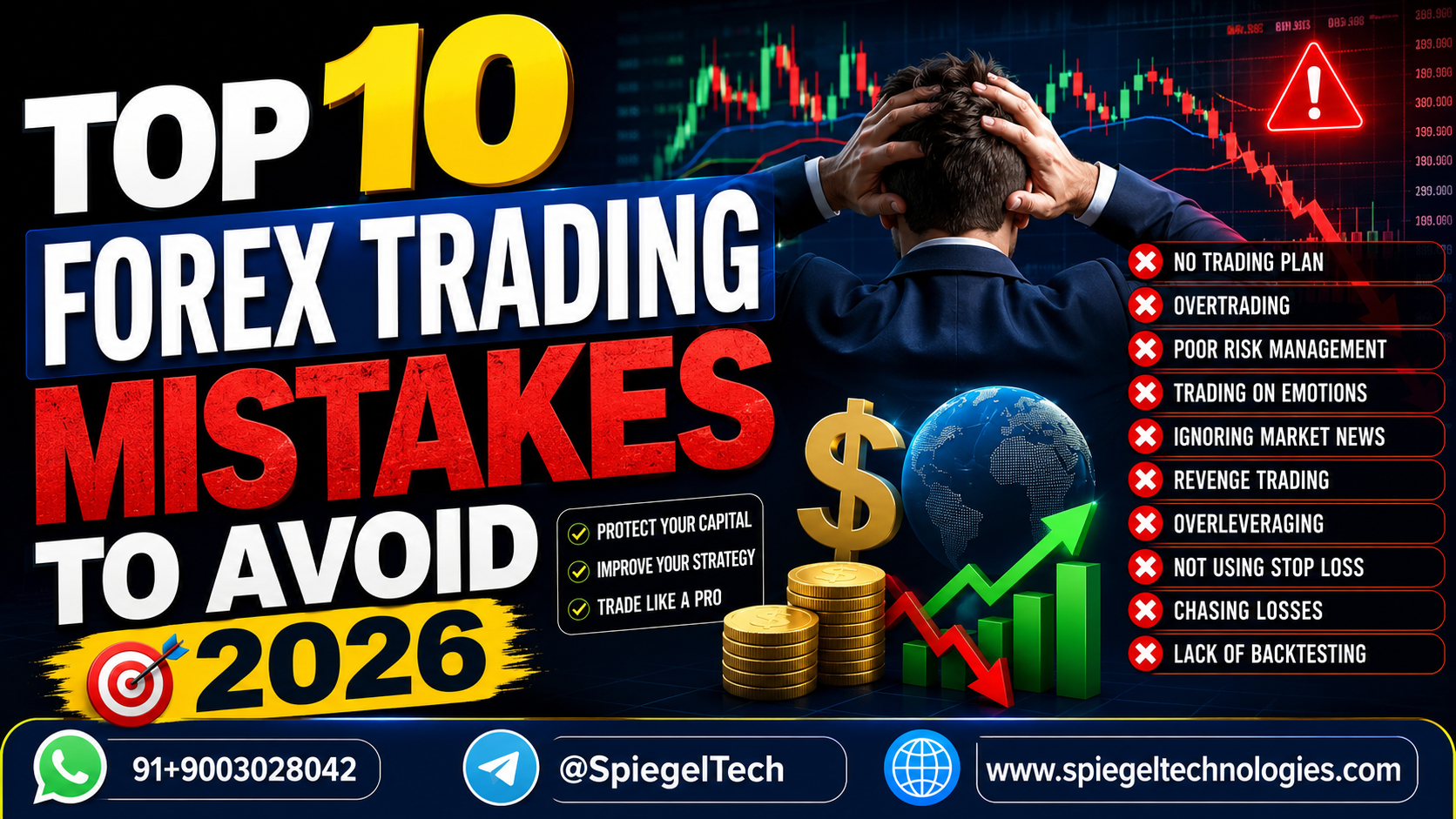
Top 10 Forex Trading Mistakes That Are Destroying Your Account (And How to Fix Them)
The forex market moves over $7.5 trillion every single day — more money than most countries generate in an entire year. It is the largest, most liquid financial market on the planet, operating around the clock, across every time zone, with no central exchange and no closing bell.
And yet, despite all that opportunity, the overwhelming majority of retail forex traders lose money.
Not because the market is rigged. Not because the successful traders have access to some secret strategy that nobody else knows. But because the same forex trading mistakes keep showing up — in account after account, trader after trader — until the balance hits zero and the platform gets deleted from the phone.
The good news? These mistakes are entirely avoidable once you know what they are. This guide breaks down the top 10 mistakes forex traders make, why each one is so financially destructive, and exactly what to do instead.
Why Most Forex Traders Fail Before They Ever Find Their Footing
Before diving into the list, it is worth understanding the common thread connecting virtually every forex trading mistake on this list: emotion overriding logic.
Forex trading is uniquely brutal in this regard because of leverage. Brokers allow you to control large positions with relatively small capital — and what feels like a minor market movement can wipe out your entire account balance in minutes. That kind of pressure exposes every psychological weakness a trader carries.
The traders who survive long enough to become consistently profitable are not necessarily the smartest people in the room. They are the most disciplined. They have studied the top 10 mistakes that end trading careers, internalized the lessons, and built systems that protect them from their own worst impulses.
That is exactly what this guide helps you do.
Mistake #1: Trading Without a Plan
This is the single most common forex trading mistake, and it is where the majority of account blow-ups begin. Traders see a currency pair moving, feel the pull of potential profit, and jump in without a defined entry point, exit strategy, risk limit, or any coherent thesis for why the trade should work.
The result is predictable: reckless trades driven by impulse, emotional buying and selling driven by fear and greed, and accounts that drain faster than they were funded.
The Fix: Build a trading plan before you place a single live trade. Your plan should define your entry and exit criteria, your maximum risk per trade, your daily loss limit, and the market conditions under which you will and will not trade. Treat it like a flight plan — deviating from it mid-trade is how crashes happen. Test every strategy on a demo account until it proves itself before putting real capital behind it.
Mistake #2: Overleveraging Your Position
Leverage is one of the most seductive and most dangerous features in forex trading. Brokers advertise ratios as high as 500:1, meaning you can theoretically control a $500,000 position with just $1,000 in your account. It sounds like an incredible opportunity — and it is, right up until the moment it is not.
Overleveraging is among the top 10 mistakes that experienced traders warn beginners about most urgently. Because when leverage amplifies your gains, it amplifies your losses by exactly the same magnitude. A 0.2% adverse move on a 500:1 leveraged position wipes out your entire margin. That is not a theoretical risk — it happens to overleveraged traders every single trading session.
The Fix: Use leverage with deliberate restraint. A foundational rule of professional forex risk management is never to risk more than 1-2% of your total account balance on any single trade. For traders who are still building experience, lower leverage ratios like 10:1 or 20:1 give you meaningful market exposure while keeping potential losses within a range you can survive and learn from. Longevity in trading is built on capital preservation first, profit generation second.
Mistake #3: Ignoring Stop-Loss Orders
Ask any trader who has blown an account to describe their experience, and a version of the same story emerges: a losing trade that they refused to close. The position went negative 30 pips. Then 60. Then 100. And at each milestone, the internal monologue was the same — "It'll come back." Sometimes it does. More often it does not, and the account does not survive to find out.
Ignoring stop-loss orders is one of the most psychologically costly forex trading mistakes because it combines denial, hope, and inaction into a single catastrophic pattern. Every moment a losing position runs without a stop, the potential damage compounds.
The Fix: Place your stop-loss order the moment you enter every trade — without exception. Set it at a technically meaningful level where your original trade thesis is definitively invalidated, not at an arbitrary pip distance. Think of your stop-loss not as an admission of failure but as a predefined exit that protects your capital for the next opportunity. The traders who last in this market treat stop-losses as non-negotiable risk management tools, not optional accessories.
Mistake #4: Chasing Losses With Revenge Trading
A losing trade hits. The frustration is immediate and visceral. And instead of stepping back, evaluating what went wrong, and approaching the next trade with a clear head, the revenge-trading instinct kicks in. Position sizes multiply. Exotic pairs that have never been studied suddenly seem attractive. The entire trading plan gets abandoned in the desperate pursuit of getting back to breakeven.
This is one of the most destructive forex trading mistakes precisely because it feels justified in the moment. It is not trading anymore — it is gambling driven by ego. And the market has no sympathy for desperation.
The Fix: Install a mandatory cool-down rule into your trading plan: after two consecutive losing trades, you are done for 24 hours. No exceptions. Start tracking your revenge trades separately in your journal — the data will quickly reveal that they have an extraordinarily high failure rate. Reframe your perspective: consistent trading is about winning over a large sample of trades across weeks and months, not recovering from one bad session before the day ends.
Mistake #5: Overtrading Every Session
New traders consistently confuse activity with productivity. They trade the London open, then the Asian session, then scalp through the New York lunch hour — racking up spread costs with every transaction while their broker quietly profits from the volume. Meanwhile, fatigue sets in, decision quality deteriorates, and the account bleeds from a thousand small cuts.
Overtrading is a top 10 mistake that is especially common among traders who feel anxious about missing opportunities. The irony is that trading less, but trading better-selected setups, almost always produces superior results.
The Fix: Define specific trading sessions and market conditions that align with your strategy — then trade only those windows. Quality of setup matters infinitely more than quantity of trades. Every unnecessary trade is a spread cost that works against your profitability before the position even opens.
Mistake #6: Skipping Education and Trading Inconsistently
Attempting to trade currencies without understanding how the forex market actually works is one of the foundational forex trading mistakes that beginners make. Technical indicators misread. Fundamental drivers misunderstood. Trading plans created but never followed consistently — replaced by impulsive decisions the moment the market moves unexpectedly.
The combination of insufficient education and inconsistent execution is the fastest route to a depleted trading account.
The Fix: Treat forex education as an ongoing investment, not a one-time onboarding activity. Study how currency pairs behave across different sessions and market conditions. Understand the fundamental drivers — interest rate differentials, economic data releases, central bank policy — that shape longer-term currency trends. And commit to following your trading plan with enough consistency that you can actually evaluate whether it works, rather than abandoning it after two losing trades.
Mistake #7: Letting Emotions Drive Trading Decisions
Emotional trading manifests in two destructive patterns that work in opposite directions. The first is cutting winning trades short — exiting a position that has moved 10 pips in your favor because you are afraid it will reverse, only to watch it continue another 50 pips without you. The second is letting losing trades run far beyond your stop — refusing to close because accepting the loss feels worse than the hope that price might recover.
This is one of the forex trading mistakes that quietly kills accounts over time. Not in one spectacular blow-up, but in a slow, grinding erosion of capital through consistently asymmetric trade outcomes.
The Fix: Remove emotional discretion from your exits by automating them. Set your take-profit and stop-loss levels the moment you enter every trade and commit to honoring them. Adopt the trading mantra that professional traders live by: "Plan the trade, trade the plan." If you find your heart rate increasing during an open position, zoom out to the weekly chart. The perspective almost always reveals that the trade you are agonizing over is a minor data point in a much larger picture.
Mistake #8: Not Keeping a Trading Journal
Most traders track their trades with roughly the same commitment they bring to gym resolutions — enthusiastic for a week, then completely abandoned. Without systematic records, there is no feedback loop. The same forex trading mistakes repeat indefinitely because there is no data to reveal the pattern. A trader might feel strongly that they "always lose on EUR/USD" — but without a journal, that conviction is just an unverified hunch.
The traders who improve fastest are almost always the most diligent journalers. Not because journaling is magical, but because it creates accountability and pattern recognition that is impossible to develop through memory alone.
The Fix: Record every trade in a detailed journal that captures entry and exit reasons, the setup screenshot, your emotional state at entry and exit, the outcome, and your honest post-trade assessment. Review your journal weekly. The patterns that emerge — the setups that consistently work, the conditions under which you make poor decisions, the emotional triggers that compromise your execution — are worth more than any trading course.
Mistake #9: Following the Crowd and Trading on FOMO
A prominent forex influencer posts "USD collapse incoming!" with a confident chart and 50,000 likes. The FOMO kicks in immediately. Traders pile into the same direction without conducting any independent analysis, essentially handing control of their capital to a stranger with a large social media following.
Among the top 10 mistakes in forex trading, crowd-following is uniquely dangerous because it is self-reinforcing right up until the moment it is not. Markets trend with the crowd — until they reverse against it sharply at exactly the moment maximum retail participation has been achieved.
The Fix: Develop the discipline to question every trade idea you did not originate from your own analysis. Ask yourself two things before any trade: has this move already happened, and what is the contrarian case? Use tools like the Commitment of Traders (COT) report to observe how institutional money is positioned relative to retail sentiment. Being early and occasionally wrong is far less costly than being consistently late and right only after the profitable move has already occurred.
Mistake #10: Ignoring High-Impact Economic News Events
Trading through major economic news events without preparation is one of the forex trading mistakes that catches traders off guard repeatedly. NFP week treated like any other trading week. A GBP/USD position held open through a central bank rate decision. The position that was showing a modest profit suddenly experiences a 150-pip adverse spike in under 30 seconds as the data releases.
Major economic events — Federal Reserve decisions, non-farm payrolls, CPI releases, central bank press conferences — create volatility environments where normal technical analysis stops functioning reliably and spreads widen dramatically. Trading through them without intentional preparation is essentially gambling on a coin flip with a rigged coin.
The Fix: Bookmark an economic calendar like Forex Factory and make it a daily ritual to check for high-impact events before you open any positions. For most strategies, red-flagged news events are no-trade zones — close your positions or stay out until the volatility settles and a clear directional bias emerges. Swing traders should consider either hedging existing positions ahead of major releases or accepting the small cost of closing and re-entering after the dust settles.
The Pattern Behind All 10 Forex Trading Mistakes
Reading through this list, a clear pattern emerges: the top 10 mistakes in forex trading are not primarily technical failures. They are behavioral ones.
Undisciplined leverage use. Emotional exits. Revenge trading. Crowd-following. These are all manifestations of the same underlying challenge — the difficulty of making rational decisions under financial pressure in real time.
The market is relentlessly efficient at redistributing capital from traders who act impulsively to those who act deliberately. Every time a trader abandons their plan in a moment of fear or greed, the disciplined trader on the other side of that trade benefits.
The solution is not a better indicator or a smarter strategy. It is building systems — a robust trading plan, consistent journaling, strict risk management rules, mandatory cool-down periods — that protect you from your own worst instincts even when the pressure is highest.
Final Thoughts: Trade Like the Market Owes You Nothing
The forex market does not care about your account balance, your financial goals, or how much you need this trade to work. It responds to supply and demand, institutional order flow, and macroeconomic forces that operate entirely independently of any individual trader's hopes.
What you control — completely and entirely — is your process. Your preparation. Your risk management. Your emotional regulation. Your commitment to avoiding the top 10 mistakes that eliminate undisciplined traders from the market every single day.
Study these forex trading mistakes. Write them down. Build your trading plan specifically to prevent each of them. And then trade that plan with the discipline of someone who understands that consistent profitability in this market is earned through patience and process — not luck, and not leverage.
The market has been redistributing wealth from the impulsive to the disciplined for decades. Decide which side of that equation you want to be on.
FAQ (Frequently Asked Questions)
1. Why do most forex traders lose money?
Most traders lose money because of emotional decision-making, poor risk management, and lack of a proper trading plan. Leverage and overtrading also accelerate losses.
2. What is the biggest mistake in forex trading?
The biggest mistake is trading without a plan. Without clear entry, exit, and risk rules, traders rely on emotions instead of strategy.
3. How much leverage should a beginner use in forex trading?
Beginners should use low leverage such as 10:1 or 20:1 and risk only 1–2% of their account per trade to avoid large losses.
4. Do stop-loss orders really help?
Yes. Stop-loss orders protect traders from large unexpected losses by automatically closing losing positions at a predefined level.
5. What is revenge trading?
Revenge trading is when a trader tries to recover losses by taking impulsive, high-risk trades. It usually leads to even bigger losses.
6. Is forex trading gambling?
Forex trading becomes gambling when decisions are based on emotion, luck, or speculation instead of analysis, strategy, and risk control.
7. How important is a trading journal?
A trading journal is very important because it helps track performance, identify mistakes, and improve long-term trading discipline.
8. Should I trade during major news events?
Most traders should avoid trading during high-impact news events like interest rate decisions or NFP, as volatility becomes unpredictable.
9. What is the safest way to trade forex?
The safest way is using a trading plan, strict risk management, stop-loss orders, and avoiding overleveraging and emotional trading.
10. Can forex trading be profitable long-term?
Yes, but only for disciplined traders who manage risk properly, avoid common mistakes, and follow a consistent strategy over time.