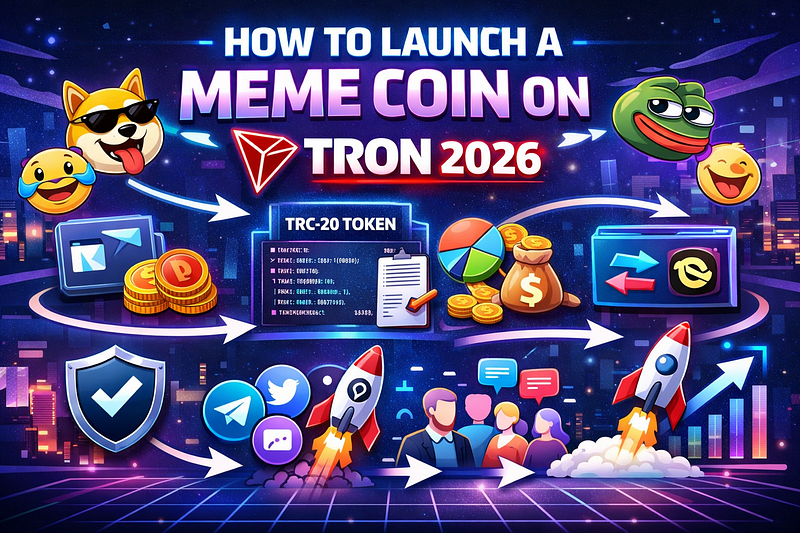
How to Launch a TRON Meme Coin in 2026: The Complete Creator’s Guide
Meme coins are no longer just internet jokes — they’ve evolved into powerful community-driven ecosystems. What begins as humor can quickly transform into a viral movement with real economic value. But behind every successful meme coin lies a strong blockchain foundation.
That’s where TRON comes in.
With ultra-low fees, fast transactions, and a rapidly growing user base, TRON has become a top choice for launching meme coins. By mid-2025, the network processed over 10 billion transactions, marking a 19% year-on-year increase. Even more impressive, TRON handled $1.93 trillion in USDT transfers in Q2 2025, the highest in its history.
For meme coin creators, this means one thing: speed, affordability, and scalability — the perfect recipe for virality.
Why TRON Is the Best Blockchain for Meme Coins
From Content Network to Blockchain Leader
Originally launched as a decentralized content-sharing platform, TRON has evolved into a full-fledged Layer-1 blockchain supporting DeFi, NFTs, and token creation. Today, it stands as a strong competitor to Ethereum and Solana.
Key Advantages for Meme Coin Creators
Near-zero fees using TRON’s bandwidth and energy model
Fast transaction speeds for seamless user experience
Simple TRC-20 token standard for easy deployment
Developer-friendly tools like TronBox, TronWeb, and TronGrid
These features make TRON ideal for meme coins, where frequent micro-transactions and high engagement are critical.
Why Serious Creators Are Choosing TRON for Meme Coins in 2026
They’re community engines, speculative assets, and cultural movements that can generate real economic activity when built on the right infrastructure. And in 2025, a growing number of creators are making the same call: TRON is that infrastructure.
Here’s the data behind that claim. By mid-2025, TRON had processed over 10 billion transactions — a 19% year-on-year jump. In Q2 2025 alone, it handled $1.93 trillion in USDT transfers, the highest quarterly stablecoin volume in its history. That’s not a niche chain. That’s a payments and liquidity backbone at institutional scale.
For meme coin creators, this matters for three concrete reasons: low fees, high throughput, and deep liquidity. Every user interaction — every buy, every transfer, every airdrop — costs fractions of a cent. That’s the friction-free environment that viral projects depend on.
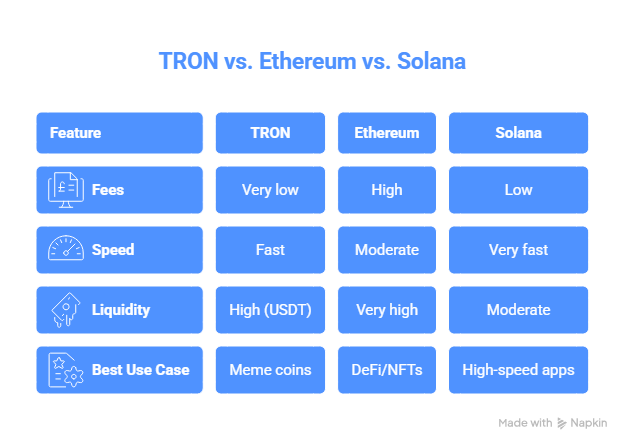
TRON vs. Ethereum vs. Solana: A Practical Comparison for Meme Creators
Before committing to a chain, it’s worth understanding the trade-offs honestly.
Ethereum remains the most recognised chain globally, but volatile gas fees and high deployment costs make it punishing for small-cap, high-volume meme projects. A single airdrop campaign can cost thousands in gas alone.
Solana offers impressive speed and has hosted several major meme coin cycles. But its stablecoin liquidity depth is comparatively thin, and its history of network outages creates reliability risk for projects that depend on sustained momentum.
TRON sits in a different position entirely:
Transaction fees are effectively near-zero under its bandwidth/energy model
Confirmation times are fast enough to keep trading momentum continuous
The TRC-20 standard is developer-friendly with mature tooling (TronBox, TronWeb, TronGrid)
USDT liquidity depth on TRON is unmatched — critical for meme coins where trading volume drives visibility
For projects where every cent and every user interaction counts, the cost structure alone makes a compelling case.
The Psychology Behind Meme Coins: Why People Actually Buy
Understanding why people buy meme coins is foundational to building one that survives past its launch week.
It’s rarely pure speculation. The real drivers are:
Emotional ownership — buyers feel they’re claiming a piece of internet culture before it breaks through
Community belonging — meme coins create tribes with shared language, inside jokes, and identity
Low-stakes gambling — the entertainment value of “this could 100x or go to zero” is genuinely part of the appeal for many participants
Social proof loops — when friends are buying, the FOMO compounds quickly
The meme coin categories that consistently perform well combine humor with recognisability: ironic names, pop culture references, animal mascots, and community-created lore. On TRON specifically, TRON’s low-cost structure means even micro-communities can sustain active trading without fees killing the fun.
The critical insight from Dogecoin, Shiba Inu, and PEPE: simple concepts with strong community ownership outlast complex projects with weak culture. PEPE built trust by burning liquidity. Shiba Inu extended its runway by adding utility through Shibarium. Dogecoin survived everything through the sheer warmth of its narrative. Community energy is the moat.
Building Your Meme Coin’s Identity Before You Write a Line of Code
This is where most meme coin projects fail — not in the smart contract, but in the brand.
Define the Personality First
Before any technical work begins, answer these questions:
What’s the emotional register? Irreverent? Absurdist? Warm? Chaotic?
Is there an underlying purpose, or is the joke the entire point?
What’s the visual language? (Animal? Character? Abstract concept?)
What would your mascot post on Twitter at 2am?
This identity needs to be consistent across everything — your visuals, your community tone, your roadmap language, your marketing. Inconsistency is the fastest way to break trust with an audience that has extremely sensitive inauthenticity detectors.
Naming: Snappy, Tweetable, Memorable
Great meme coin names share a few properties: they’re short enough to fit in a tweet naturally, they carry some inherent absurdity or wit, and they’re easy to turn into a hashtag. Avoid anything that sounds like it was named by a committee. The best names feel like they came from a group chat at midnight.
Designing a Mascot That Spreads Itself
Your visual identity needs to be remixable by design. The mascot should be simple enough to reproduce in memes, distinct enough to be recognisable at thumbnail size, and expressive enough that fans want to draw it, cosplay it, or insert it into other meme formats.
The most successful meme projects don’t protect their IP — they encourage creative reuse. When your community is generating the content, your marketing costs drop to near zero.
Positioning: Joke Coin or Community Asset?
This is a decision worth making deliberately. “Pure joke” lowers expectations and preserves flexibility but limits long-term holder commitment. “Community asset with utility” promises more but requires delivery. Many successful projects quietly work on utility while marketing themselves as jokes — giving them both virality and staying power. Pick a lane, but know both options exist.
Tokenomics That Actually Work: Designing for Longevity
Poor tokenomics kill more meme coins than bad marketing does. Hype drives the launch — tokenomics determine whether anyone is still holding six months later.
Supply Structure: Fixed, Burn-Based, or Hybrid
Fixed supply creates a known ceiling — simple to communicate, good for scarcity narrative
Burn model reduces circulating supply over time, reinforcing scarcity as activity increases
Hybrid approach (small inflation rate offset by fee-driven burns or buybacks) can balance growth incentives with deflationary pressure
There’s no universally “correct” answer — the right structure depends on your community size, utility plans, and long-term roadmap.
Incentive Mechanics: Finding the Right Balance
The most common mechanisms for maintaining holder engagement:
Reflection — a transaction tax redistributed proportionally to all holders
Auto-burn — a portion of every transaction sent to a dead wallet permanently
Staking rewards — incentivise holding over flipping
LP rewards — incentivise users to provide liquidity, deepening the pool
The calibration challenge: tax rates that are too high kill trading momentum. Rates that are too low fail to incentivise the behaviours you want. Most successful projects in 2025 are running total transaction taxes in the 2–5% range, distributed across burn, redistribution, and liquidity.
Fair Launch vs. Pre-Sale
Pre-sales fund the project but create immediate sell pressure from early buyers. Fair launches are slower to build liquidity but generate stronger community trust signals. Many TRON meme projects use a hybrid model — a small private pre-sale for seed capital, followed by a public fair launch with clear tokenomics disclosure. Whatever you choose, announce it transparently before launch.
Liquidity on TRON DEXes
To create a tradeable market, you’ll need to provide liquidity on a TRON-native DEX — SunSwap, JustSwap, or JustMoney are the primary options. Pair your token with TRX or USDT, and contribute equal value on both sides. More liquidity at launch means less slippage, which means a better first-day experience for early traders. Reserve a meaningful portion of your token allocation for LP rewards to keep pools healthy beyond day one.
Technical Build: Developing Your TRC-20 Meme Coin
Setting Up Your Dev Environment
For new developers, TronIDE (browser-based) is the fastest entry point — write, compile, and deploy contracts without any local setup. For more serious builds, TronBox (TRON’s equivalent of Truffle) handles compilation, testing, and deployment through JavaScript scripts. Before mainnet deployment, always run your contracts on a testnet — Shasta or Nile are the standard TRON testnets.
Writing a Secure TRC-20 Contract
A standard TRC-20 implementation requires: name, symbol, totalSupply, transfer, approve, and transferFrom. Beyond these basics, you can layer in your custom economics — transaction taxes, auto-burn logic, access control for admin functions.
Security fundamentals to build in from the start:
Guard against reentrancy attacks in any function that sends value
Use SafeMath or Solidity 0.8+ overflow protection
Decide upfront whether your contract will be upgradeable or immutable — and communicate that decision to your community
Avoid centralised admin functions that could allow a single wallet to drain the contract
Optional Features Worth Considering
Transaction tax routing — split fees between burn wallet, redistribution, and liquidity pool on every transfer
Airdrop logic — built into the contract rather than handled by external scripts (reduces risk)
Time-locked functions — prevent rapid changes to key parameters during volatile early trading periods
Audits Are Non-Negotiable
Deploy nothing without testing and a third-party audit. Write comprehensive unit tests. Simulate edge cases and adversarial inputs. Engage a reputable audit firm — the cost is trivial compared to what an exploitable contract can lose, both financially and reputationally. Many successful TRON meme coins publish their audit reports publicly as a trust signal.
Verifying on Tronscan
After deployment, verify your contract source code on Tronscan. Verified contracts display their source openly — a significant trust signal for early buyers who want to confirm the contract does exactly what it claims. Unverified contracts are routinely treated with suspicion, and rightly so.
Deployment and Launch: Going Live on TRON Mainnet
Pre-Launch Checklist
Before deployment, confirm:
✅ Contract audited and unit tests passing
✅ Deployment wallet funded with sufficient TRX for energy and bandwidth
✅ Tokenomics publicly documented and locked in
✅ Liquidity pool allocation confirmed
✅ Community channels (Twitter/X, Telegram, Discord) seeded and active
Deploying to Mainnet
Deploy via TronBox, TronIDE, or CLI scripts. Record the contract address immediately after deployment. Verify and publish source code on Tronscan. At this point, the token exists — but it’s still invisible to traders until it’s paired with liquidity.
Adding and Locking Liquidity
Add your initial liquidity pool on SunSwap or JustSwap. Lock the LP tokens using a time-locked contract or trusted third-party service. This is the single most important trust signal available at launch — it proves you can’t rug the pool. Many TRON meme projects in the SunPump ecosystem have locked liquidity for 6–12 months as standard practice. Publish the lock transaction hash publicly.
Managing Launch Day Volatility
Early trading is almost always chaotic. Large swings, bot activity, and coordinated order manipulation are common. Consider implementing:
Small initial sell walls to temper extreme price spikes
Cooldown periods on large transactions in the first hours
Transparent communication with your community about expected volatility
Don’t promise price stability — explain the mechanics instead. Communities that understand what to expect are far more resilient.
Launch Marketing: Build Tension Before the Drop
The launch moment should feel like an event, not an announcement. Run a countdown. Drop teasers. Host Twitter AMAs. Engage meme communities in the days before. Give early followers the feeling that they’re “in” before everyone else catches on. Reveal your tokenomics and LP lock details on day one — holders who feel informed from the start stick around.
Community and Marketing: The Real Product
Building the Tribe
The community is the product for a meme coin. Start building across Twitter/X, Telegram, and Discord before launch. Seed the channels with memes, genuine engagement, and personality. Reward early believers visibly. Let informal conversation happen — forced community management feels hollow immediately.
The goal is to turn holders into evangelists. When your community is creating content, sharing memes, and recruiting friends, your marketing budget effectively multiplies itself.
Content That Actually Drives Growth
Meme-of-the-day challenges with token rewards for winners
User-generated art contests — your mascot, remixed
Community leaderboards for holders, creators, and referrers
Weekly AMAs with the team — transparency builds trust
Giveaways tied to actions, not just passive holding
Build your content calendar two to three weeks ahead of your launch date. Running out of content momentum in week two is one of the most common failure modes.
Working With KOLs and Influencers
Prioritise TRON-native communities and crypto content creators who actually understand the ecosystem. One genuine endorsement from a credible voice reaches a more relevant audience than a dozen paid promotions from generic crypto accounts. Vet partners carefully — influencer misalignment can damage credibility faster than it builds it.
Gamified Distribution Platforms
Platforms like Zealy, Galxe, and QuestN let you build quest-based campaigns where users earn tokens for completing specific actions — retweeting, creating memes, referring friends. Used well, these drive high-quality engagement. Used poorly, they attract bots and passive participants who dump rewards immediately. Design quests that require genuine creative participation, not just clicks.
Managing FOMO Without Overpromising
FOMO is a powerful tool. Empty hype is a liability. There’s a significant difference between building genuine anticipation and making promises you can’t keep. Use language like “exploring,” “planned,” or “roadmap in progress” for anything not yet delivered. Communicate timelines with buffers, not optimism. The communities that weather bear markets are the ones that were never lied to during the bull run.
Real TRON Meme Coin Success Stories
SunPump: Infrastructure as a Launch Catalyst
SunPump demonstrated what happens when you lower the barrier to entry dramatically. In just 11 days following launch, the platform generated over $1 million in revenue. On its peak day, 2.78 million TRX (~$400,000) flowed into new token contracts, and over 6,000 new meme tokens were created on the platform.
The lesson for builders: infrastructure that enables experimentation at scale creates its own ecosystem momentum. SunPump didn’t just launch tokens — it created a culture of rapid iteration that drew attention to TRON’s meme capabilities broadly.
Key lesson: Lowering the floor for creation raises the ceiling for discovery — but quality signals matter more as volume increases.
SUNDOG: Community Credibility at Scale
SUNDOG established itself as TRON’s leading meme coin by market cap, sitting at approximately $37 million according to CoinGecko data, and consistently appearing at the top of TRON meme coin rankings.
Its rise came from a combination of early community momentum, a simple and memorable brand concept, and effective use of SunPump infrastructure for day-one liquidity access.
Key lesson: Broad appeal and a clear, memorable identity outperform complex narratives in the meme coin space. Simplicity scales.
Frequently Asked Questions
How much does it cost to launch a meme coin on TRON?
Deployment costs on TRON are minimal — typically a few dollars in TRX for energy and bandwidth. The larger costs come from initial liquidity (which you’re providing, not spending), audit fees if using a professional firm, and marketing. A scrappy launch can happen for under $900; a well-resourced one with audit and marketing budget typically runs $5,000–$50,000+.
Do I need to know Solidity to build a TRC-20 token?
TRC-20 contracts use Solidity (TRON’s EVM-compatible layer supports it). For basic token contracts with standard features, templates are widely available. For custom tax logic, burn mechanics, or complex staking, you’ll either need Solidity knowledge or a developer. No-code platforms like SunPump remove this barrier entirely, with corresponding trade-offs in flexibility.
What’s the difference between SunSwap and JustSwap?
Both are TRON-native DEXes for providing liquidity and enabling token swaps. SunSwap is the more actively developed platform in 2025, with deeper integration into the SunPump ecosystem. JustSwap has longer history on TRON. Most creators provide initial liquidity on SunSwap for new launches.
How do I prevent a rug pull accusation even if I’m building legitimately? Transparency is everything: lock your LP tokens and publish the transaction hash, verify your contract on Tronscan, publish a professional audit, and maintain consistent communication with your community. Renouncing contract ownership (or transferring to a multisig) removes the ability to make unilateral changes — a strong signal to holders.
What’s a realistic timeline from concept to launch? A well-prepared launch takes 4–8 weeks minimum: 1–2 weeks for concept and branding, 2–3 weeks for contract development and testing, 1 week for audit turnaround, and 1–2 weeks for pre-launch community building. Rushing any of these phases increases risk significantly.
Is it legal to launch a meme coin? Regulatory treatment varies by jurisdiction and depends heavily on how the token is marketed and structured. Tokens marketed as pure community assets or utility tokens are generally treated differently than those marketed as investments with expected returns. Consult legal counsel in your jurisdiction before launch — this is particularly important if you’re running a pre-sale or promising returns.
Ready to Launch Your TRON Meme Coin?
spiegeltechnologies offers end-to-end TRON token development services — from concept to deployment — helping you build scalable, secure, and high-performing meme coin projects.