
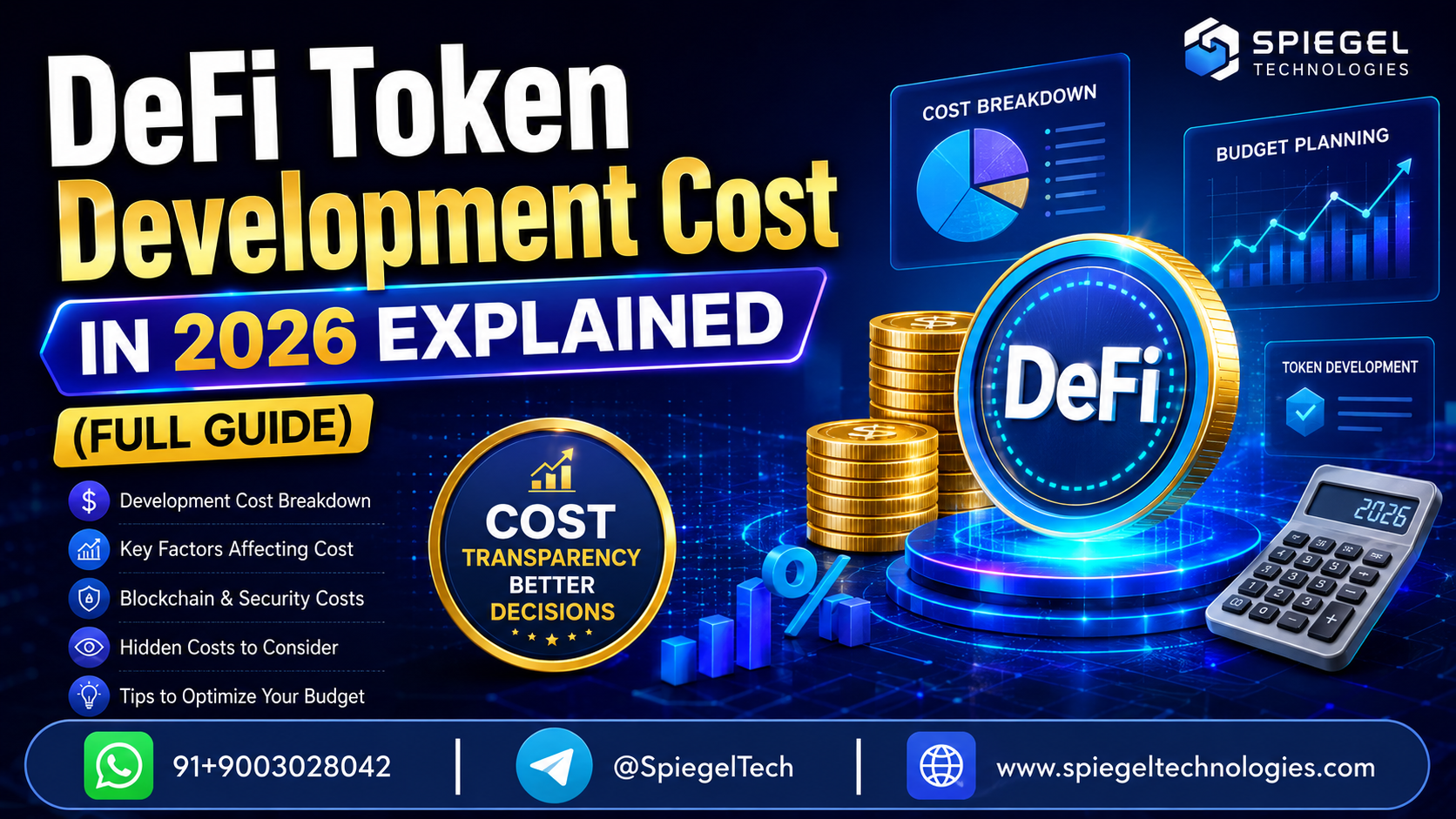
DeFi Token Development Cost in 2026 Explained (Full Guide)
DeFi token development sits at the heart of modern blockchain innovation. From governance systems that put users in control to liquidity-driven platforms processing billions in daily volume, tokens define how decentralized applications function, grow, and sustain value over time.
But here is what separates serious DeFi token development from the noise: it is not about launching an asset. It is about engineering utility-driven tokens built around real usage, genuine liquidity, and economic systems designed to perform long after the launch hype fades. That discipline is precisely what separates functional DeFi tokens from short-lived models like meme coins, which rely on timing and social momentum rather than structural design.
Whether you are a startup founder exploring Web3, an established protocol expanding its ecosystem, or an enterprise evaluating blockchain-based financial infrastructure, this guide covers everything you need to know about DeFi token development — from concept to launch and beyond.
What Is a DeFi Token?
A DeFi token is a digital asset that operates inside decentralized finance platforms running on blockchain networks. Unlike traditional financial systems, these platforms function without banks or intermediaries — every transaction, rule, and reward is governed by smart contracts that execute automatically on-chain.
DeFi tokens serve multiple roles depending on the platform they power. They enable trading and earning rewards. They grant voting rights on protocol decisions. They act as collateral for borrowing. In some systems, they function as access keys to premium features or exclusive liquidity pools.
That combination of utility and governance control makes DeFi tokens the functional currency of the decentralized financial ecosystem — and the reason why DeFi token development services have become one of the fastest-growing segments in blockchain engineering.
DeFi Token vs. Standard Crypto vs. Security Token
Understanding where DeFi tokens fit in the broader asset landscape is essential before beginning any DeFi token development project.
DeFi Tokens vs. Standard Cryptocurrencies
Standard cryptocurrencies like Bitcoin and Ethereum operate as base-layer assets powering their own blockchain networks. DeFi tokens, by contrast, are built on top of existing blockchains and tied directly to the applications and smart contracts that run on those networks. Bitcoin stores value and processes payments. A DeFi token like UNI, AAVE, or MKR powers specific protocol functions — lending, trading, governance — within the DeFi ecosystem.
DeFi Tokens vs. Security Tokens
Security tokens represent ownership rights in real-world assets — equity, real estate, or financial instruments — and are subject to strict regulatory frameworks. DeFi tokens, while increasingly scrutinized by regulators, are primarily designed around protocol utility: enabling users to interact with a platform, earn yield, or participate in governance. The regulatory treatment of each is fundamentally different and must be factored into any serious DeFi token development strategy from day one.
Common Misconception: Is Bitcoin or Solana a DeFi Token?
No — and this confusion is worth addressing directly. Bitcoin functions as digital money and a store of value, running on its own independent blockchain. Solana is a high-performance base-layer network supporting decentralized applications. DeFi tokens operate in an entirely different category: they are used inside specific platforms for trading, yield generation, and voting. Bitcoin only enters DeFi indirectly through wrapped versions on compatible networks.
Why DeFi Tokens Are Reshaping the Future of Finance
The scale of DeFi's growth makes the opportunity unmistakable for any entrepreneur evaluating DeFi token development services:
The DeFi crypto market cap has already reached nearly $59 billion, reflecting concentrated real capital and genuine user activity — not speculative hype. Stablecoin transfer volumes regularly exceed $72 billion, demonstrating the borderless, global reach of on-chain financial infrastructure. Traditional banks and financial institutions are now actively integrating blockchain technology to meet growing consumer demand for cross-border payment solutions — validating DeFi's trajectory from experiment to infrastructure.
Beyond the numbers, several structural trends reinforce why DeFi token development is accelerating:
Growing Adoption: DeFi has matured well beyond its experimental phase. Capital and user activity are concentrating in platforms with proven liquidity depth and sustainable tokenomics.
Regulatory Clarity: Governments are beginning to define clearer frameworks for digital assets, giving users and institutional participants more confidence to engage with the DeFi ecosystem.
Improved Security: Smart contract transparency means every transaction is independently verifiable, reducing reliance on centralized trust and improving overall system integrity.
Community Governance: Most DeFi protocols use governance tokens to give users direct influence over protocol decisions — a structural shift that traditional financial systems cannot replicate.
Core Features Every DeFi Token Must Have
When evaluating DeFi token development services, understanding the technical features that define a functional DeFi token is essential. Here are the components that matter:
Transferability — Tokens move directly between users through self-custody wallets following rules defined in the token standard (typically ERC-20 on Ethereum), validated by the network's consensus mechanism.
Supply Management — Token supply is governed by minting logic, burning mechanisms, and issuance rules embedded in the smart contract. Professional DeFi token development typically incorporates either deflationary models or fixed supply schedules to influence long-term scarcity and value.
Governance Voting — Governance tokens enable holders to vote through DAO systems, with votes executed transparently on-chain through smart contracts on EVM-compatible networks.
Fee Extraction — DeFi protocols generate fees through automated market maker (AMM) activity inside liquidity pools. These fees are distributed to liquidity providers and token holders through staking or yield mechanisms.
Staking Interface — Staking allows users to lock tokens in a smart contract to support a blockchain or liquidity system, earning rewards from protocol incentives or token emissions in return.
Access Controls — Smart contract permissions define who can perform specific actions within a protocol, often supported by security audit processes to prevent unauthorized access.
Pausability — Pausability allows developers or governance to temporarily halt contract functions during emergencies, exploits, or critical security events — an important safeguard in any serious DeFi token development project.
Upgradability — Upgradable DeFi systems use proxy-based smart contract architecture, enabling protocol improvements after mainnet launch without breaking existing token standard compatibility.
Key Components of a DeFi Token
A well-architected DeFi token built by an experienced DeFi token development company consists of five interconnected layers:
Smart Contract Base — The core on-chain code controlling transfers, supply management, and fundamental token behavior. Every other layer depends on its correctness and security.
Tokenomic Engine — The economic model governing token distribution, incentive structures, supply dynamics, and long-term value balance. Poor tokenomics design is the most common cause of DeFi project failure.
Governance Mechanism — The system allowing token holders to vote on protocol decisions, enabling genuinely decentralized control as the protocol matures.
Liquidity Architecture — The framework defining how users can trade or access tokens in DeFi markets, including liquidity pool design and DEX integration strategy.
Value Accrual Layer — The mechanism connecting protocol usage, fee generation, or ecosystem activity to token demand — determining how value ultimately flows back to token holders.
The Real Benefits of Professional DeFi Token Development
Choosing a professional DeFi token development company delivers advantages that extend far beyond simply getting code to production:
Enhanced Liquidity — Professional DeFi token development services design liquidity architectures using automated market systems and liquidity pools that keep markets active around the clock, without fixed trading hours or centralized market makers.
Cross-Protocol Composability — Well-designed DeFi tokens move freely across lending markets, trading platforms, and derivatives protocols. This composability — the ability to stack financial strategies without permission barriers — is what allows DeFi to scale faster than traditional financial systems.
Decentralized Governance — Token holders gain direct influence over fees, emissions, and risk parameters, shifting control from centralized operators to on-chain decision systems.
Cost Efficiency — Smart contract automation removes operational layers that traditionally sit between users and settlement, dramatically reducing the cost of financial coordination at scale.
Global Accessibility — DeFi tokens democratize access to global financial markets without the bank account requirements, geographic restrictions, or institutional gatekeeping of traditional finance.
Programmable Money — Built-in logic that executes automatically — staking rules, reward schedules, liquidation conditions — makes DeFi tokens uniquely flexible financial instruments. This flexibility is also why correct design by an experienced DeFi token development company is so critical.
Radical Transparency — All DeFi activity is recorded on-chain and independently verifiable, replacing institutional reporting with real-time open data access.
Understanding the Challenges in DeFi Token Development
No honest guide to DeFi token development would be complete without addressing the genuine challenges involved:
Smart Contract Vulnerabilities — Smart contracts control real user funds. Even minor code errors can create exploitable vulnerabilities. Once deployed, contracts are immutable — issues cannot simply be patched. Independent security auditing by a reputable DeFi token development company is non-negotiable.
Scalability Limits — High demand on congested networks means higher fees and slower transactions. Blockchain selection and Layer 2 strategy must account for expected usage patterns from the outset.
Regulatory Uncertainty — Rules governing DeFi tokens continue to evolve across jurisdictions. Long-term regulatory uncertainty creates compliance risk that must be managed proactively through legal structuring.
Oracle Risks — DeFi protocols depend on external price feeds to function correctly. If data from providers like Chainlink is manipulated or fails, the system can react incorrectly — with potentially severe financial consequences.
Interoperability Fragility — Cross-chain movement of DeFi tokens introduces new attack surfaces and lacks consistent security standards. Bridging risk must be carefully evaluated in any multi-chain DeFi token development strategy.
Tokenomics Flaws — The collapse of Terra/LUNA is the most prominent example of how quickly a structurally flawed economic model can destroy an otherwise technically functional project. Getting tokenomics right is not optional — it is existential.
Use Cases: Where DeFi Tokens Create Real Value
A credible DeFi token development company will design tokens around genuine use cases rather than speculative demand. The most established applications include:
Governance — Token holders vote on protocol upgrades, fee models, and treasury allocation through DAO structures. This is the mechanism that makes decentralized protocols genuinely community-owned.
Liquidity Provision — Users deposit tokens into liquidity pools, enabling trading without requiring a direct counterparty. AMM systems price assets automatically, and liquidity providers earn a share of trading fees proportional to their contribution.
Yield Farming — Tokens move across pools and platforms to maximize yield, earning rewards from trading fees, lending interest, and protocol incentives. Effective yield farming strategy is increasingly a key driver of TVL growth.
Collateralization — Users lock tokens as collateral to borrow against their holdings, accessing liquidity without selling assets — a cornerstone use case for DeFi lending protocols.
Staking — Tokens are locked in smart contracts to earn rewards and support network security, reducing circulating supply and creating natural holding incentives.
Insurance — Some DeFi platforms offer coverage against smart contract failures through community-funded pools, adding a risk management layer to the ecosystem.
Access Control — Tokens function as access keys to premium features, early launches, or exclusive liquidity pools — creating demand driven by platform utility rather than speculation alone.
Designing DeFi Token Strategy and Tokenomics
This is where most DeFi token development projects either build a durable foundation or quietly set themselves up for failure. Tokenomics is not just supply and allocation — it is the complete economic system governing how your token behaves in the market over time.
Types of DeFi Tokens
Utility Tokens power specific platform actions — fees, access, and on-chain interactions. Their value tracks actual protocol usage rather than speculative sentiment.
Governance Tokens give holders voting power over DAO decisions. Many protocols distribute these to early users to progressively decentralize control.
Stablecoins maintain a fixed value (typically pegged to USD) and serve as the base trading pair and settlement currency across DeFi.
Liquidity Provider (LP) Tokens represent a user's proportional share of a liquidity pool, enabling withdrawal of deposited assets plus accrued fees.
Supply, Allocation, and Vesting
These three decisions shape your token's price behavior more than any other factor in DeFi token development:
Total Supply — A smaller supply creates perceived scarcity, but scarcity without demand produces nothing. Supply decisions must be grounded in genuine utility modeling.
Token Allocation — Distribution across the team, investors, community rewards, and ecosystem incentives requires careful balance. Insider-heavy allocations are immediately visible to sophisticated market participants and erode trust before trading begins.
Vesting Schedule — Time-locked release with cliff periods slows early selling pressure and signals long-term commitment from the founding team. A thoughtful DeFi token development company treats vesting design as a critical trust signal, not a technical afterthought.
Deflationary vs. Inflationary Models
Inflationary Model — New tokens continuously enter circulation through staking rewards and yield farming incentives. Effective for early user acquisition, but requires careful calibration to avoid farm-and-dump dynamics where users harvest rewards and immediately sell.
Deflationary Model — Tokens are systematically removed from circulation through fee burns or buyback mechanisms. Reduces supply, but only creates value if the protocol generates sufficient activity to make the burn rate meaningful.
Most mature DeFi token development services implement hybrid models that balance early growth incentives with long-term supply discipline.
How to Create a DeFi Token: Step-by-Step
Step 1: Choose the Right Blockchain Network
Blockchain selection is the first real technical decision in DeFi token development and has cascading effects on everything that follows:
| Factor | Ethereum (L1) | Base (L2) | Solana |
|---|---|---|---|
| Transaction Cost | ~$0.065 | ~$0.012 | ~$0.002 |
| Speed | 15–30 TPS | 250–500+ TPS | 65,000+ TPS |
| Liquidity Depth | Deepest in DeFi | Growing rapidly | Expanding |
| Best For | High-value DeFi | Scalable low-fee DeFi | High-frequency trading and gaming |
Ethereum remains the strongest liquidity hub in DeFi. Solana leads in raw throughput for high-frequency applications. Layer 2 networks offer the best balance of Ethereum security and scalable performance for most new DeFi token development projects in 2026.
Step 2: Select the Right Token Standard
Token standards govern how your token behaves after launch and determine its compatibility with the broader DeFi ecosystem. ERC-20 dominates on Ethereum — virtually every DeFi protocol, DEX, and wallet supports it natively. Solana's SPL standard offers faster execution and lower costs but operates in a separate ecosystem. Choosing the wrong standard for your target ecosystem creates integration friction that slows adoption before it begins.
Step 3: Develop Core Smart Contract Components
The smart contract is the technical definition of your token. Three functions are foundational to any DeFi token development project:
Minting controls how new tokens enter circulation, typically restricted to specific roles like a multisig wallet or governance contract to prevent unauthorized supply inflation.
Burning permanently removes tokens from circulation, commonly used in fee mechanisms and deflationary models where protocol activity reduces supply over time.
Transfer Logic updates token balances between sender and receiver, with many protocols extending this basic flow with custom rules specific to their ecosystem mechanics.
Step 4: Build the Staking Infrastructure
Staking keeps liquidity stable and reduces constant selling pressure by incentivizing long-term token holding. A professional staking system from a DeFi token development company includes three components: a secure contract that holds locked tokens, a reward distribution system that releases emissions over time, and a configurable exit mechanism with optional lock periods. Reward rates are calibrated to attract sufficient liquidity without creating unsustainable emission pressure.
DeFi Token Security and Legal Compliance
Security and compliance are not optional add-ons in serious DeFi token development — they are prerequisites for launch.
Smart Contract Auditing: Automated and Manual
Professional DeFi token development services combine automated scanning and manual review before any mainnet deployment. Automated tools detect known vulnerability patterns — reentrancy, unsafe external calls, missing access controls — quickly and cost-efficiently. Manual review by experienced auditors goes deeper, tracing logic paths, edge cases, and real execution flows that automated tools miss.
Critical Vulnerabilities to Eliminate
Reentrancy Attacks occur when a contract sends funds before updating its internal balance, allowing attackers to repeatedly call the same function and drain the contract. This is how the original DAO hack occurred and remains one of the most common exploits in DeFi.
Flash Loan Attacks exploit instantly borrowed large liquidity to manipulate price oracles or protocol state within a single transaction block. Proper oracle design and price delay mechanisms are the primary defenses.
Legal Wrappers and Compliance Strategy
Most serious DeFi token development companies recommend establishing legal structure before token launch. A legal wrapper — typically a foundation, LLC, or DAO legal structure depending on jurisdiction — allows the project to operate within real-world regulatory frameworks. SAFTs (Simple Agreements for Future Tokens) provide a compliant mechanism for early investor participation before the token is publicly tradeable. Jurisdictions like Switzerland, Singapore, and the Cayman Islands offer well-established frameworks for DeFi projects. Engaging legal counsel early is significantly less expensive than responding to regulatory enforcement after launch.
How to Launch a DeFi Token Successfully
A professional DeFi token development company will guide you through a structured launch sequence:
Finalize Tokenomics First — Lock supply, allocation, and incentive structures before any code is written. Changes to tokenomics after smart contract deployment are expensive and disruptive.
Audit Before Deployment — Test and audit smart contracts thoroughly on testnet. Every issue found before mainnet deployment costs a fraction of what it costs to address after launch.
Seed Liquidity — Add initial liquidity to DEX pools before announcing trading. Without liquidity, the token cannot function in the market regardless of its technical quality.
Choose Your Distribution Platform — IDO launchpads like Polkastarter or liquidity bootstrapping pools on Balancer provide structured initial distribution with built-in audiences.
Build Community Before Launch — A user base primed and engaged before launch drives initial demand and provides the social proof that attracts subsequent participants.
Plan Post-Launch Actively — Stability, feature updates, and community engagement after launch determine whether your token sustains momentum or fades after initial excitement.
What Does DeFi Token Development Cost in 2026?
Cost varies significantly based on scope, blockchain choice, and feature complexity. Here is a realistic breakdown from professional DeFi token development services:
| Component | Basic Token | Advanced DeFi Token |
|---|---|---|
| Smart Contracts | $3,000 – $4,000 | $5,000 – $8,000+ |
| Security Audits | $3,000 – $5,000 | $20,000 – $200,000+ |
| Deployment | $500 – $2,000 | $2,000 – $10,000 |
| Liquidity and Marketing | $5,000 – $20,000 | $30,000 – $180,000+ |
| Legal and Compliance | $0 – $10,000 | $30,000 – $150,000+ |
| Total | $8,000 – $0,000 | $0,000 – $00,000+ |
The wide range reflects the genuine variance in scope between a simple utility token and a full-featured DeFi protocol with governance, staking, liquidity architecture, and institutional-grade security. A reputable DeFi token development company will provide detailed scoping and transparent pricing based on your specific requirements before any commitment.
Why Work With a Professional DeFi Token Development Company?
A professional DeFi token development company brings three things that cannot be easily self-taught: the experience to avoid the mistakes that are invisible until they are catastrophic, the technical depth to build securely across the full stack, and the operational capacity to deliver on time with appropriate quality controls.
Smart contracts that hold real user funds have zero tolerance for errors. Tokenomics models that look sound in a spreadsheet can collapse in live market conditions. Regulatory frameworks that seem clear in one jurisdiction can create serious exposure in another. An experienced DeFi token development company has navigated all of these challenges across multiple projects and brings that institutional knowledge to your build.
What to Look For in a DeFi Token Development Partner:
Audit history showing consistently clean or well-resolved security reviews. Active GitHub with genuine ongoing development work. Demonstrated EVM and multi-chain expertise across Ethereum, Layer 2 networks, and non-EVM chains. Security-first development culture with CI/CD pipelines and formal testing processes. Scalability evidence showing systems that have performed under real production load. Post-launch monitoring commitment that extends beyond deployment. Team credentials backed by verifiable past projects and client references.
Frequently Asked Questions About DeFi Token Development
Q1: How long does DeFi token development take?
A basic token with standard ERC-20 functionality can be deployed in days. A properly executed DeFi token development project — including testing, independent security auditing, legal review, and deployment — typically takes 4 to 12 weeks depending on scope and complexity. Advanced protocols with governance systems, staking architecture, and multi-chain support require proportionally more time.
Q2: Can I create a DeFi token without coding experience?
You can deploy a basic token using no-code tools, but a deployable token is not the same as a functional DeFi product. Real DeFi token development — with proper security, sustainable tokenomics, liquidity architecture, and regulatory compliance — requires expert engineering. Attempting to skip that expertise is the most common reason DeFi projects fail or get exploited.
Q3: Does deploying a smart contract automatically list my token on exchanges?
No. Deploying a smart contract makes your token exist on-chain, but it does not create liquidity or market access. You must separately seed liquidity on DEX platforms, apply for CEX listings, and build the trading environment that makes your token actually tradeable. Professional DeFi token development services include liquidity strategy as a core component of the launch plan.
Q4: What makes a DeFi token successful long-term?
Long-term success in DeFi token development comes from four factors working together: genuine utility that drives sustained protocol usage, sustainable tokenomics that don't reward short-term farming over long-term holding, security architecture that prevents exploits and builds user trust, and community governance that creates genuine stakeholder alignment. Tokens that check all four boxes consistently outperform those that rely on any single factor.
Q5: What blockchain should I choose for DeFi token development? The right blockchain depends on your target user segment, performance requirements, and existing liquidity relationships. Ethereum offers the deepest DeFi liquidity and broadest ecosystem support. Layer 2 networks like Base and Arbitrum offer Ethereum security at lower cost and higher throughput. Solana is optimal for high-frequency applications where raw transaction speed is the primary requirement. A professional DeFi token development company will help you evaluate these tradeoffs against your specific project requirements.
Q6: How important are security audits in DeFi token development? Non-negotiable. Smart contracts controlling user funds have been exploited for billions of dollars across the DeFi ecosystem — including projects from well-funded, technically sophisticated teams. Independent security audits from reputable firms are the minimum standard for any serious DeFi token development project. Budget for audits from day one, not as an afterthought.
Q7: What are the regulatory considerations for DeFi token development? Regulatory treatment of DeFi tokens varies significantly by jurisdiction and token structure. Key considerations include whether your token may be classified as a security under applicable law, KYC/AML obligations depending on your platform's functionality, and the legal wrapper structure needed to operate compliantly in target markets. Engaging qualified legal counsel early is strongly recommended — the cost of proactive compliance is a fraction of the cost of enforcement response.
Q8: What is the difference between governance tokens and utility tokens? Governance tokens give holders voting rights over protocol decisions — fee structures, emissions, risk parameters, treasury allocation. Utility tokens provide access to specific platform functions — trading, staking, fee payment, feature access. Many modern DeFi token development projects design tokens with both properties, using utility to drive demand and governance to incentivize long-term holding.
Conclusion: Build Your DeFi Token With the Foundation It Deserves
DeFi token development is one of the most technically demanding, economically complex, and strategically consequential projects in the blockchain space. Tokenomics, smart contract architecture, security auditing, liquidity design, and regulatory compliance all interact in ways that amplify both successes and failures.
The projects that endure market cycles and build genuine ecosystems are almost always those that engaged experienced DeFi token development services from the start — building the right foundation rather than fixing the wrong one under pressure.
If you are ready to build a DeFi token that is designed for long-term value rather than short-term hype, partner with a DeFi token development company that treats security as a design principle, tokenomics as a discipline, and your project's success as their professional reputation.
Disclaimer: This article is for informational and educational purposes only. It does not constitute financial, legal, or investment advice. Always consult qualified professionals before making decisions related to blockchain development, token launches, or DeFi investments.