
- First and largest CFTC-regulated prediction market in the US
- Multiple payment methods including debit card, Apple Pay, Google Pay, bank transfer, and crypto
- Structured event contracts creating a genuinely new regulated asset class
- Institutional-grade compliance and surveillance infrastructure
- Largest decentralized prediction market by trading volume
- Highest liquidity across most active markets
- Censorship-resistant, permissionless participation
- On-chain architecture with full position transparency and no counterparty insolvency risk
- Rapid adoption trajectory — 511,000+ users and $150M+ volume in first year
- Multi-chain deployment across Abstract, Linea, and Celo
- AMM model ensuring continuous liquidity
- DAO-based decision framework for community governance
- Massive existing user base providing immediate distribution advantage
- Strengthened regulatory compliance through Kalshi integration
- Diverse market options across multiple event categories
- Frictionless onboarding for users already familiar with Coinbase's interface
- Completely decentralized and open-source architecture
- Three market types supporting diverse prediction structures
- Native REP token for incentivized governance and dispute resolution
- Battle-tested oracle mechanism with years of production history
- Reputation-based forecasting with historical accuracy tracking
- Social trading mechanics enabling strategy copying from top performers
- Emphasis on signal quality over trading volume
- Accessible to both beginners and professional forecasters
- Play-money forecasting eliminates financial barriers to participation
- User-generated markets on virtually any question
- Charity integration connecting predictions to social impact
- Massive market creation volume driven by zero-cost participation
- First capital-efficient prediction market on Solana
- DeFi infrastructure integration enabling sophisticated position management
- DAO-driven governance with genuine token holder control
- High liquidity combined with perpetual-style market mechanics
- Conditional Tokens Framework enabling complex multi-outcome markets
- Gnosis Safe integration for multi-signature asset management
- Permissionless environment supporting open market creation
- Significant influence on DeFi prediction market protocol standards
- CFTC-approved and regulated for political event trading
- Real-money prediction market with actual financial incentives
- Deep specialization in US political and legislative forecasting
- Established track record across multiple US election cycles
Top 10 Prediction Market Platforms in 2026: The Complete Guide to Blockchain Forecasting
We live in a world where data moves faster than decisions. Uncertainty shapes critical business choices, investment strategies, and policy directions every single day. And in that environment, prediction market platforms have emerged as one of the most powerful tools available for turning collective intelligence into actionable foresight.
By 2026, prediction market software has evolved far beyond niche innovation. These platforms now serve businesses, researchers, institutional investors, policy makers, and millions of individual traders who want to profit from accurate event forecasting. The global interest in blockchain prediction market infrastructure is accelerating, driven by DeFi adoption, regulatory clarity, and the integration of AI into forecasting ecosystems.
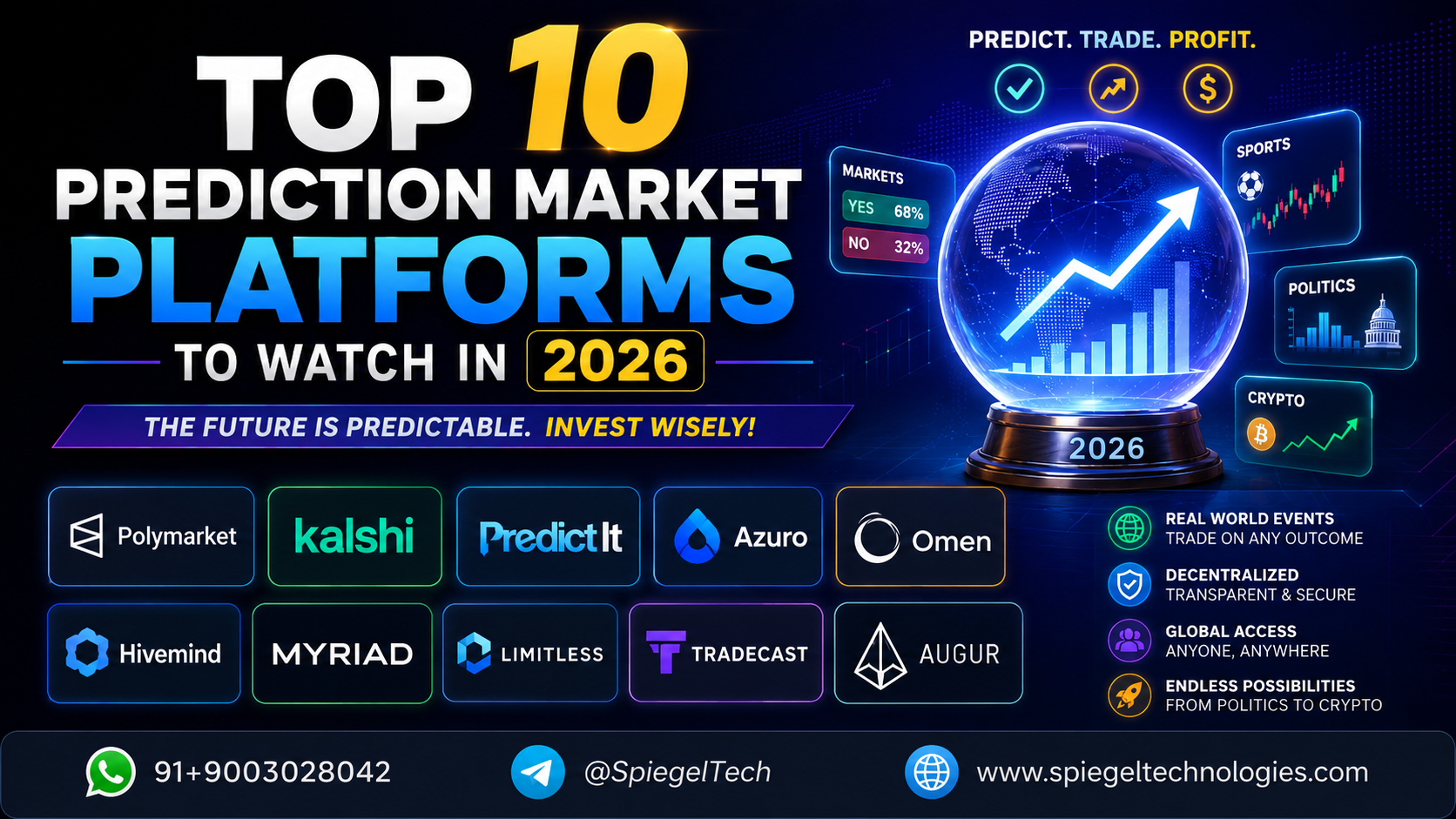
This guide covers the top 10 prediction market platforms shaping the industry in 2026, explains how prediction markets work at a fundamental level, breaks down the leading prediction market business models, and provides everything entrepreneurs need to understand about how to build a prediction market platform in today's competitive landscape.
How Prediction Markets Work: The Fundamentals
Before evaluating individual platforms, understanding how prediction markets work is essential context for anyone building in this space or investing in it.
A prediction market transforms real-world events into tradable assets. Participants buy shares representing the probability of a specific outcome — a yes or no answer to a defined question. If "Yes" shares for a given event trade at $0.72, the market is collectively estimating a 72% probability that the event will occur.
What makes decentralized prediction market platforms particularly powerful is that price signals emerge from real financial stakes. Participants with accurate beliefs profit; those with inaccurate beliefs lose. This incentive structure produces crowd-sourced probability estimates that consistently outperform traditional polling, expert panels, and algorithmic forecasting models across most event categories.
The mechanics flow through five stages in most modern prediction market software:
Market Creation — A question is defined with specific resolution criteria and a verified data source for settlement.
Share Trading — Participants buy Yes or No shares. Prices shift in real time based on trading activity and new information.
Price Discovery — Share prices at any moment represent the market's best estimate of event probability, updated continuously.
Event Resolution — When the event occurs, verified outcome data is fed into the system through oracle networks or trusted data sources.
Settlement — Winning shares pay out at $1.00; losing shares expire at $0. Settlement is automatic through smart contracts in blockchain prediction market systems.
This elegant mechanism — combining financial incentives, crowd intelligence, and automated settlement — is why AI prediction platforms and institutional investors are increasingly treating prediction market data as a primary intelligence source rather than a secondary signal.
Why Businesses Are Turning to Prediction Market Platforms in 2026
The institutional adoption of prediction market platform development as a business tool has accelerated sharply. Here is why organizations across industries are integrating these platforms into their decision-making infrastructure:
Crowd Intelligence at Scale — Prediction markets aggregate the diverse knowledge of thousands or millions of participants, producing probability estimates that no single analyst or AI model can match. Financial institutions are increasingly using web3 prediction market data as a real-time sentiment indicator that updates faster than traditional research.
Actionable Real-Time Insights — Unlike quarterly reports or periodic surveys, prediction market software tracks market sentiment continuously. Price movements signal shifting consensus in real time, enabling businesses to adjust strategies before changes become consensus knowledge.
Risk Management Applications — Fintech firms, insurers, and investment managers are using blockchain prediction market infrastructure to hedge exposure to regulatory changes, political events, and macroeconomic shifts. If a governance token market is pricing a 65% chance of unfavorable regulation, that signal has direct portfolio implications.
Radical Transparency — Decentralized prediction market platforms built on public blockchains make every trade, price movement, and settlement verifiable by anyone. This transparency — unprecedented in traditional forecasting — builds institutional trust and enables independent data auditing.
Regulatory Signal Detection — Prediction markets aggregate early signals about regulatory shifts from participants with genuine expertise and financial stakes. For businesses navigating complex regulatory environments, this early warning intelligence is increasingly valuable.
Top 10 Prediction Market Platforms in 2026
1. Kalshi
Kalshi stands as the first CFTC-regulated prediction market platform based in the United States and is widely considered the largest regulated forecast hub in the world. The platform enables users to trade on real-world events spanning politics, economics, finance, and more — structured as binary yes/no event contracts that constitute a new regulated asset class.
Kalshi's regulatory standing is its defining competitive advantage. The platform implements a comprehensive AML/KYC program for all participants, maintains a rigorous market surveillance and compliance framework for detecting suspicious behavior, and records full audit trail information tracking all customer orders from receipt through execution.
For prediction market app development entrepreneurs building regulated products, Kalshi's compliance architecture sets the benchmark for what CFTC-compliant infrastructure looks like in practice.
What Sets Kalshi Apart:
2. Polymarket
Polymarket is the world's most recognized decentralized prediction market platform, enabling users to trade on global events across politics, crypto, sports, and more. Built on Polygon — an Ethereum Layer-2 scaling solution — Polymarket offers the highest liquidity of any web3 prediction market platform and has become the default choice for crypto-native traders globally.
Polymarket's prediction market business model during its growth phase prioritized volume over immediate revenue: no trading fees, combined with a liquidity rewards program that compensates users for placing competitive limit orders. This approach drove cumulative trading volume past $9 billion in a single year and monthly volumes exceeding $3.5 billion at peak.
In 2026, Polymarket has introduced a dynamic, probability-based taker fee structure across select market categories, projected to generate $800,000 to $1 million in daily revenue at current volumes — demonstrating how prediction market platform development can scale from liquidity-first growth to sustainable monetization.
What Sets Polymarket Apart:
3. Myriad
Myriad represents the next generation of blockchain prediction market infrastructure, deploying an EVM-compatible architecture that enables users to trade on real-world events using USDC for price stability. Launched in March 2025, Myriad achieved rapid market validation — exceeding $150 million in on-chain volume and attracting over 511,000 users who collectively placed more than 7 million predictions within its first year.
Myriad's multi-chain deployment across Abstract, Linea, and Celo gives it broader reach than single-chain competitors, while its automated market maker model ensures continuous liquidity availability regardless of organic trading volume. For teams evaluating prediction market platform development approaches, Myriad's DAO-based governance framework and AMM architecture provide a compelling technical blueprint.
What Sets Myriad Apart:
4. Coinbase
Coinbase's entry into prediction market platform territory represents one of the most significant distribution events in the industry's history. Leveraging its position as one of the world's most widely used crypto exchanges, Coinbase is making event-based trading accessible to its existing user base — enabling predictions on thousands of global events spanning sports, elections, and crypto markets.
Coinbase's prediction market app development strategy integrates Kalshi's regulated event contracts, combining Coinbase's distribution scale with Kalshi's regulatory credibility. The emphasis on flexible real-time position adjustment and seamless user onboarding positions Coinbase to convert existing crypto users into prediction market participants at a scale no standalone platform can match.
What Sets Coinbase Apart:
5. Augur
Augur is one of the original decentralized prediction market platforms, built on Ethereum as a fully open-source, community-governed system. Augur supports three market types — Binary (Yes/No), Multiple Choice, and Scalar — giving it structural flexibility that most platforms lack.
Augur's native REP token (an ERC-20 standard token on Ethereum) serves utility functions across incentivization, dispute resolution, governance, and outcome reporting. Its robust oracle mechanism — decentralized and resistant to manipulation — set early standards for blockchain prediction market settlement infrastructure that later platforms have built upon.
For prediction market software developers studying protocol architecture, Augur's smart contract design and dispute resolution mechanics remain among the most thoroughly documented in the industry.
What Sets Augur Apart:
6. Hedgehog
Hedgehog is a next-generation prediction market platform built on the Solana blockchain, combining traditional forecasting with social trading mechanics that create a unique community intelligence layer. Users can follow top-performing predictors, copy their strategies, and build reputation scores based on verified historical accuracy.
Hedgehog's reputation system is its most distinctive feature — tracking performance across predictions and ranking users by accuracy history. This transforms the platform from a simple trading venue into a prediction market app where signal quality and forecaster reputation are the primary competitive assets. For AI prediction platforms developers, Hedgehog's approach to surfacing high-quality human predictors offers an interesting alternative to pure algorithmic forecasting.
What Sets Hedgehog Apart:
7. Manifold
Manifold occupies a unique position in the prediction market platform landscape — a social prediction market where users create markets on any question and trade using play-money currency called Mana (M$). The play-money mechanics remove financial barriers to participation while still rewarding accuracy and engagement.
Users begin with M$1,000 in Mana for free and earn more by winning markets. While Mana is not legal currency, it can be converted into charitable donations — giving Manifold's gamified forecasting model a social impact dimension that distinguishes it from purely financial prediction market software.
For prediction market platform development teams targeting mainstream non-financial audiences, Manifold's play-money model demonstrates how removing monetary stakes can dramatically expand participation and market creation volume.
What Sets Manifold Apart:
8. Drift (BET)
Drift's BET platform is the first capital-efficient prediction market built on the Solana network, specifically designed for crypto-native traders who prioritize capital efficiency in their forecasting strategies. Unlike conventional prediction platforms that require full capital commitment per position, BET's DeFi integration enables more sophisticated position management.
The platform runs on Solana's DeFi infrastructure, offering rapid transaction execution and deep liquidity combined with perpetual-style market mechanics that make it the most technically sophisticated decentralized prediction market currently operating on Solana. DAO-driven governance gives token holders direct control over protocol parameters.
For web3 prediction market developers studying DeFi-integrated architectures, Drift BET's capital efficiency model represents a meaningful technical advance over traditional prediction market designs.
What Sets Drift (BET) Apart:
9. Gnosis
Gnosis is one of Ethereum's most established blockchain prediction market platforms, distinguished by its Conditional Tokens Framework — a technical standard that enables the creation of complex, multi-outcome prediction markets and event-based financial instruments.
Gnosis has influenced prediction market software development at a protocol level, setting open-source standards for market creation and liquidity distribution in the DeFi space. Its integration with Gnosis Safe — the industry-leading multi-signature wallet — provides institutional-grade asset security for platform participants and treasury management.
What Sets Gnosis Apart:
10. PredictIt
PredictIt rounds out the top 10 as a well-established regulated prediction market platform with a specialized focus on political event forecasting. CFTC-approved and US-based, PredictIt enables users to trade real money on elections, legislative events, and political developments with the credibility of regulatory oversight.
PredictIt's specialization in political prediction makes it the benchmark platform for understanding how prediction markets work in the context of electoral forecasting — consistently generating probability estimates that rival or outperform major polling organizations.
What Sets PredictIt Apart:
How 2026 Is Reshaping Prediction Market Platform Development
The prediction market platform development landscape is undergoing a structural transformation driven by four converging technological forces:
Artificial Intelligence Integration — Modern AI prediction platforms are combining machine learning models with crowd intelligence, using AI to identify market mispricings, generate automated trading signals, and improve resolution accuracy for complex events. The hybrid of human crowd forecasting and AI analysis is producing accuracy levels neither approach achieves independently.
Blockchain Maturation — Layer-2 scaling solutions have resolved the throughput and cost limitations that previously constrained blockchain prediction market platforms. Transactions that once cost dollars on Ethereum mainnet now cost fractions of a cent on Polygon, Arbitrum, Base, and Solana — removing the fee friction that deterred casual participation.
Regulatory Clarity — The CFTC's regulated treatment of event contracts in the United States, combined with emerging frameworks in the EU and Asia-Pacific, is creating a clearer compliance path for new prediction market app development projects. Regulatory clarity reduces institutional risk perception and opens the door to wider financial participation.
Gamification and Accessibility — Platforms like Manifold have demonstrated that gamified prediction mechanics dramatically expand participation beyond traditional financial audiences. The combination of social features, reputation systems, and accessible interfaces is bringing prediction market software to mainstream users who would never engage with traditional financial markets.
Understanding the Prediction Market Business Model
For entrepreneurs evaluating how to build a prediction market platform, understanding the viable revenue architectures is as important as the technical design. The prediction market business model has evolved significantly in 2026:
Transaction Fees — The primary revenue mechanism for most platforms. Dynamic probability-based fee structures — charging higher fees on markets closer to resolution — are emerging as the sophistication standard. Polymarket's new fee model, projected at $800K–$1M daily, validates this approach at scale.
Liquidity Provider Incentives — Maker rebate programs that reward liquidity providers create tighter spreads and deeper markets, which in turn drive higher trading volumes and greater fee revenue. This virtuous cycle is central to scaling prediction market platform revenue.
Data Monetization — Prediction market price signals are increasingly valuable intelligence products. Financial news organizations, hedge funds, and enterprise risk teams pay for real-time access to market probability data. This B2B data revenue stream is separate from and additive to trading fee revenue.
Token Economics — Native utility tokens create governance participation incentives, staking reward structures, and fee-sharing mechanisms that align long-term holder interests with platform growth. Well-designed token economics transform high-volume traders into protocol stakeholders.
Premium Subscriptions — Advanced analytics dashboards, priority API access, and institutional data feeds command subscription pricing from professional and institutional users.
White-Label Licensing — Prediction market software licensed to financial data companies, media organizations, and enterprise risk platforms generates recurring B2B revenue without direct user acquisition costs.
How to Build a Prediction Market Platform: Key Considerations
For entrepreneurs ready to build a prediction market platform, the technical and strategic requirements are significant but navigable with the right foundation:
Blockchain Selection — Ethereum offers the deepest DeFi liquidity and broadest developer ecosystem. Solana delivers the highest throughput for high-frequency markets. Layer-2 networks like Polygon and Base balance Ethereum security with scalable, low-cost transactions. Your blockchain prediction market architecture should match your expected transaction volume and target user segment.
Oracle Infrastructure — The oracle system that feeds real-world event outcomes into your smart contracts is the most critical trust component of any decentralized prediction market. Chainlink, UMA Protocol, and Pyth Network are the leading oracle solutions, each with different security models and coverage areas.
Market Mechanism Design — Automated market makers provide continuous liquidity but introduce price path dependency. Central limit order books offer price efficiency but require critical mass of participants. Most competitive prediction market platform development projects in 2026 implement hybrid mechanisms.
Compliance Architecture — Whether building a regulated prediction market app like Kalshi or a web3 prediction market like Polymarket, compliance infrastructure must be designed into the system from the start. KYC/AML workflows, jurisdiction-based access controls, and transaction monitoring are non-negotiable for platforms handling real money.
Security Standards — Smart contract auditing, multi-signature treasury management, oracle manipulation resistance, and DDoS protection form the security baseline for any production prediction market software deployment.
Frequently Asked Questions About Prediction Market Platforms
Q1: What is a prediction market platform and how does it differ from traditional betting?
A prediction market platform transforms future events into tradable assets where share prices represent the collective probability of outcomes. Unlike traditional betting where odds are set by a bookmaker, prediction market prices emerge from participant trading activity — making them more accurate and continuously updated. Decentralized prediction market platforms add blockchain-based settlement and transparency that traditional betting cannot match.
Q2: How do prediction markets make money?
The prediction market business model typically combines transaction fees on completed trades, data monetization through API access for institutional users, premium subscription tiers for professional analytics, and token economics that create stakeholder alignment. Polymarket's 2026 fee model — generating an estimated $800K–$1M daily — demonstrates how prediction market platform development can scale from growth-first liquidity building to sustainable revenue.
Q3: What blockchain is best for prediction market platform development?
The optimal blockchain for blockchain prediction market development depends on your priorities. Ethereum offers the deepest liquidity and most established DeFi ecosystem. Solana provides the highest throughput for high-frequency markets. Polygon and Base offer the best balance of Ethereum security and low transaction costs for most new prediction market app development projects in 2026.
Q4: How much does it cost to build a prediction market platform? Prediction market platform development costs vary significantly by scope and architecture. A basic prediction market app with standard binary markets, wallet integration, and simple oracle settlement can be built for $50,000–$150,000. A full-featured decentralized prediction market with custom AMM design, multi-chain support, governance token system, and institutional-grade security typically ranges from $200,000–$600,000+. Ongoing audit, compliance, and infrastructure costs add 20–30% annually to initial development investment.
Q5: What is the difference between a centralized and decentralized prediction market? Centralized prediction market platforms like Kalshi and PredictIt operate under regulatory oversight with traditional KYC requirements and custodial fund management. Decentralized prediction market platforms like Polymarket and Augur use smart contracts for automated settlement and allow non-custodial participation where users maintain control of their funds throughout the trading process. Both models have distinct advantages — regulatory credibility for centralized, censorship resistance and transparency for decentralized.
Q6: How do AI prediction platforms differ from traditional prediction markets?
AI prediction platforms layer machine learning models on top of crowd forecasting to identify market inefficiencies, generate automated trading signals, and improve resolution accuracy for complex events. Traditional prediction markets rely purely on human participant intelligence. The most sophisticated prediction market software in 2026 combines both — using AI to enhance human forecasting rather than replace it.
Q7: Can I build a white-label prediction market platform?
Yes. White-label prediction market software allows businesses to launch branded prediction markets without building the underlying infrastructure from scratch. This approach is used by media companies creating audience engagement products, enterprises building internal forecasting tools, and fintech firms adding event-based trading to existing platforms. White-label solutions reduce development time from 12–18 months to 4–8 weeks for most use cases.
Q8: What are the regulatory requirements for launching a prediction market platform? Regulatory requirements vary significantly by jurisdiction and market structure. In the United States, event contract trading requires CFTC registration or designation. Prediction market app development projects targeting EU users must navigate MiFID II and MiCA frameworks. Web3 prediction market platforms operating in a fully decentralized model face different regulatory treatment than custodial platforms. Legal counsel familiar with your target jurisdiction is essential before any prediction market platform development investment.
Q9: What oracle system should I use for my prediction market platform?
Oracle selection is one of the most consequential technical decisions in blockchain prediction market development. Chainlink provides the broadest event coverage and most decentralized architecture. UMA Protocol offers a dispute-based resolution mechanism well-suited to complex or ambiguous event categories. Pyth Network excels for financial data feeds requiring sub-second latency. Most professional prediction market platform development projects implement redundant oracle sources for critical markets.
Q10: How long does it take to build a prediction market platform from scratch?
A minimum viable prediction market app — binary markets, wallet integration, basic oracle settlement, and simple admin controls — can be deployed in 3 to 5 months with an experienced team. A full-featured decentralized prediction market with custom AMM mechanics, governance systems, multi-chain support, and institutional-grade security typically requires 1to 5 months. Using a white-label prediction market software foundation can compress these timelines to 6 to 12 weeks for the MVP launch phase.
Conclusion: The Prediction Market Opportunity in 2026
The prediction market industry in 2026 is no longer a fringe experiment at the intersection of finance and information theory. It is rapidly becoming core infrastructure for how businesses, investors, institutions, and individuals make decisions under uncertainty.
The platforms profiled in this guide — from Kalshi's regulated US exchange to Polymarket's decentralized global market to emerging players like Myriad and Drift BET — collectively demonstrate the breadth of viable approaches to prediction market platform development. Each has found a distinct position through a combination of technical architecture, market focus, regulatory strategy, and prediction market business model design.
For entrepreneurs evaluating how to build a prediction market platform, the timing in 2026 is compelling. Blockchain infrastructure has matured. Regulatory pathways are clearer. AI prediction platforms are expanding the analytical tools available to participants. And institutional demand for real-time probability data is creating revenue opportunities that extend well beyond trading fees.
The question is not whether prediction market software will become mainstream financial infrastructure. The trajectory is clear. The question is which platforms — and which entrepreneurs — will define what that infrastructure looks like.